After observing an ecosystem, a student writes the following conclusion in a notebook.

Is the student's conclusion logical?
After observing an ecosystem, a student writes the following conclusion in a notebook.
Is the student's conclusion logical?
Which of the following nonliving components do all living organisms depend on for survival?
This question has two parts. First answer Part A, then answer Part B.
Students learn the following information about a strangler fig.
In the rainforest, strangler fig seedings begin growing on other trees, wrapping roots around the host tree. When the roots reach the ground, the strangler fig takes root and grows larger than the host tree, taking nutrients from the host tree and growing to the height of the rainforest canopy.
Part A
How does the strangler fig interact with other living components in its ecosystem in order to survive?
Which of the following is a nonliving component of an ecosystem?
In Africa, lions chase and kill their prey. The lion family eats all it wants and then vultures come and finish the rest.
Are the vultures a living or nonliving component of the ecosystem?
Vultures are a component of the ecosystem.
Scientists observe that the deer population is growing and worry there will not be enough plants for the deer during the winter. Which best describes the relationship between the deer population and the plants?
Colorado elk need food, water, and air to sustain their population. Based on this information, what statement is true regarding the elk's ecosystem?
Which of these are examples of relationships between living organisms and another living organism in an ecosystem?
Select TWO correct answers.
A group of students uses their outdoor classroom to investigate the way organisms live and survive in their ecosystem. They notice a trail of ants carrying bits of food into a mound of dirt. The students are making –
Ecologists study the soil particles from a desert biome to learn how the nutrients in the soil sustain plant survival. Which of the following tools is the most beneficial for observing the particles of soil?
After observing an ecosystem, a student writes the following conclusion in a notebook.
Is the student's conclusion logical?
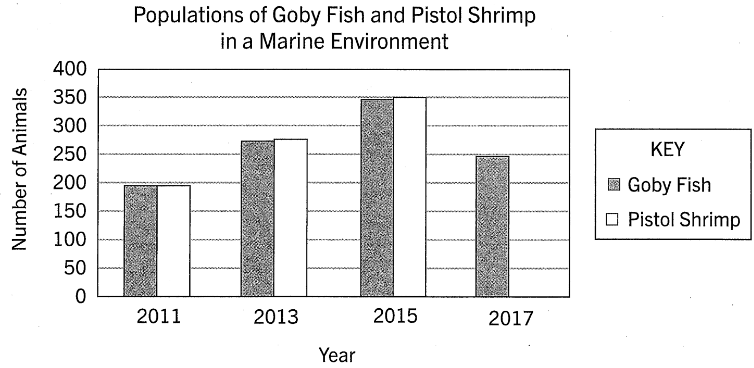
A pistol shrimp is a burrowing shrimp with poor eyesight. The shrimp digs a hole for both it and the goby fish to live. The shrimp uses it antennae to stay in contact with the tail of the goby fish. When danger approaches, the goby fish swishes its tail and the shrimp quickly hides in the burrow.
Based on the data shown above, what will most likely happen to the shrimp population in 2017?
Part B
What evidence supports your answer to Part A?