1
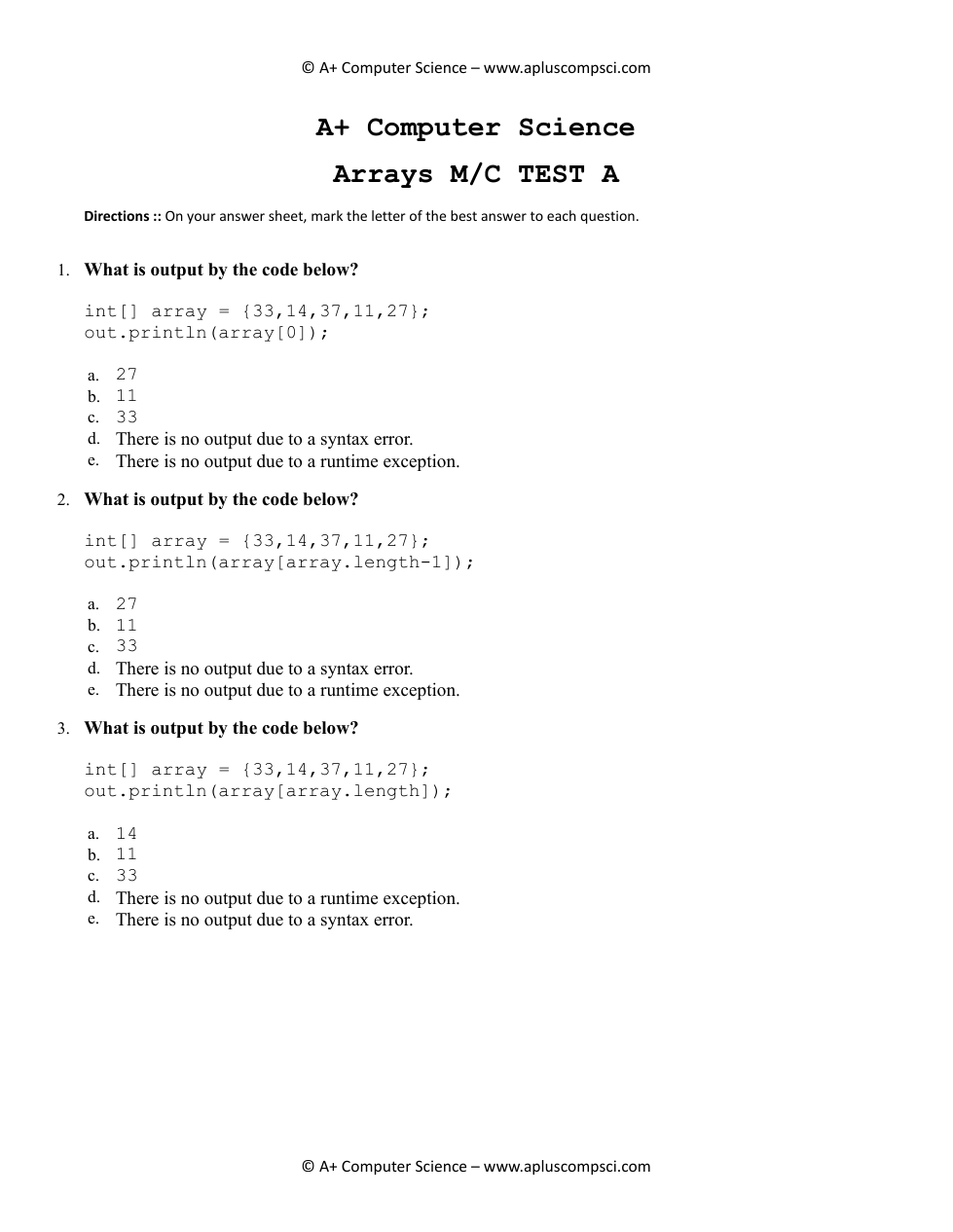
What is output by the code below? int[] array = {33,14,37,11,27}; out.println(array[0]);
What is output by the code below? int[] array = {33,14,37,11,27}; out.println(array[0]);
1
1
What is output by the code below? int[] array = {33,14,37,11,27}; out.println(array[0]);
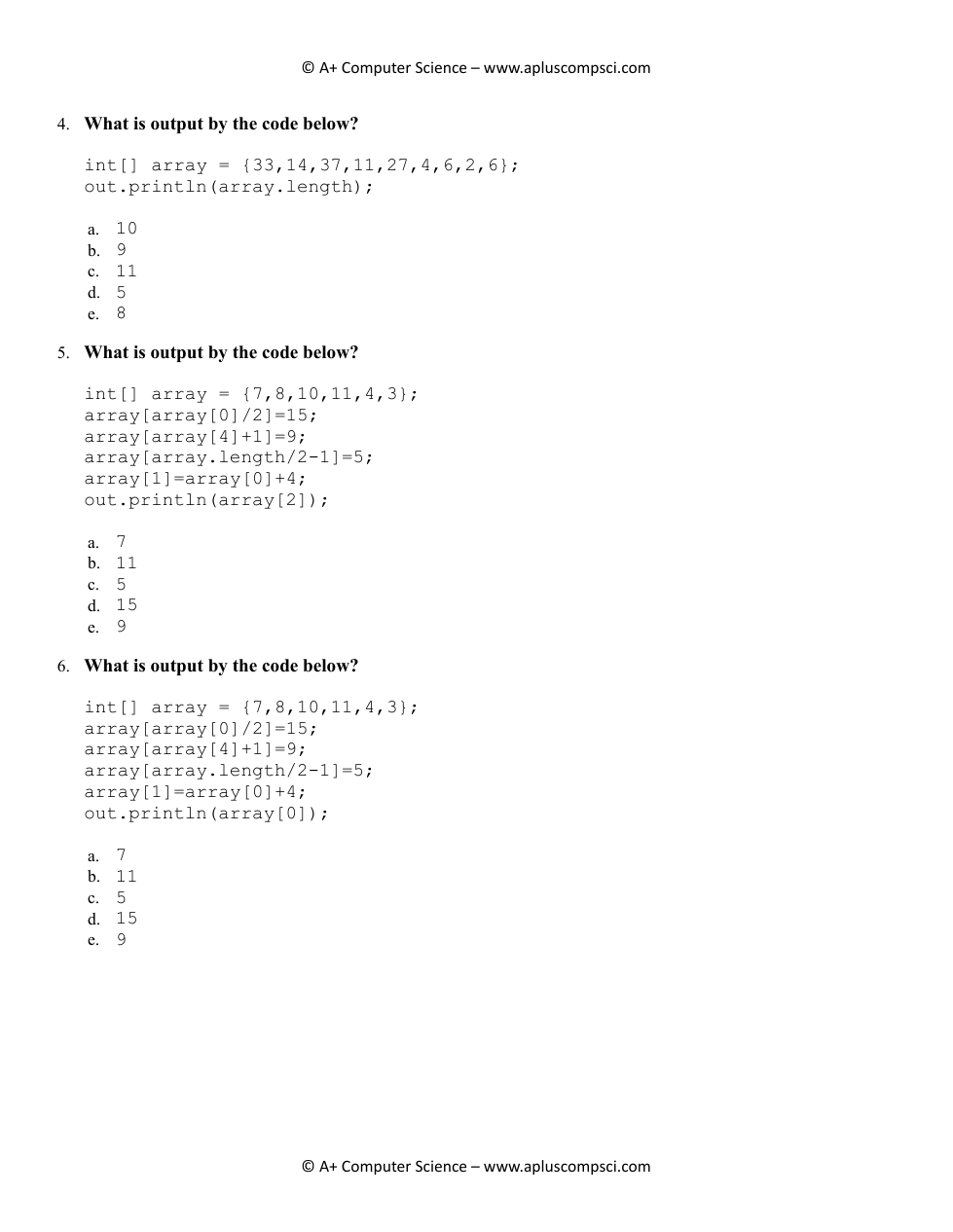
What is output by the code below? int[] array = {33,14,37,11,27,4,6,2,6}; out.println(array.length);
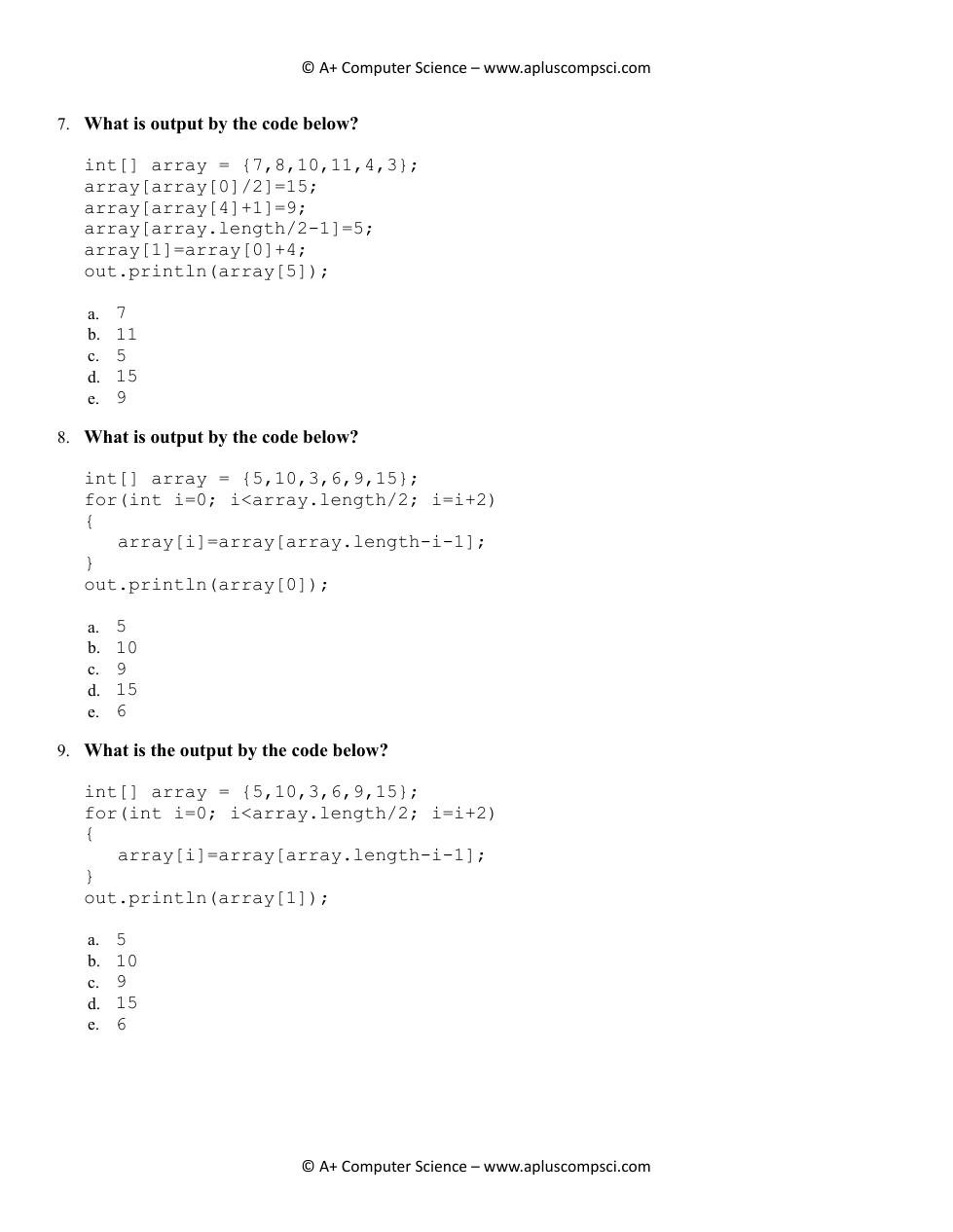
What is output by the code below? int[] array = {7,8,10,11,4,3}; array[array[0]/2]=15; array[array[4]+1]=9; array[array.length/2-1]=5; array[1]=array[0]+4; out.println(array[5]);
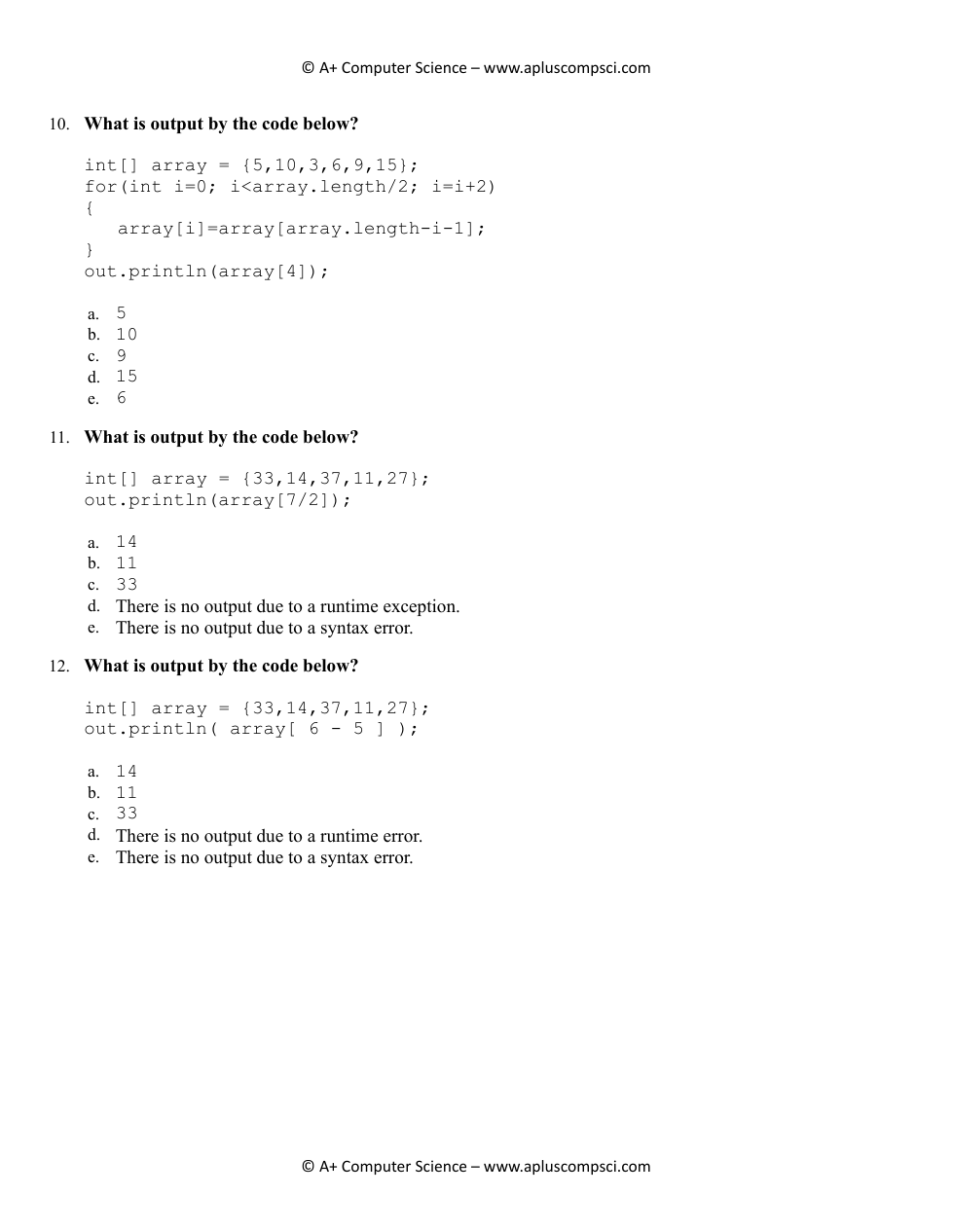
What is output by the code below? int[] array = {5,10,3,6,9,15}; for(int i=0; i<array.length/2; i=i+2) { array[i]=array[array.length-i-1]; } out.println(array[4]);
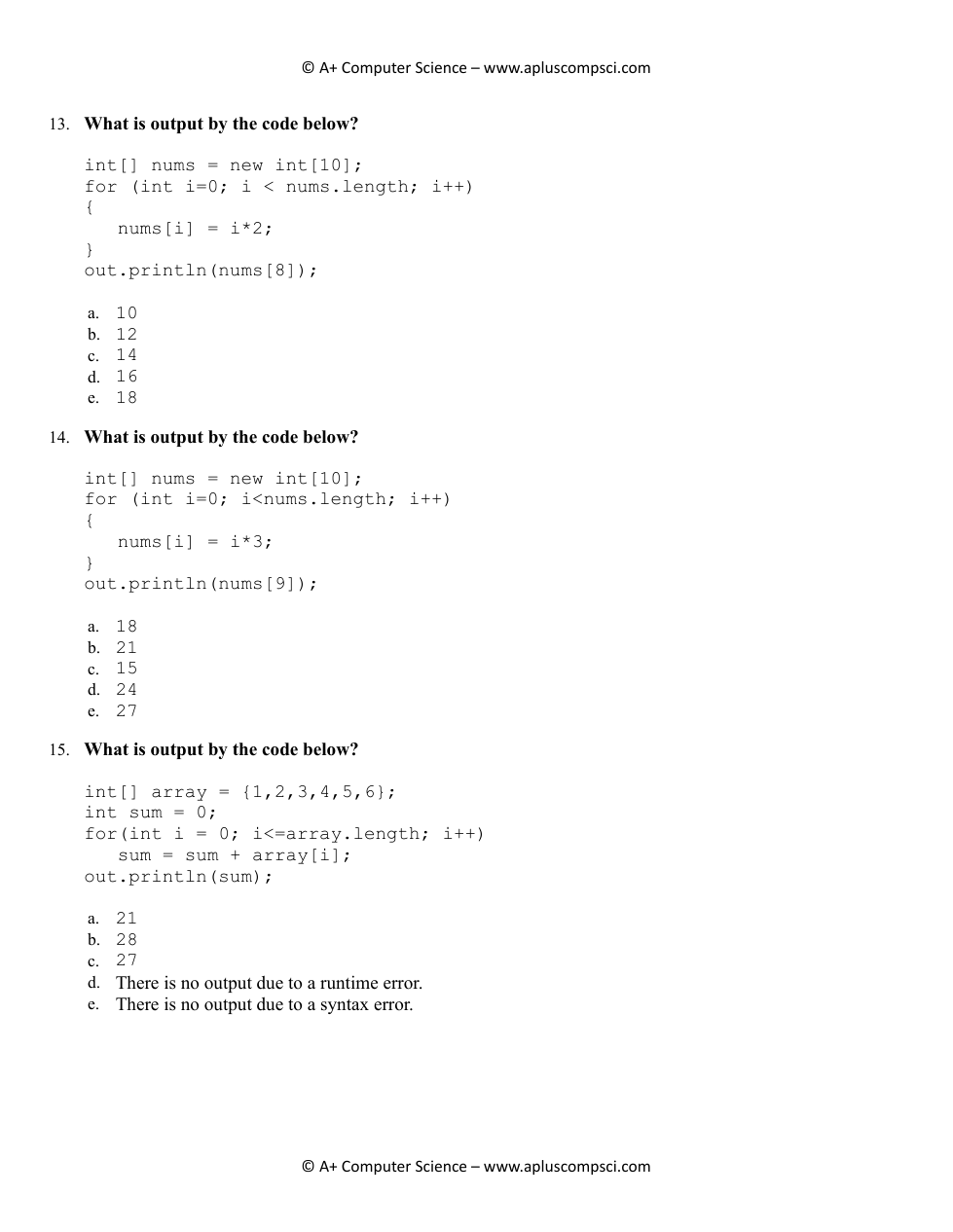
What is output by the code below? int[] nums = new int[10]; for (int i=0; i < nums.length; i++)
{ nums[i] = i*2; } out.println(nums[8]);
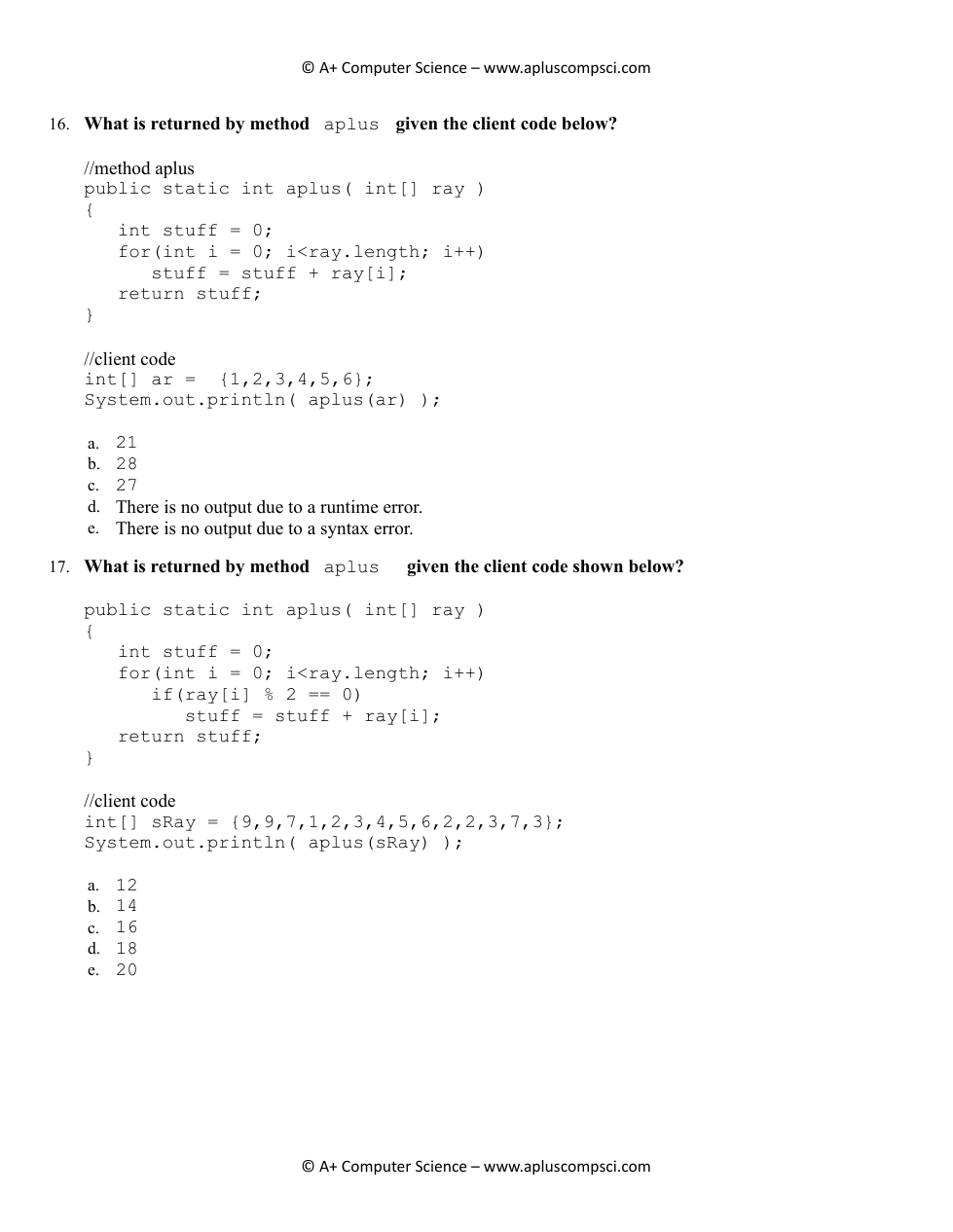
What is returned by method aplus given the client code below? //method aplus public static int aplus( int[] ray ) { int stuff = 0; for(int i = 0; i<ray.length; i++) stuff = stuff + ray[i]; return stuff; } //client code int[] ar = {1,2,3,4,5,6}; System.out.println( aplus(ar) );
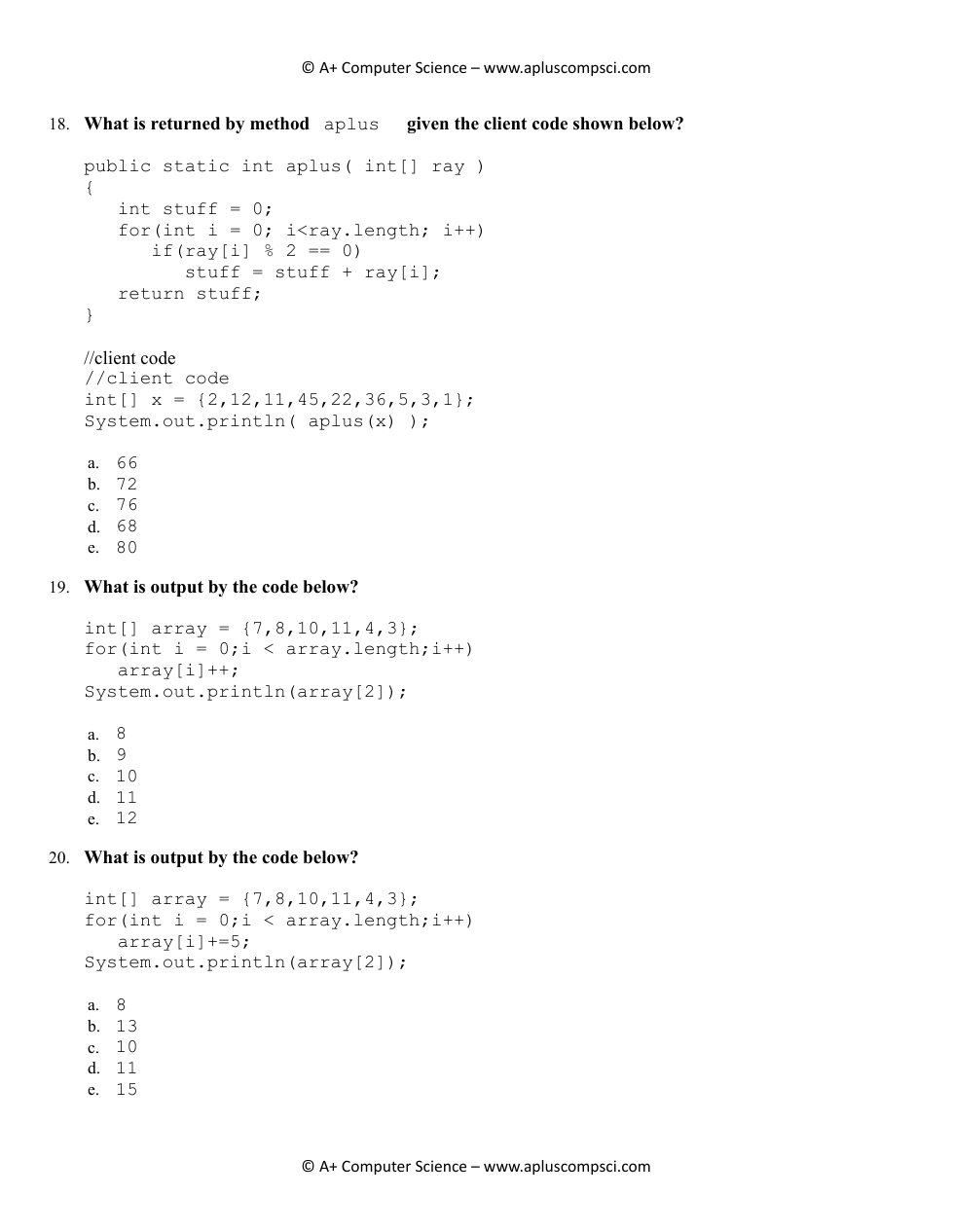
What is returned by method aplus given the client code shown below? public static int aplus( int[] ray ) { int stuff = 0; for(int i = 0; i<ray.length; i++) { if(ray[i] % 2 == 0) { stuff = stuff + ray[i]; } } return stuff; } //client code int[] x = {2,12,11,45,22,36,5,3,1}; System.out.println( aplus(x) );
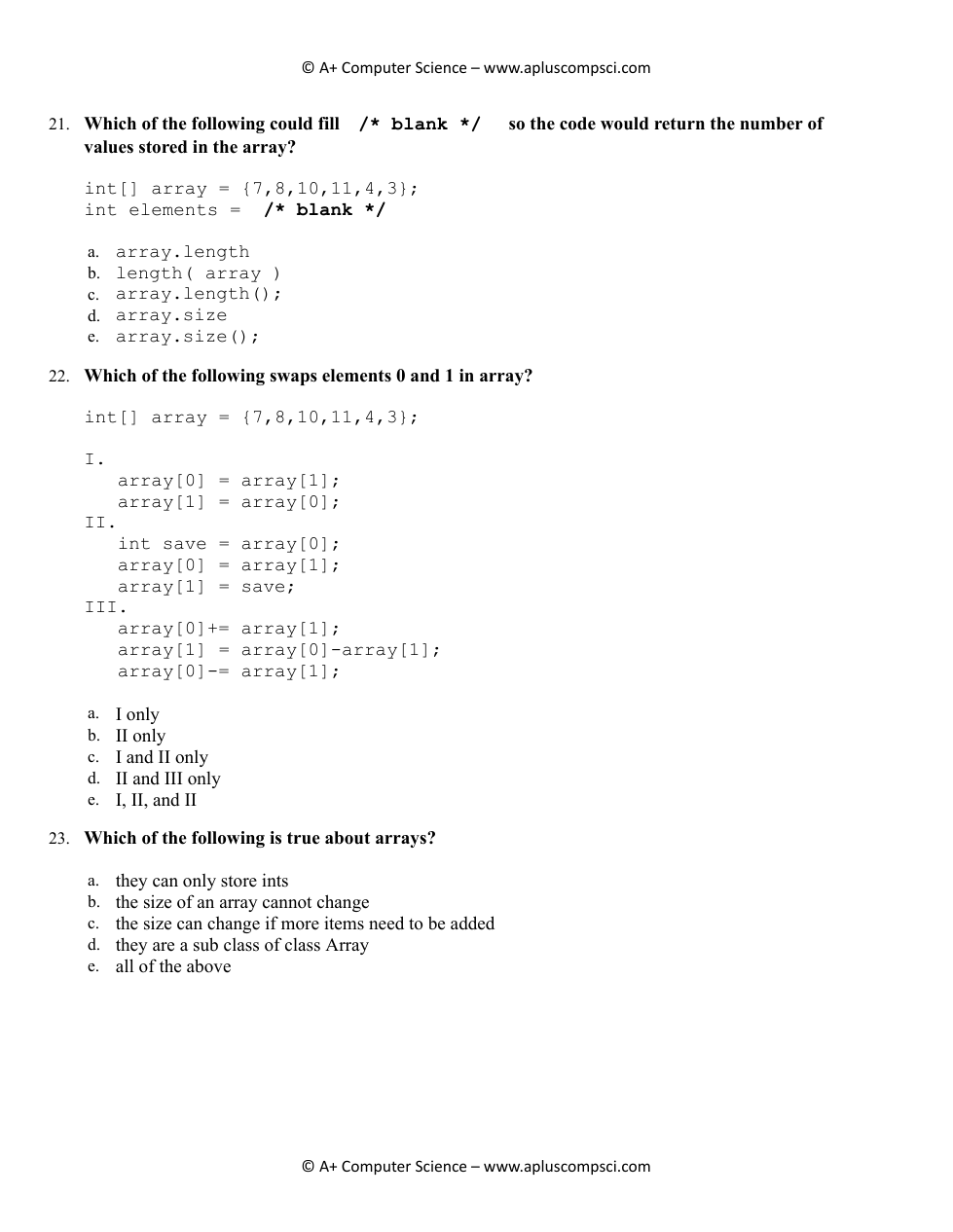
Which of the following could fill the blank so the code would return the number of values stored in the array? int[] array = {7,8,10,11,4,3}; int elements = /* blank */
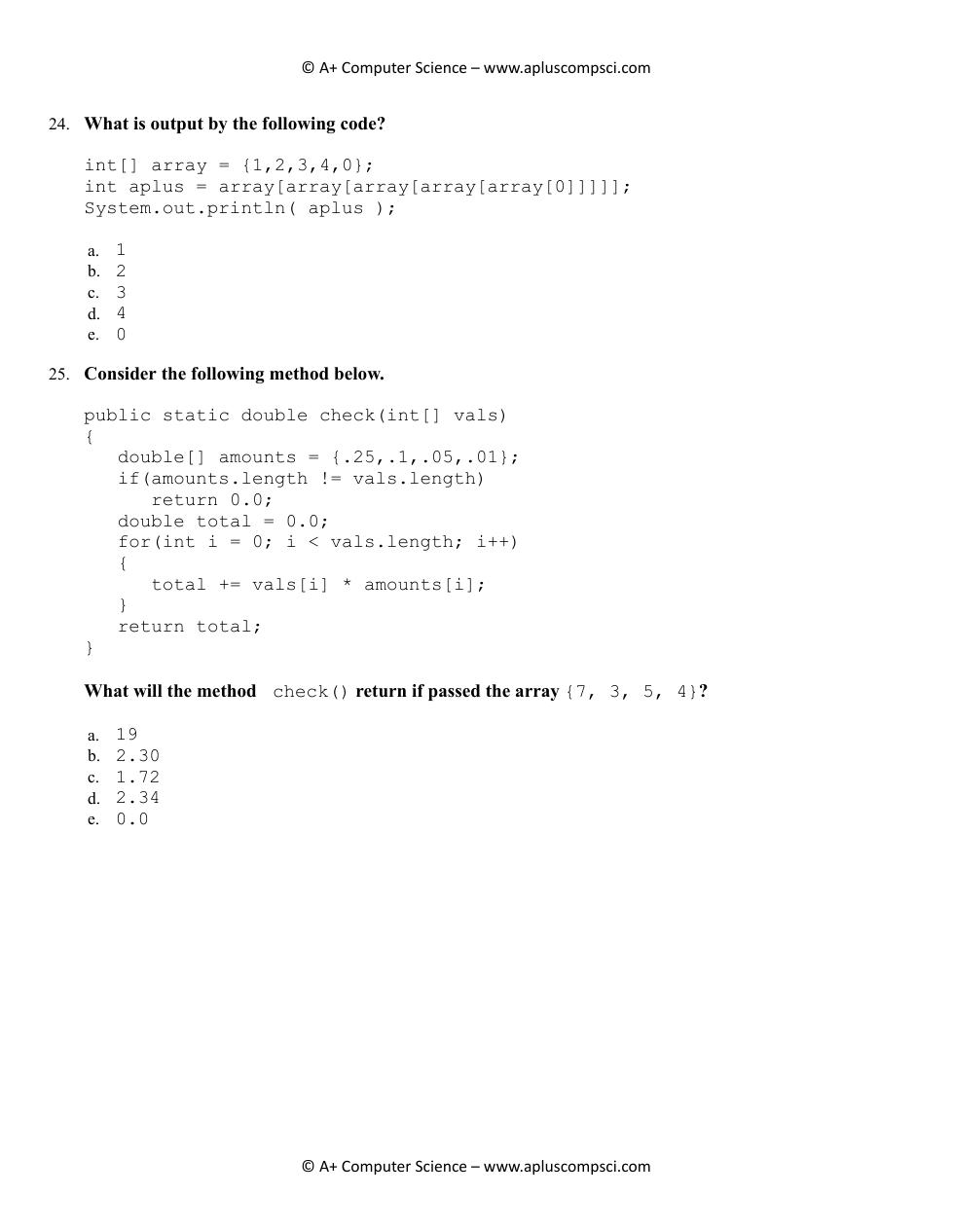
Question 24: What is output by the following code? int[] array = {1,2,3,4,0}; int aplus = array[array[array[array[array[0]]]]]; System.out.println(aplus);
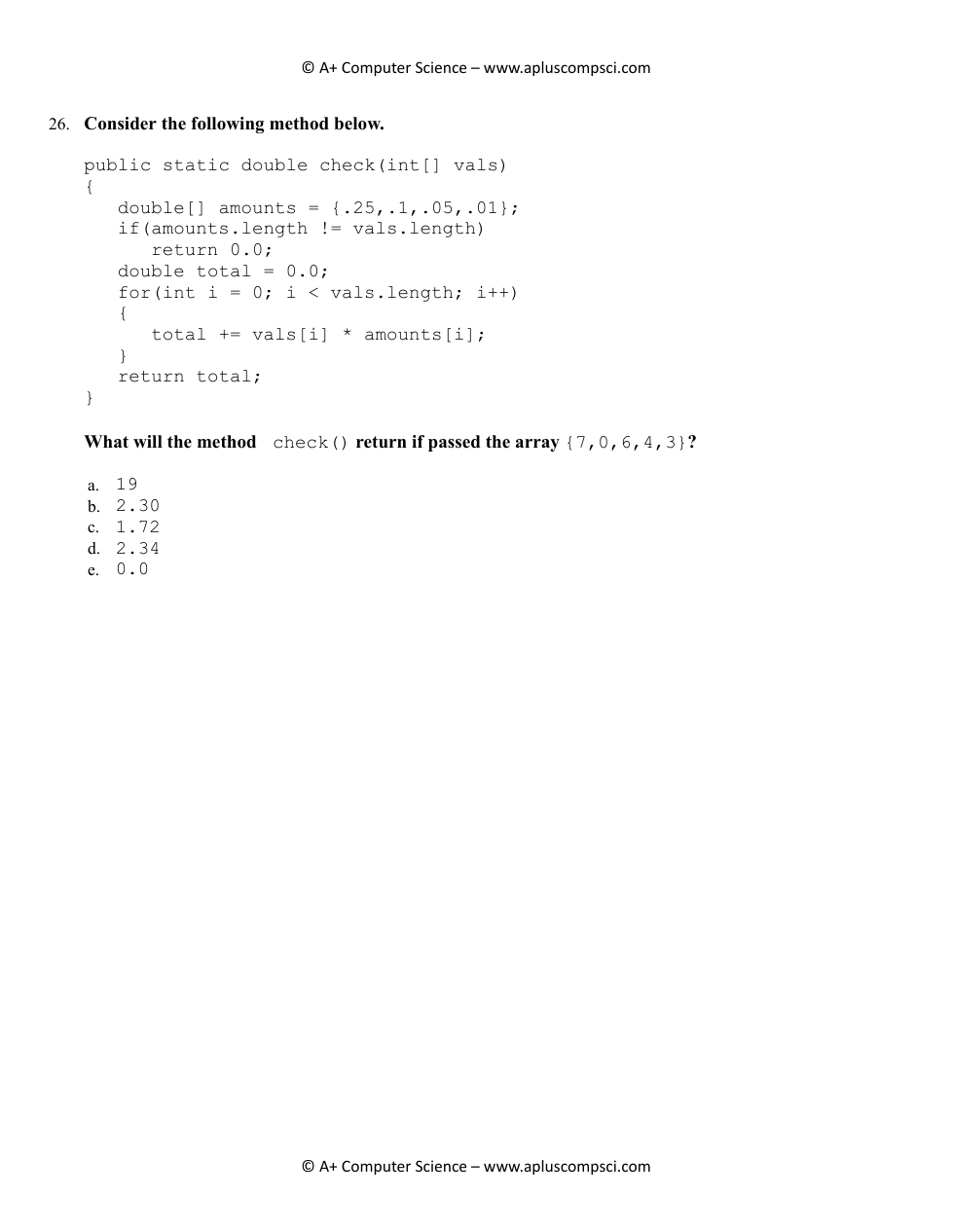
Consider the following method below. public static double check(int[] vals) { double[] amounts = {.25,.1,.05,.01}; if(amounts.length != vals.length) return 0.0; double total = 0.0; for(int i = 0; i < vals.length; i++) { total += vals[i] * amounts[i]; } return total; } What will the method check() return if passed the array {7,0,6,4,3} ?
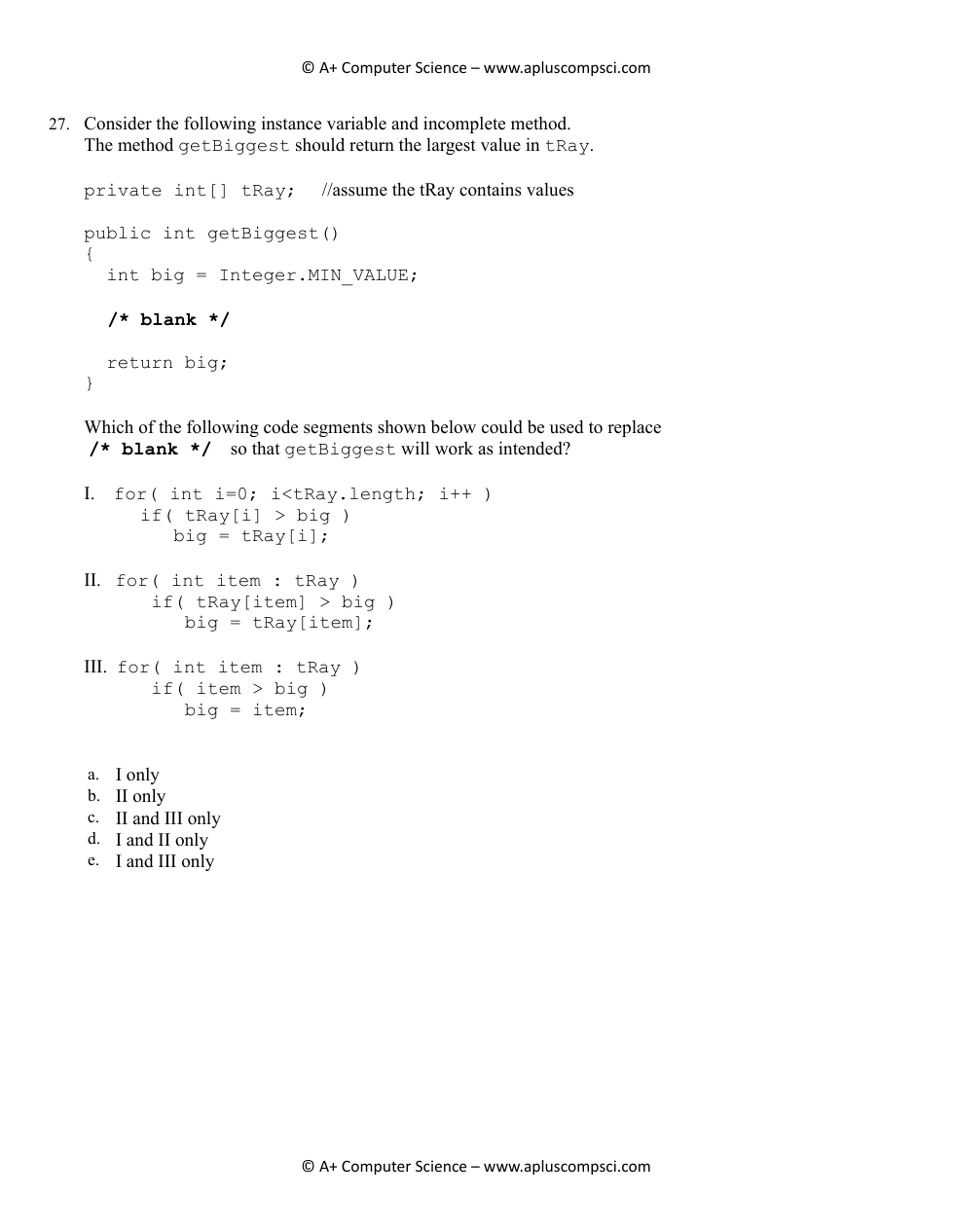
Consider the following instance variable and incomplete method. The method getBiggest should return the largest value in tRay. private int[] tRay; // assume the tRay contains values public int getBiggest() { int big = Integer.MIN_VALUE; /* blank */ return big; } Which of the following code segments shown below could be used to replace /* blank */ so that getBiggest will work as intended?
I. for (int i = 0; i < tRay.length; i++) if (tRay[i] > big)
big = tRay[i];
II. for (int item : tRay)
if (tRay[item] > big)
big = tRay[item];
III. for (int item : tRay)
if (item > big)
big = item;
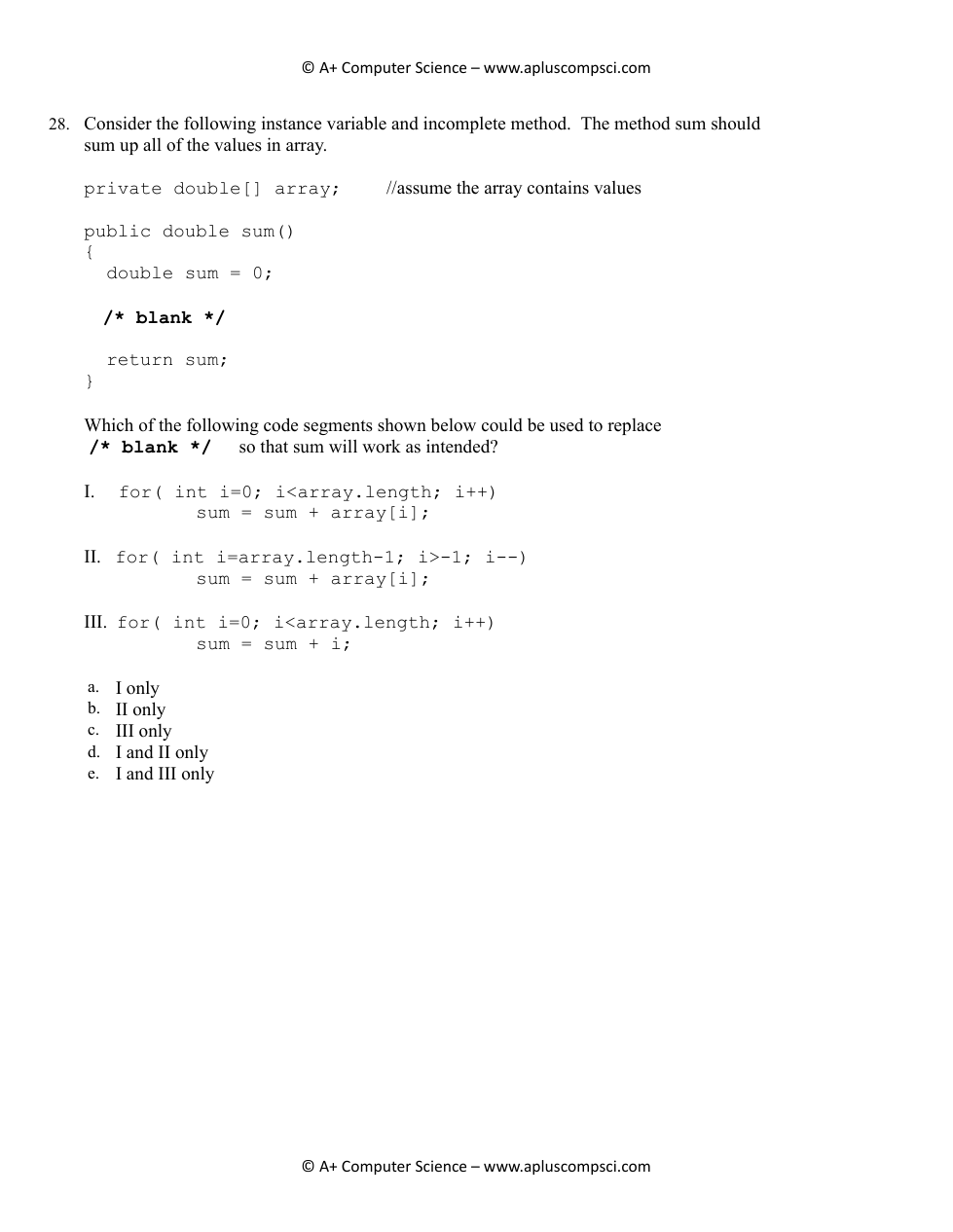
Consider the following instance variable and incomplete method. The method sum should sum up all of the values in array. private double[] array; //assume the array contains values public double sum() { double sum = 0; /* blank */ return sum; } Which of the following code segments shown below could be used to replace /* blank */ so that sum will work as intended? I. for( int i=0; i<array.length; i++)
sum = sum + array[i]; II. for( int i=array.length-1; i>-1; i--)
sum = sum + array[i]; III. for( int i=0; i<array.length; i++)
sum = sum + i;
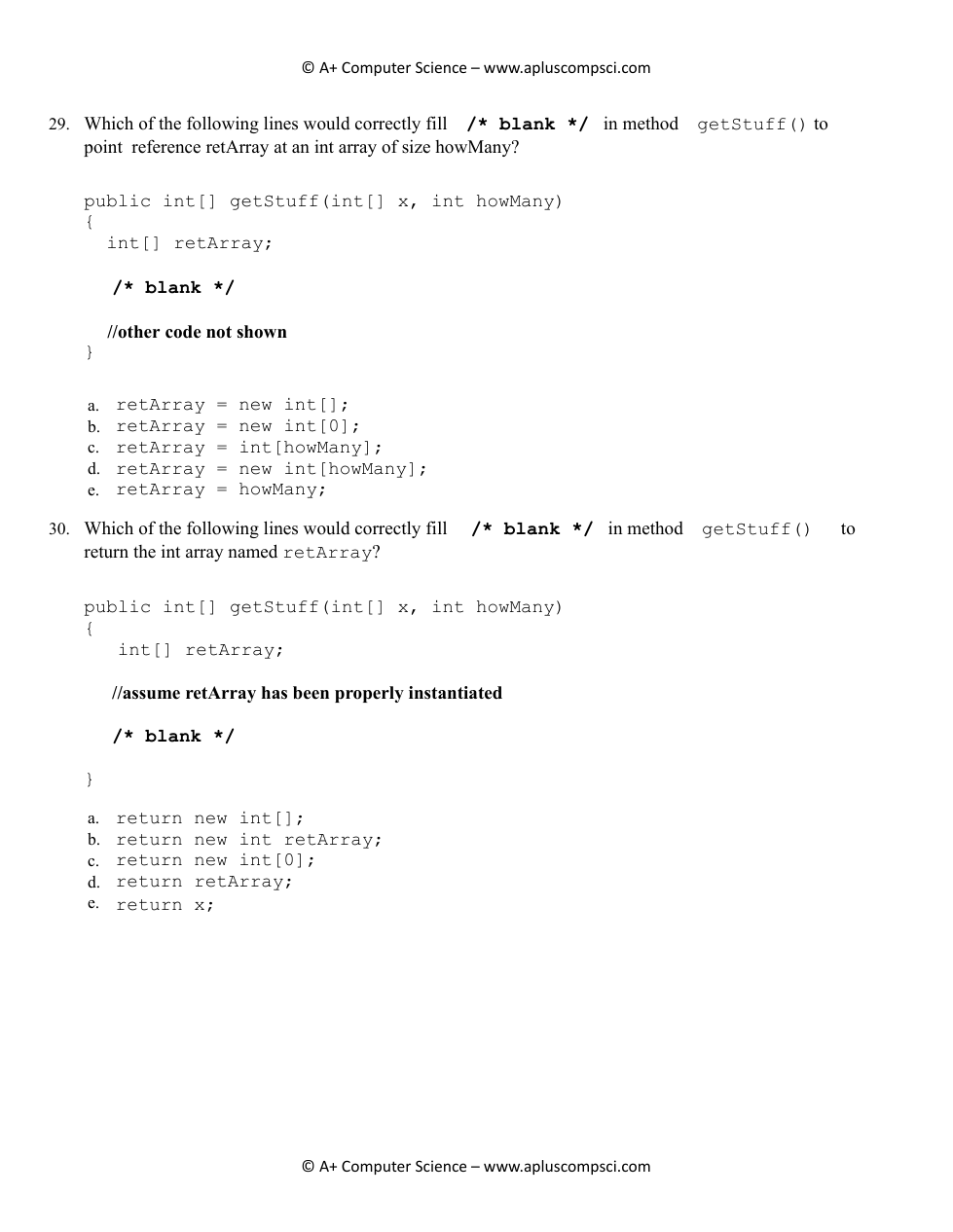
Which of the following lines would correctly fill the blank in method getStuff() to point reference retArray at an int array of size howMany?
public int [] get Stuff(int [] x, int howMany){
int [] retArray;
/* blank *\
///other code not shown
}
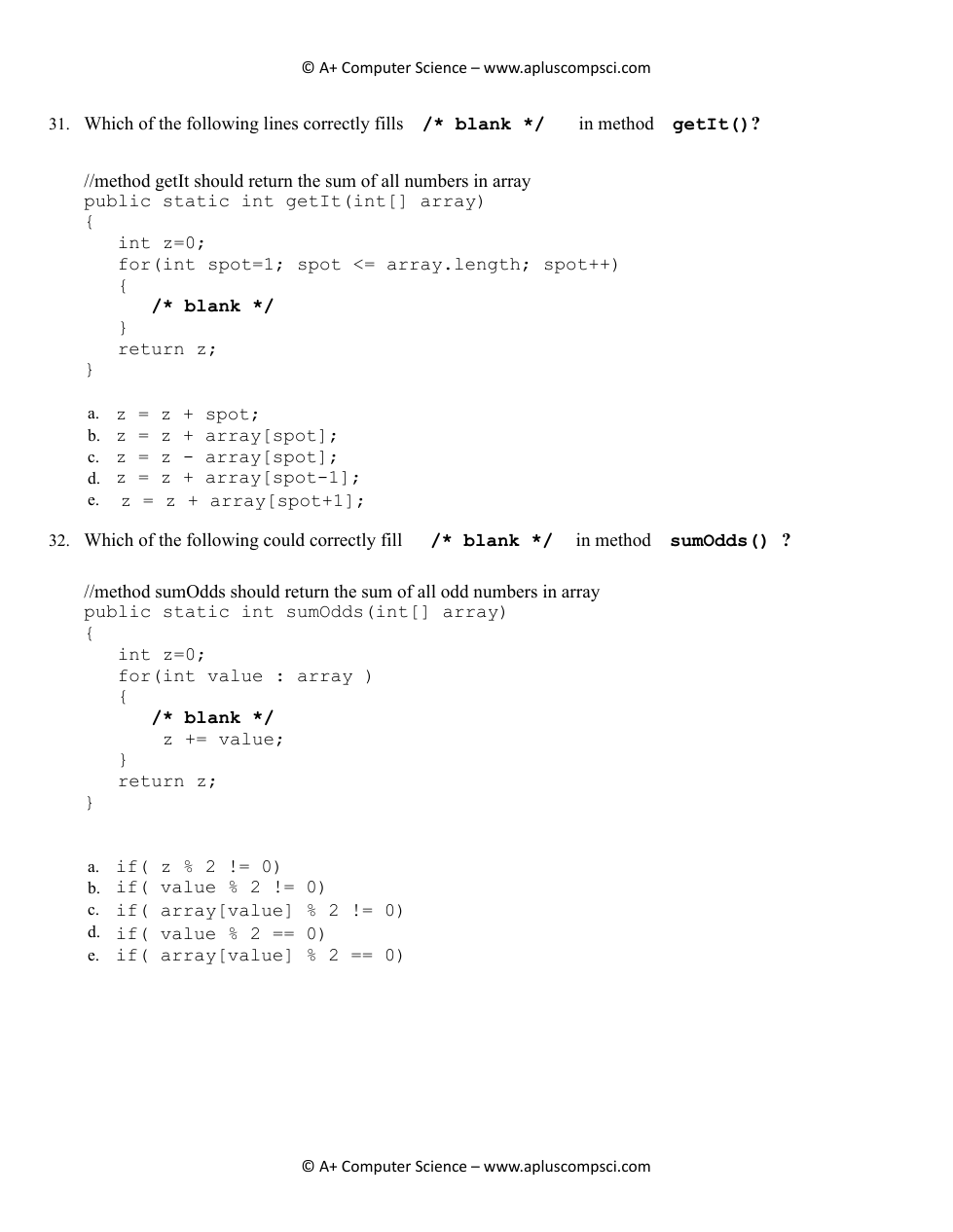
Question 31: Which of the following lines correctly fills in method getIt()? //method getIt should return the sum of all numbers in array public static int getIt(int[] array) { int z=0; for(int spot=1; spot <= array.length; spot++) { /* blank */ } return z; }
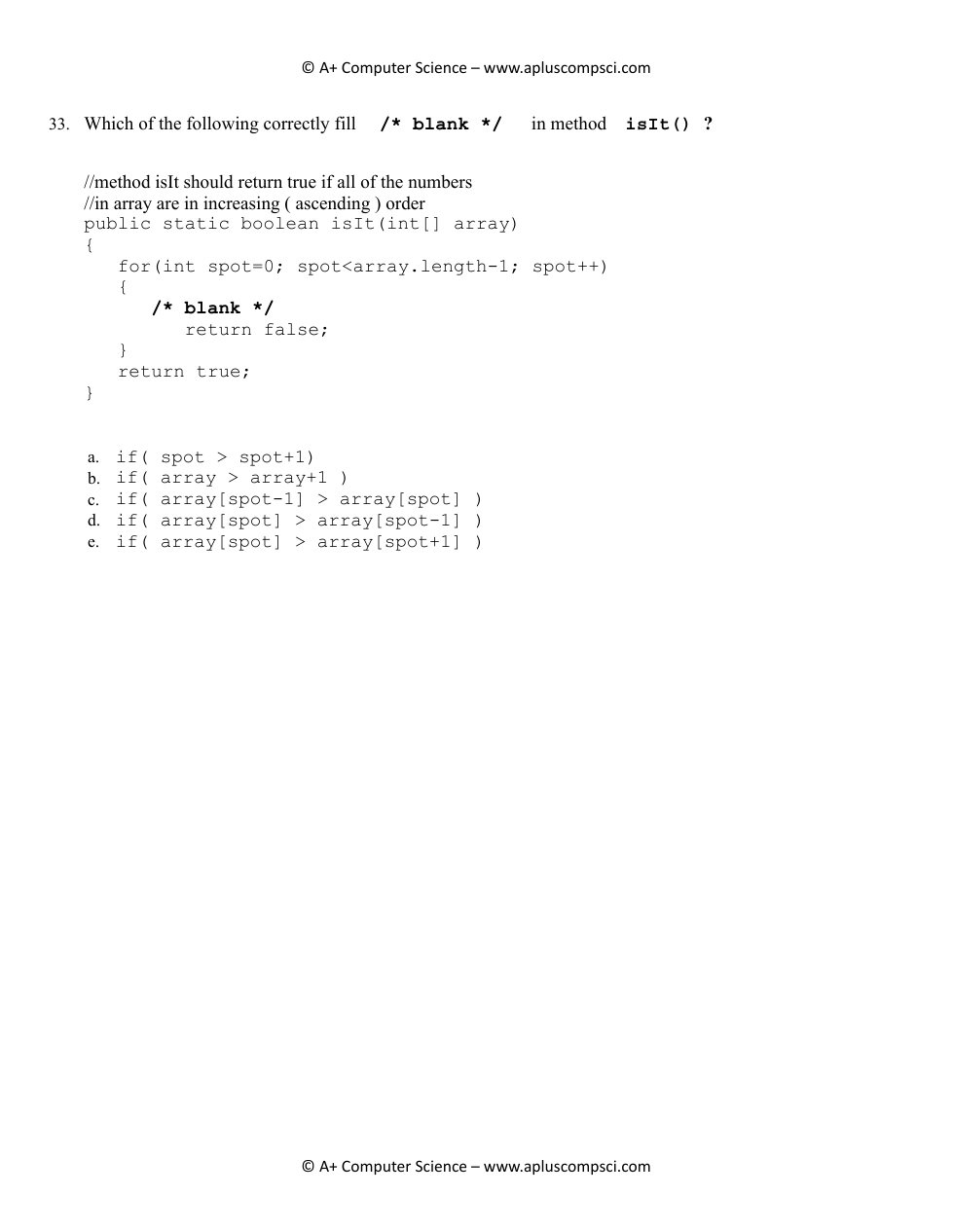
Which of the following correctly fill /* blank */ in method isIt() ? //method isIt should return true if all of the numbers //in array are in increasing (ascending) order public static boolean isIt(int[] array) { for(int spot=0; spot<array.length-1; spot++)
{ /* blank */ return false; } return true; }
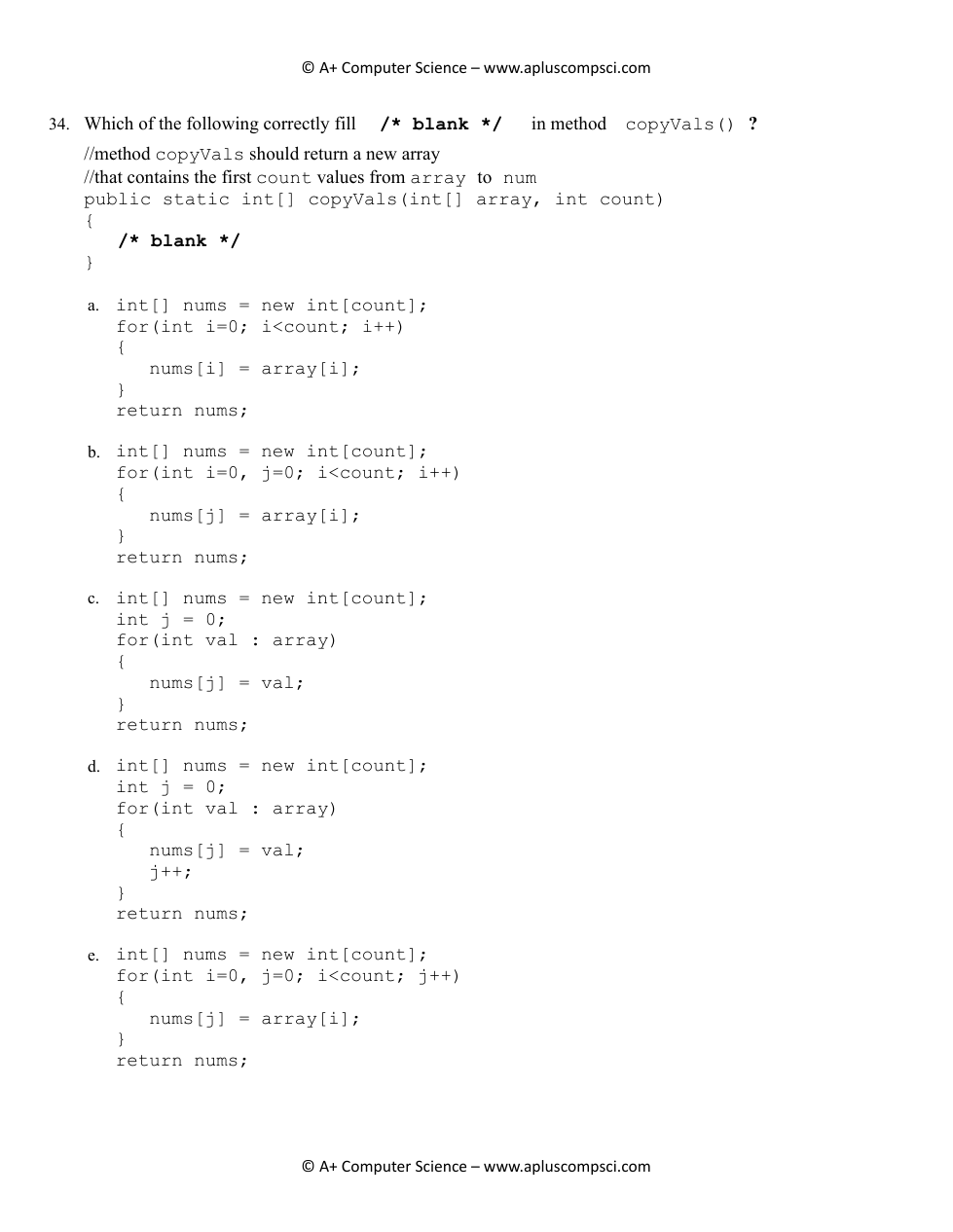
Which of the following correctly fill /* blank */ in method copyVals()? //method copyVals should return a new array //that contains the first count values from array to num public static int[] copyVals(int[] array, int count) { /* blank */ }
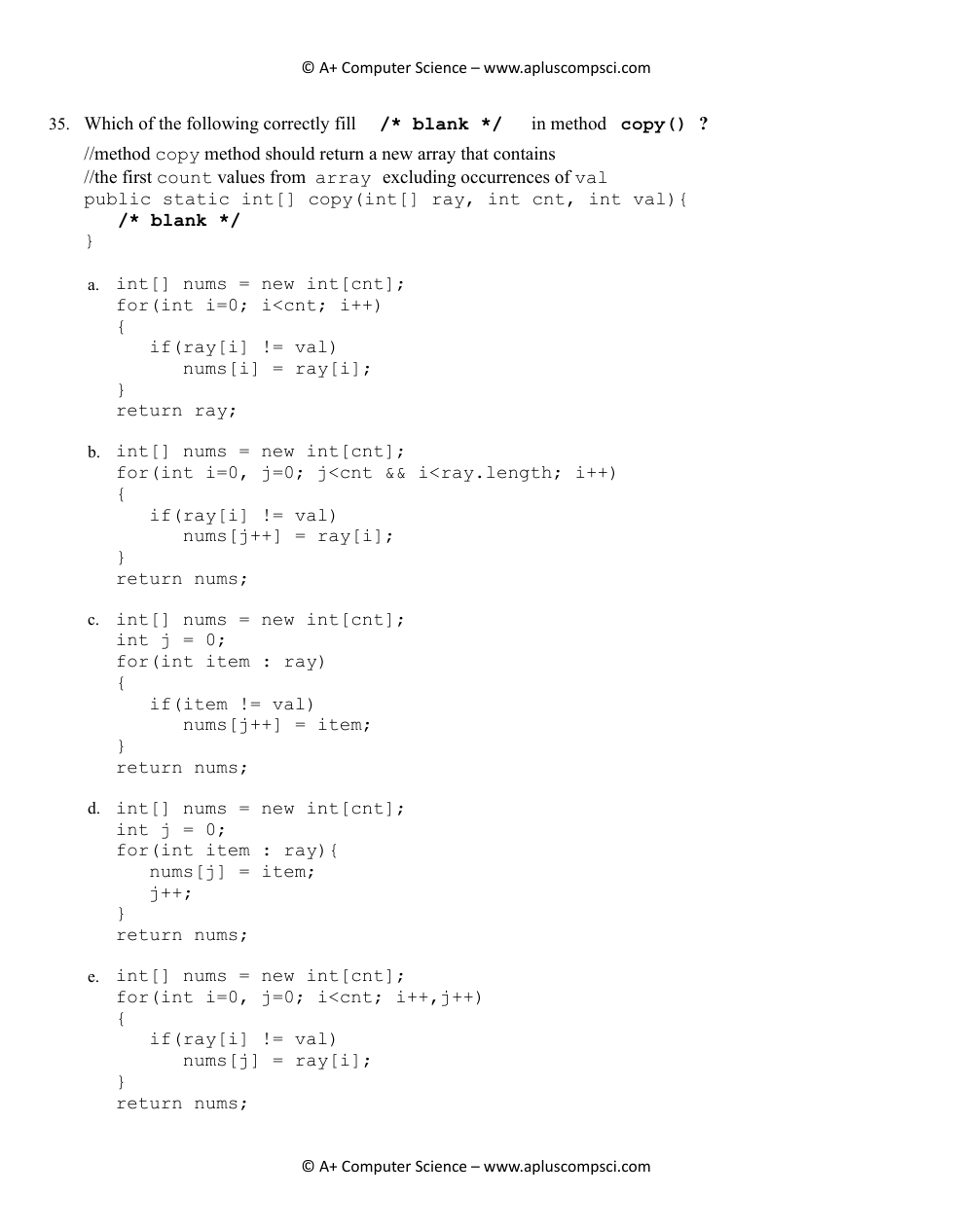
Question 35: Which of the following correctly fill in method copy()? //method copy method should return a new array that contains //the first count values from array excluding occurrences of val public static int[] copy(int[] ray, int cnt, int val){ /* blank */ } a. int[] nums = new int[cnt]; for(int i=0; i<cnt; i++) { if(ray[i] != val) nums[i] = ray[i]; } return ray; b. int[] nums = new int[cnt]; for(int i=0, j=0; j<cnt && i<ray.length; i++) { if(ray[i] != val) nums[j++] = ray[i]; } return nums; c. int[] nums = new int[cnt]; int j = 0; for(int item : ray) { if(item != val) nums[j++] = item; } return nums; d. int[] nums = new int[cnt]; int j = 0; for(int item : ray){ nums[j] = item; j++; } return nums; e. int[] nums = new int[cnt]; for(int i=0, j=0; i<cnt; i++,j++) { if(ray[i] != val) nums[j] = ray[i]; } return nums;
Consider the following instance variable and incomplete method. The method go should
return the difference between the smallest and largest values in the array. The array will
contain values that range from Integer.MIN_VALUE to Integer.MAX_VALUE.
private int[] array; //assume the array contains values
public int go()
{
int diff = 0;
/* blank */
return diff;
}
Which of the following code segments shown below could be used to replace
/* blank */ so that method go will work as intended?
I.
int small = 0, big = 0;
for( int i=0; i<array.length; i++)
{
if( small < array[i] )
small = array[i];
if( big > array[i] )
big = array[i];
}
diff = big - small;
II.
int small = Integer.MAX_VALUE;
int big = Integer.MIN_VALUE;
for( int i=0; i<array.length; i++)
{
if( small > array[i] )
small = array[i];
if( big < array[i] )
big = array[i];
}
diff = big - small;
III.
int small = Integer.MAX_VALUE;
int big = Integer.MIN_VALUE;
for( int i=0; i<array.length; i++)
{
if( small < array[i] )
small = array[i];
if( big > array[i] )
big = array[i];
}
diff = big - small;
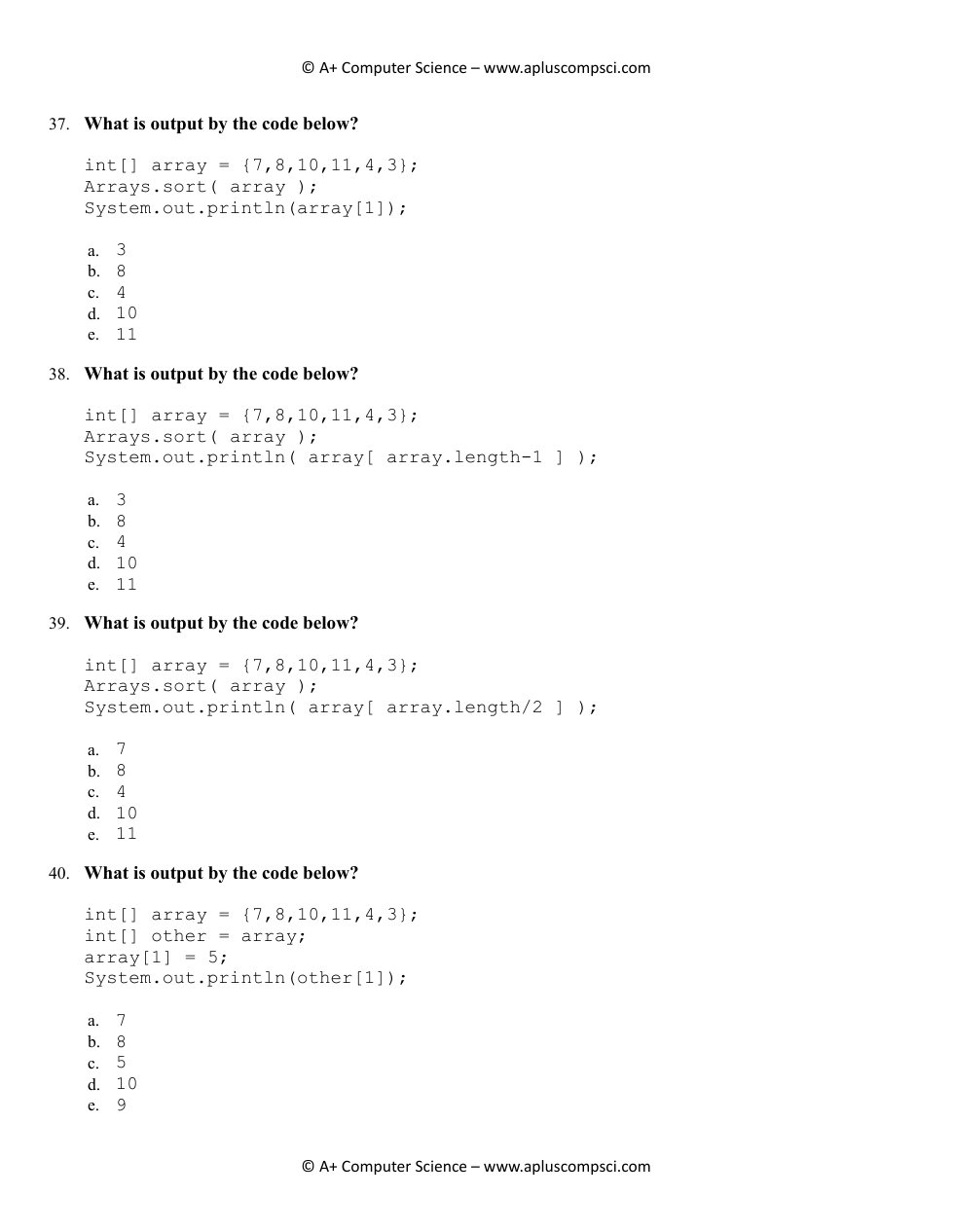
What is output by the code below? int[] array = {7,8,10,11,4,3}; Arrays.sort(array); System.out.println(array[1]);
What is output by the code below? int[] array = {33,14,37,11,27}; out.println(array[array.length-1]);
What is output by the code below? int[] array = {33,14,37,11,27}; out.println(array[array.length]);
What is output by the code below? int[] array = {7,8,10,11,4,3}; array[array[0]/2]=15; array[array[4]+1]=9; array[array.length/2-1]=5; array[1]=array[0]+4; out.println(array[2]);
What is output by the code below? int[] array = {7,8,10,11,4,3}; array[array[0]/2]=15; array[array[4]+1]=9; array[array.length/2-1]=5; array[1]=array[0]+4; out.println(array[0]);
What is output by the code below?
int[] array = {5,10,3,6,9,15};
for(int i=0; i<array.length/2; i=i+2)
{
array[i]=array[array.length-i-1];
}
out.println(array[0]);
What is the output by the code below? int[] array = {5,10,3,6,9,15};
for(int i=0; i<array.length/2; i=i+2)
{
array[i]=array[array.length-i-1];
}
out.println(array[1]);
What is output by the code below? int[] array = {33,14,37,11,27}; out.println(array[7/2]);
What is output by the code below? int[] array = {33,14,37,11,27}; out.println( array[ 6 - 5 ] );
What is output by the code below? int[] nums = new int[10]; for (int i=0; i<nums.length; i++)
{ nums[i] = i*3; } out.println(nums[9]);
What is output by the code below? int[] array = {1,2,3,4,5,6}; int sum = 0; for(int i = 0; i<=array.length; i++) sum = sum + array[i]; out.println(sum);
What is returned by method aplus given the client code shown below? public static int aplus( int[] ray ) { int stuff = 0; for(int i = 0; i<ray.length; i++) if(ray[i] % 2 == 0) stuff = stuff + ray[i]; return stuff; } //client code int[] sRay = {9,9,7,1,2,3,4,5,6,2,2,3,7,3}; System.out.println( aplus(sRay) );
What is output by the code below? int[] array = {7,8,10,11,4,3}; for(int i = 0; i < array.length; i++) { array[i]++; } System.out.println(array[2]);
What is output by the code below? int[] array = {7,8,10,11,4,3}; for(int i = 0; i < array.length; i++) { array[i]+=5; } System.out.println(array[2]);
Which of the following swaps elements 0 and 1 in array? int[] array = {7,8,10,11,4,3}; I. array[0] = array[1]; array[1] = array[0]; II. int save = array[0]; array[0] = array[1]; array[1] = save; III. array[0]+= array[1]; array[1] = array[0]-array[1]; array[0]-= array[1];
Which of the following is true about arrays?
Question 25: Consider the following method below. public static double check(int[] vals) { double[] amounts = {.25,.1,.05,.01}; if(amounts.length != vals.length) return 0.0; double total = 0.0; for(int i = 0; i < vals.length; i++) { total += vals[i] * amounts[i]; } return total; } What will the method check() return if passed the array {7, 3, 5, 4}?
Which of the following lines would correctly fill the blank in method getStuff() to return the int array named retArray?
public int [] getStuff(int [] x, int howMany)
{
int [] retArray;
//assume retArray has been properly instantiated
/*blank*/
}
Question 32: Which of the following could correctly fill in method sumOdds()? //method sumOdds should return the sum of all odd numbers in array public static int sumOdds(int[] array) { int z=0; for(int value : array ) { /* blank */ z += value; } return z; }
What is output by the code below? int[] array = {7,8,10,11,4,3}; Arrays.sort(array); System.out.println(array[array.length-1]);
What is output by the code below? int[] array = {7,8,10,11,4,3}; Arrays.sort(array); System.out.println(array[array.length/2]);
What is output by the code below? int[] array = {7,8,10,11,4,3}; int[] other = array; array[1] = 5; System.out.println(other[1]);