Q4 - Staying with Uncle Stephen
star
star
star
star
star
Last updated 9 months ago
4 questions
Note from the author:
6.5F - The student is expected to make inferences and use evidence to support understanding.
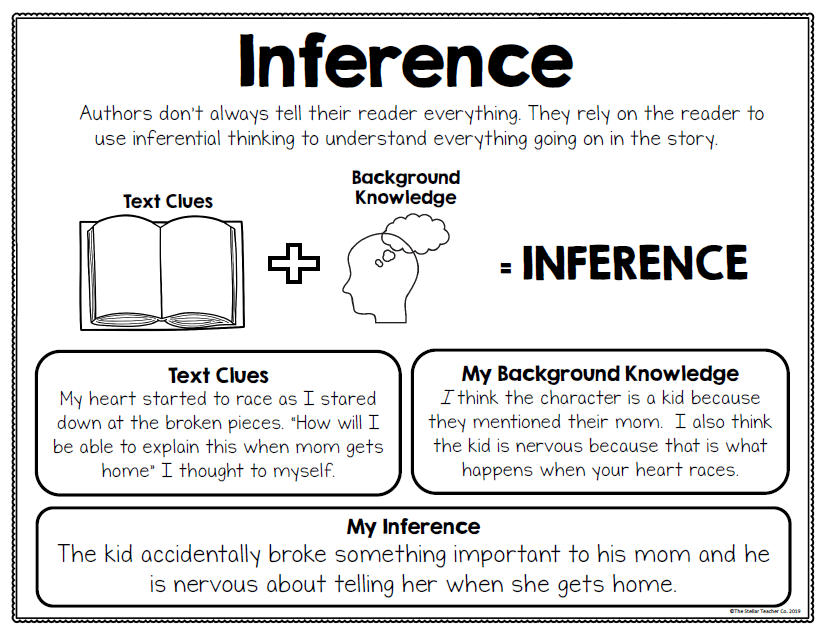
- You should make reasonable connections within and beyond a text to draw conclusions about information or ideas not explicitly stated in the text. For example, you might recognize that a poem titled “Eating Vegetables” lists activities a person might find unpleasant (e.g., having cavities filled, cleaning the bottom of the trash can with bare hands, and so on). Even if none of the lines ever mentions anything about vegetables, you could reasonably infer that the speaker of the poem finds vegetables undesirable. You should use context presented in the text, prior knowledge or experience, text features, and/or other comprehension tools to make logical assumptions about the intended meaning in a text.
- You should use information presented in a text to make reasonable, logical assumptions about the intended meaning. Evidence that corroborates understanding can be any relevant details, facts, or information that helps you understand what you are reading.
6.5F - The student is expected to make inferences and use evidence to support understanding.
- You should make reasonable connections within and beyond a text to draw conclusions about information or ideas not explicitly stated in the text. For example, you might recognize that a poem titled “Eating Vegetables” lists activities a person might find unpleasant (e.g., having cavities filled, cleaning the bottom of the trash can with bare hands, and so on). Even if none of the lines ever mentions anything about vegetables, you could reasonably infer that the speaker of the poem finds vegetables undesirable. You should use context presented in the text, prior knowledge or experience, text features, and/or other comprehension tools to make logical assumptions about the intended meaning in a text.
- You should use information presented in a text to make reasonable, logical assumptions about the intended meaning. Evidence that corroborates understanding can be any relevant details, facts, or information that helps you understand what you are reading.
1
Which answer did you pick for question 4?
4. Based on paragraphs 12 through 15, what can the reader infer about Brody?
Which answer did you pick for question 4?
4. Based on paragraphs 12 through 15, what can the reader infer about Brody?
1
Why did you chose that answer?
1
Which answer should you have chosen?
4. Based on paragraphs 12 through 15, what can the reader infer about Brody?
Which answer should you have chosen?
4. Based on paragraphs 12 through 15, what can the reader infer about Brody?
1
What will you do differently next time?