Please don't start this until we discuss it in class.
Which of the following are functions of the cardiovascular system?
Order the path of deoxygenated blood starting at the body
Pulmonary artery
Inferior/Superior vena cava
The valve between the ventricle and artery (pulmonary valve)
Right atrium
Right ventricle
Leaves the pulmonary arteries to go to the lungs
The valve between the atrium and ventricle (tricuspid valve)
What are the small sacks in the lungs where the majority of gas exchange happens?
As the blood passes by the alveoli through the capillaries which of the following occurs?
Order the path of oxygenated blood starting at the lungs
Left ventricle
Pulmonary veins
Leaves the aorta to go to the body
The valve between the atrium and ventricle (mitral valve)
Left atrium
The valve between the ventricle and the artery (aortic valve)
Aorta
As the blood passes by the cells in our calves through the capillaries which of the following occurs?
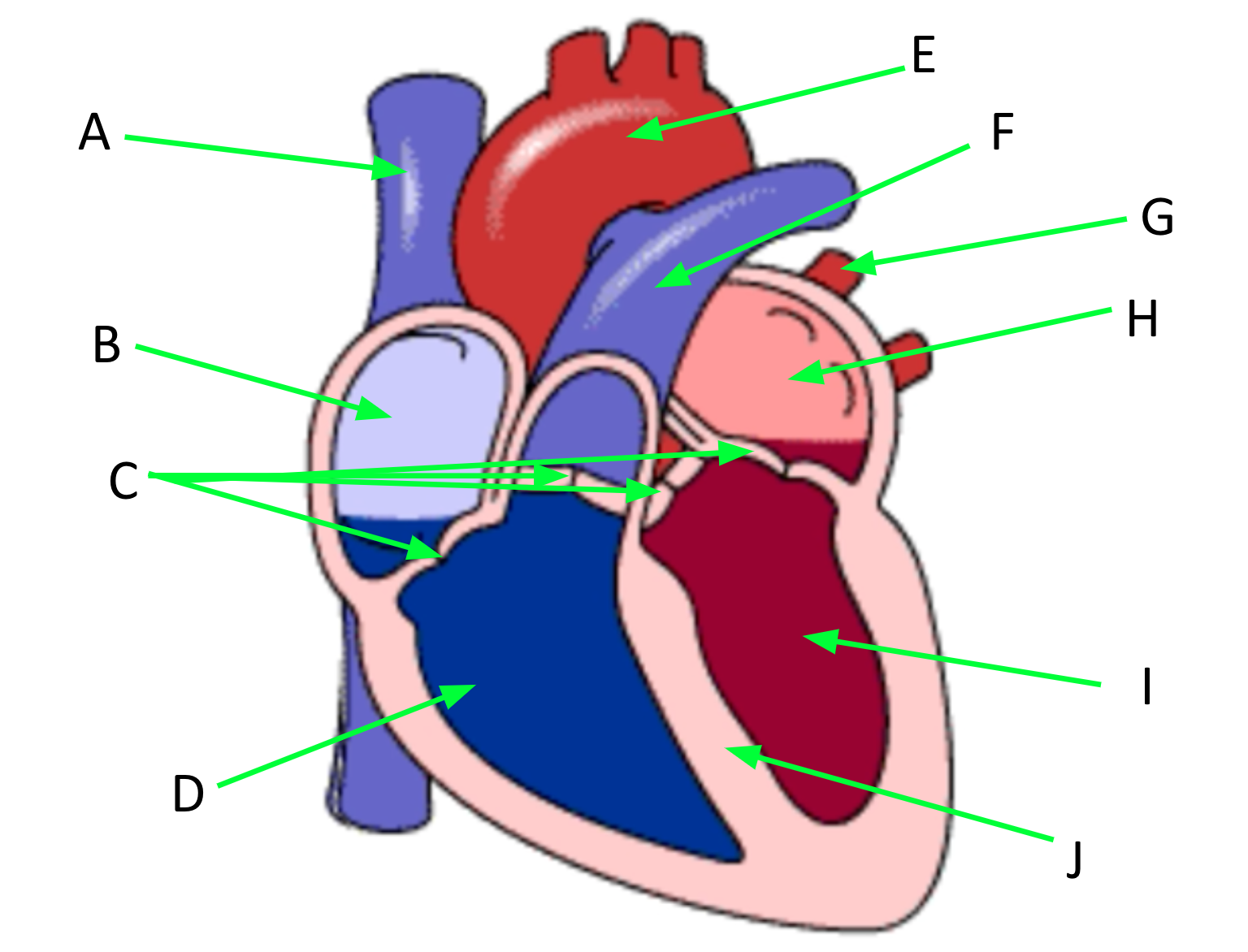
This question is just asking about the chambers of the heart (match the letters to the structure)
| Draggable item | arrow_right_alt | Corresponding Item |
|---|---|---|
I | arrow_right_alt | Right atrium |
H | arrow_right_alt | Right ventricle |
B | arrow_right_alt | Left atrium |
D | arrow_right_alt | Left ventricle |
This question is just asking about the arteries and ventricles of the heart (match the letters to the structure)
| Draggable item | arrow_right_alt | Corresponding Item |
|---|---|---|
E | arrow_right_alt | Superior vena cava |
F | arrow_right_alt | Aorta |
G | arrow_right_alt | Pulmonary artery |
A | arrow_right_alt | Pulmonary veins |
What are the names of the structures that C is pointing to? They prevent back flow in the heart.
What is J pointing to?
What is the name of the circuit that carries blood to and from the body and the heart
What is the name of the circuit that carries blood to and from the lungs and the heart
This question is asking about the cardiac cycle. Match the following into the functions of the two nodes in the heart
Receives a signal from the SA node
Sends a signal down the interventricular septum
Receives a signal directly from the brain
Is also known as the pacemaker
Signals the contraction of the atria
Directly leads to the contraction of the ventricles
Signals the AV node
Sinoatrial Node (SA Node)
Atrioventricular Node (AV Node)
Sort the following into the different types of blood vessels
Needs to have a lot of elasticity because of the high pressure from the blood pumping
Is lined in skeletal muscle
The smallest blood vessels
Has a very large overall area so the blood pressure is low so the blood moves slowest inside of them
The aorta is an example of this type of blood vessel
Has thinner walls (not as thin as capillaries)
Carries blood away from the heart
Contains valves
The vena cava is an example of this type of blood vessel
Carries blood to the heart
Has the thickest walls
Is the main site of nutrient and gas exchange
Has very thin and porous walls
Arteries
Veins
Capillaries
What is the majority of blood made up of (it contains water, nutrients, and some carbon dioxide)
Sort the following into the different blood cells
Cell fragments
Contains hemoglobin
Helps to fight off infections
Carries oxygen
Important in clotting
Red blood cells
White blood cells
Platelets
What is the protein in red blood cells that is attracted to and carries oxygen?
Sort the following for blood pressure calculations
The number that is in the numerator (top)
The higher number
The lower number
The pressure caused by the contraction of the ventricles
The number that is in the denominator (bottom)
Systolic Pressure
Diastolic Pressure