Log in
Sign up for FREE
arrow_back
Library

TEST Transformations Acc

star
star
star
star
star
Last updated almost 2 years ago
22 questions
4.55
4.55
4.55
4.55
4.55
4.55
4.55
4.55
4.55
4.55
4.55
4.55
4.55
4.55
4.55
4.55
4.55
4.55
4.55
4.55
4.55
4.55
*****REMEMBER that there is a time limit on this test. After you open this is doesn't matter if you get off of it the time is counting down. After the time is out it will automatically submit. Make sure that when you open this you are ready to complete it. The time is counting RIGHT NOW. ******
Go for it!
Question 1
1.

Question 2
2.

Question 3
3.

Question 4
4.

Question 5
5.

Question 6
6.

Question 7
7.

Question 8
8.

Question 9
9.

Question 10
10.

Question 11
11.

Question 12
12.

Question 13
13.

Question 14
14.

Question 15
15.

Question 16
16.

Question 17
17.

Question 18
18.

Question 19
19.

Question 20
20.

Question 21
21.

Question 22
22.

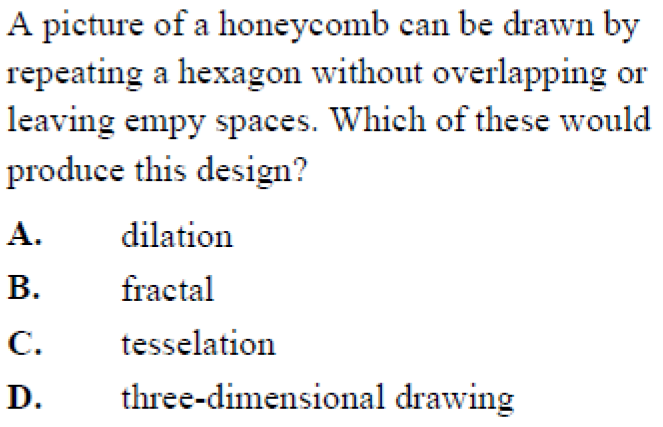
A picture of a honeycomb can be drawn by repeating a hexagon without overlapping or leaving empty spaces. Which of these would produce this design?
Dilation
Fractal
Tesselation
Three-Dimensional Drawing

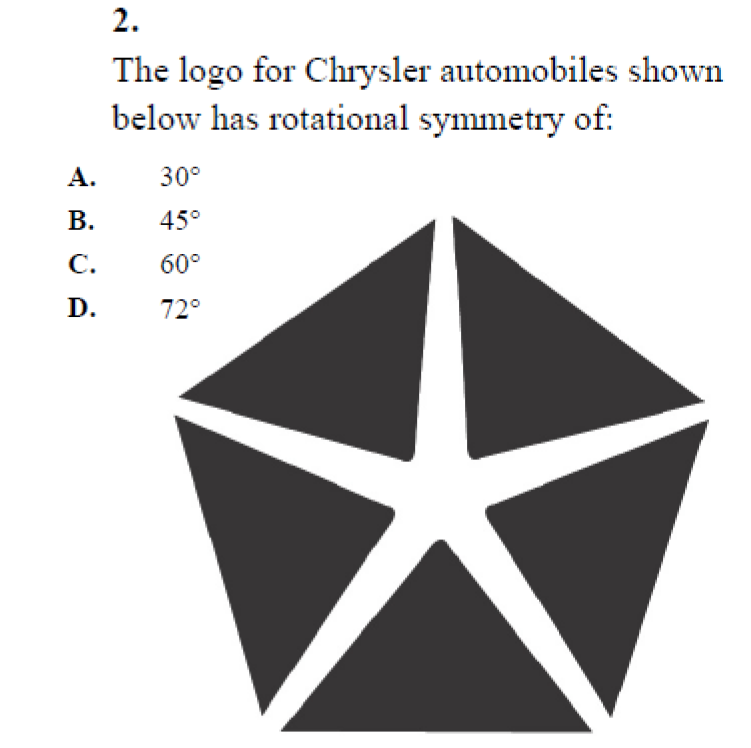
The logo for Chrysler automobiles shown below has rotational symmetry of:
30°
45°
60°
72°
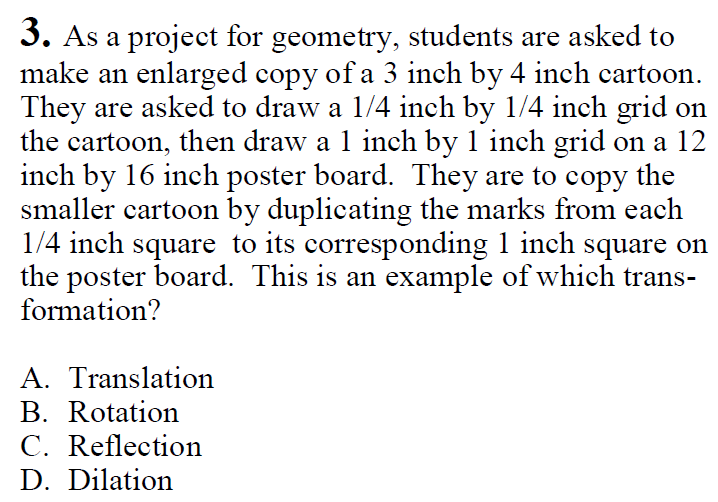
As a project for geometry students are asked to make an enlarged copy of a 3 inch by 4 inch cartoon. They are asked to draw a 1/4 inch by 1/4 inch grid on the cartoon, then draw a 1 inch by 1 inch grid on a 12 inch by 16 inch poster board. They are to copy the smaller cartoon by duplicating the marks from each 1/4 inch square to its corresponding 1 inch square on the poster board. This is an example of which transformation?
Translation
Rotation
Reflection
Dilation
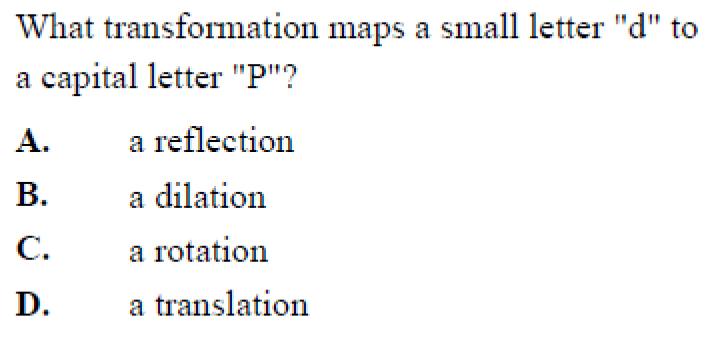
What transformation maps a small letter "d" to a capital letter "P" ?
A Reflection
A Dialtion
A Rotation
A Translation

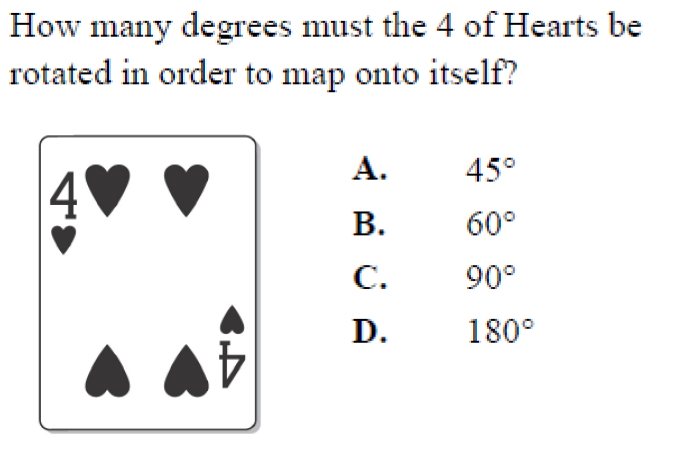
How many degrees must the 4 of Hearts be rotated in order to map onto itself?
45°
60°
90°
180°
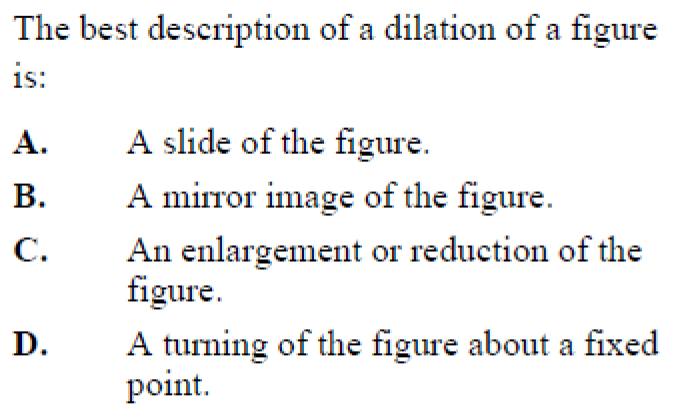
The best description of a DILATION of a figure is:
A slide of the figure.
A mirror image of the figure.
An enlargement or reduction of the figure.
A turning of the figure about a fixed point.
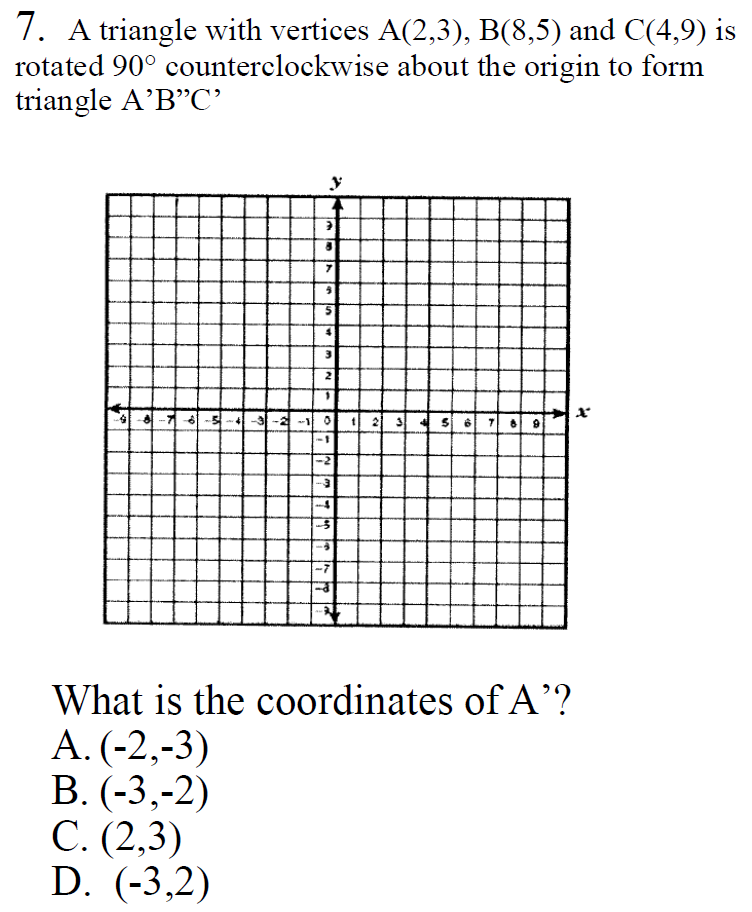
A triangle with vertices A(2,3), B(8,5) and C(4,9) is rotated 90° counterclockwise about the origin to form triangle A'B'C'. What is the coordinates of A'?
(-2,3)
(-3,-2)
(2,3)
(-3,2)
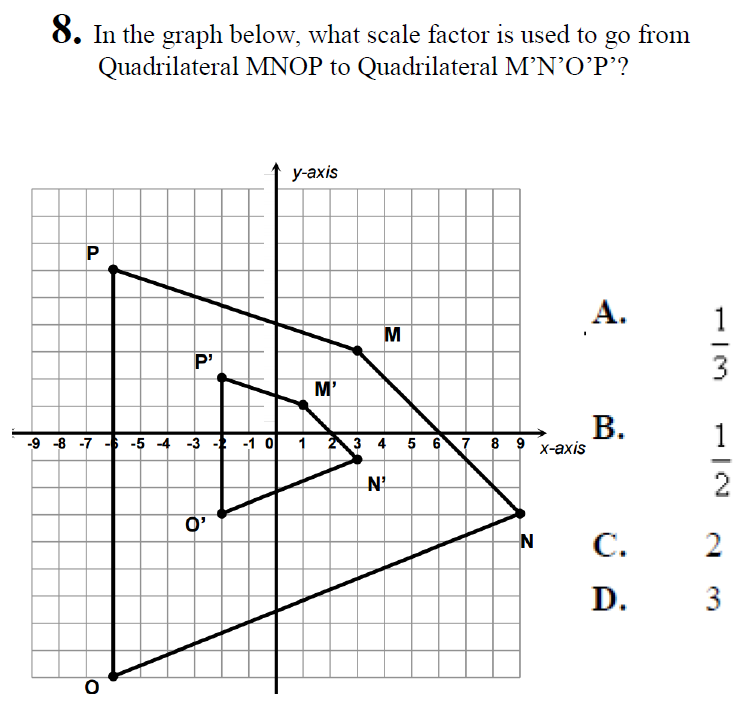
In the graph below, what scale factor is used to go from Quadrilateral MNOP to Quadrilateral M'N'O'P'?
1/3
1/2
2
3
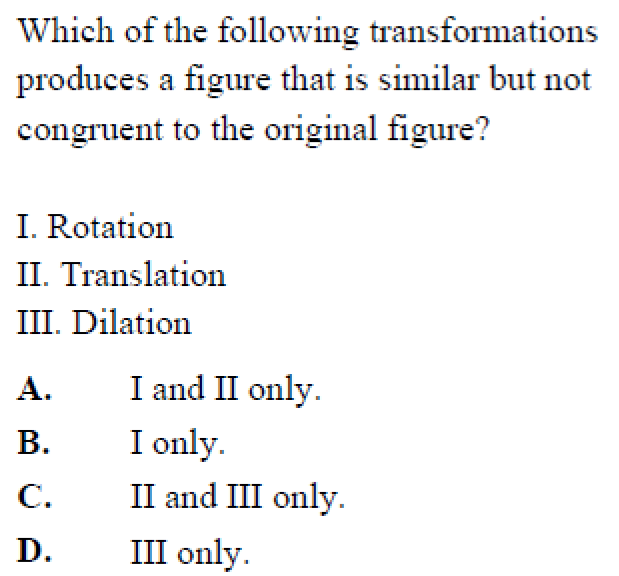
Which of the following transformations produces a figure that is similar but not congruent to the original figure?
I. Rotation
II. Translation
III. Dilation
I and II only
I only
II and III only
III only
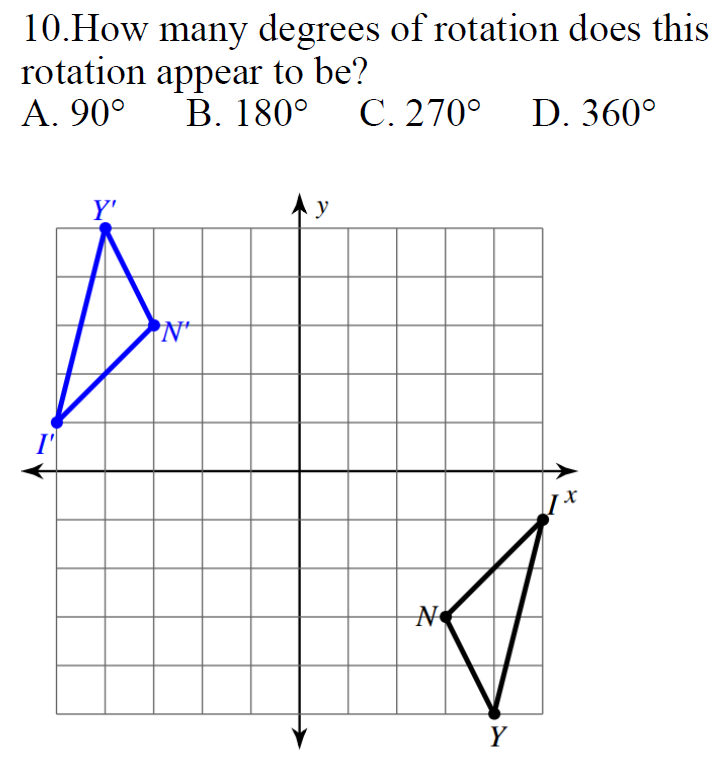
How many degrees of rotation does this rotation appear to be?
90°
180°
270°
360°
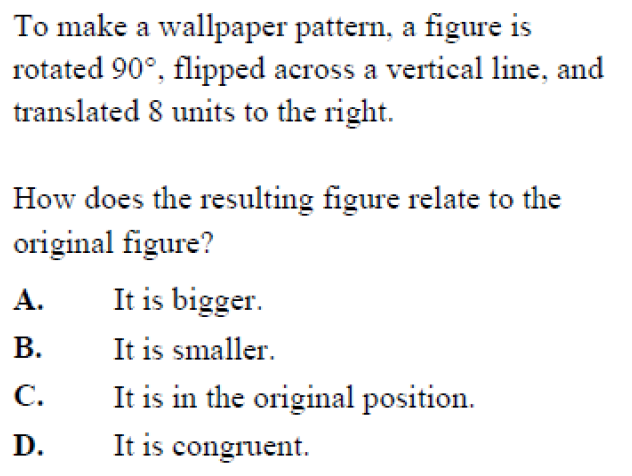
To make a wallpaper pattern, a figure is rotated 90°, flipped across a vertical line, and translated 8 units to the right.
How does the resulting figure relate to the original figure?
It is bigger
It is smaller
It is in the original position
It is congruent
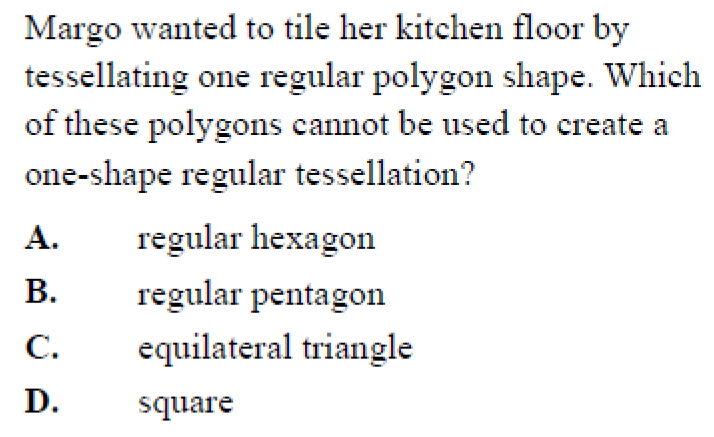
Margo wanted to tile her kitchen floor by tessellating one regular polygon shape. Which of these polygons cannot be used to create a one-shape regular tessellation?
Regular hexagon
Regular pentagon
Equilateral triangle
Square

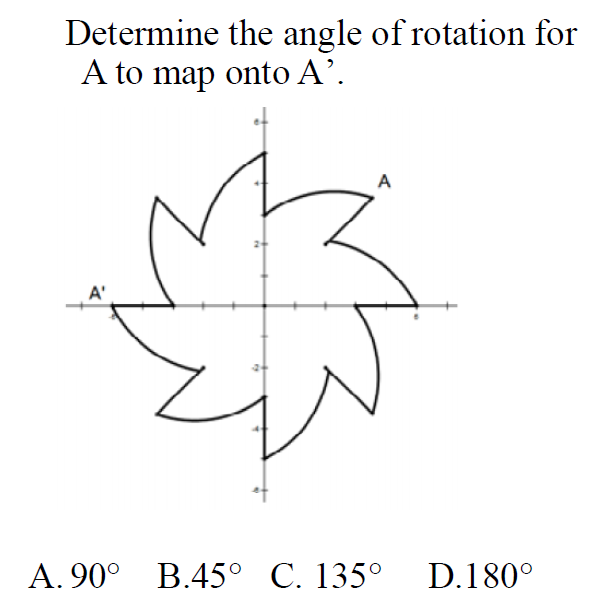
Determine the angle of rotation for A to map onto A'.
90°
45°
135°
180°
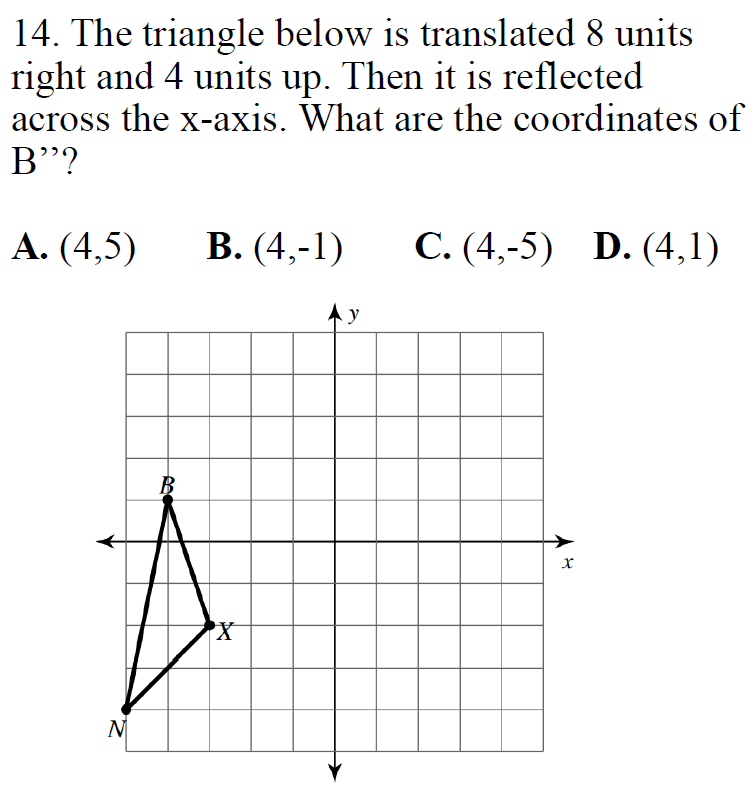
The triangle below is translated 8 units right and 4 units up. Then it is reflected across the x-axis. What are the coordinates of B''?
(4,5)
(4,-1)
(4,-5)
(4,1)
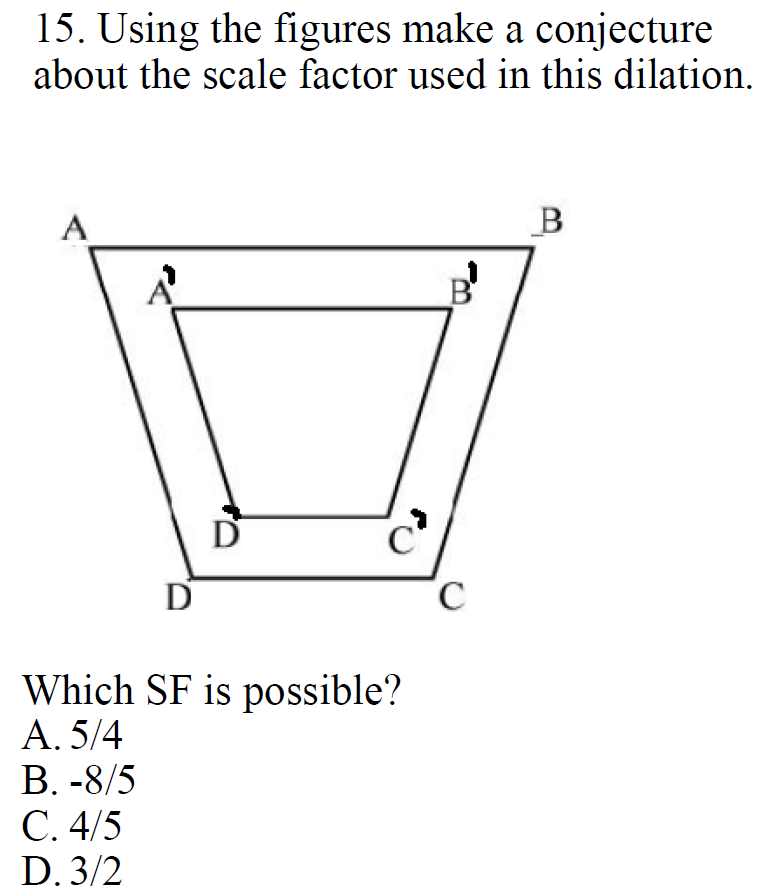
Using the figures make a conjecture about the scale factor used in this dilation.
5/4
-8/5
4/5
3/2
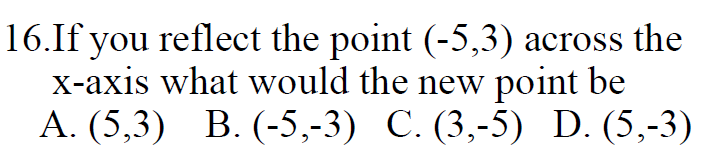
If you reflect the point (-5,3) across the x-axis what would the new point be
(5,3)
(-5,-3)
(3,-5)
(5,-3)
If you reflect the point (-12,15) across the line y = x the new point would be
(12,15)
(12,-15)
(15,12)
(15,-12)
If you rotate the point (7,5) 180° about the origin the new point would be
(-7,-5)
(7,-5)
(-5,-7)
(5,7)
What set of vectors would move (3,14) to the point (6,18)
<-3,4> then <5,12>
<4,3> then <12,3>
<-2,6> then <5,-2>
<-5,-4> then <8,8>
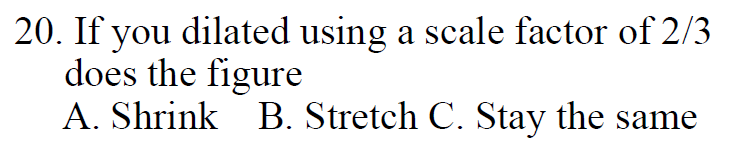
If you dilated using a scale factor of 2/3 does the figure
Shrink
Stretch
Stay the same
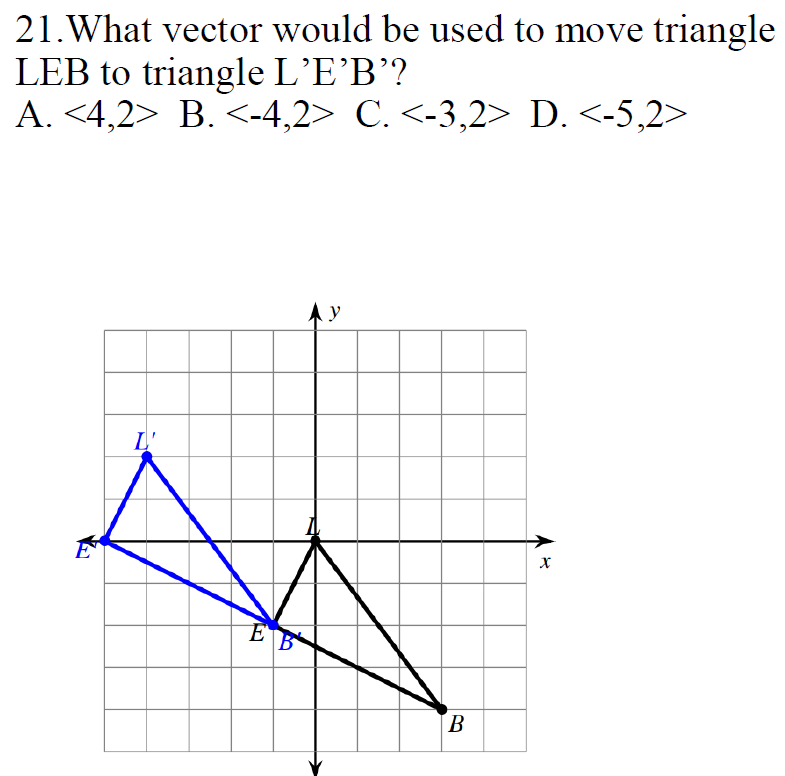
What vector would be used to move triangle LEB to triangle L'E'B'?
<4,2>
<-4,2>
<-3,2>
<-5,2>
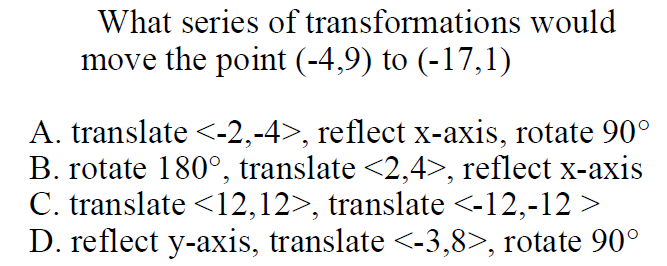
What series of transformations would move the point (-4,9) to (-17,1)
translate <-2,-4>, reflect x-axis, rotate 90°
rotate 180°, translate <2,4>, reflect x-axis
translate <12,12>, translate <-12,-12>
reflect y-axis, translate <-3,8>, rotate 90°