Read the passage below, & then answer the questions.
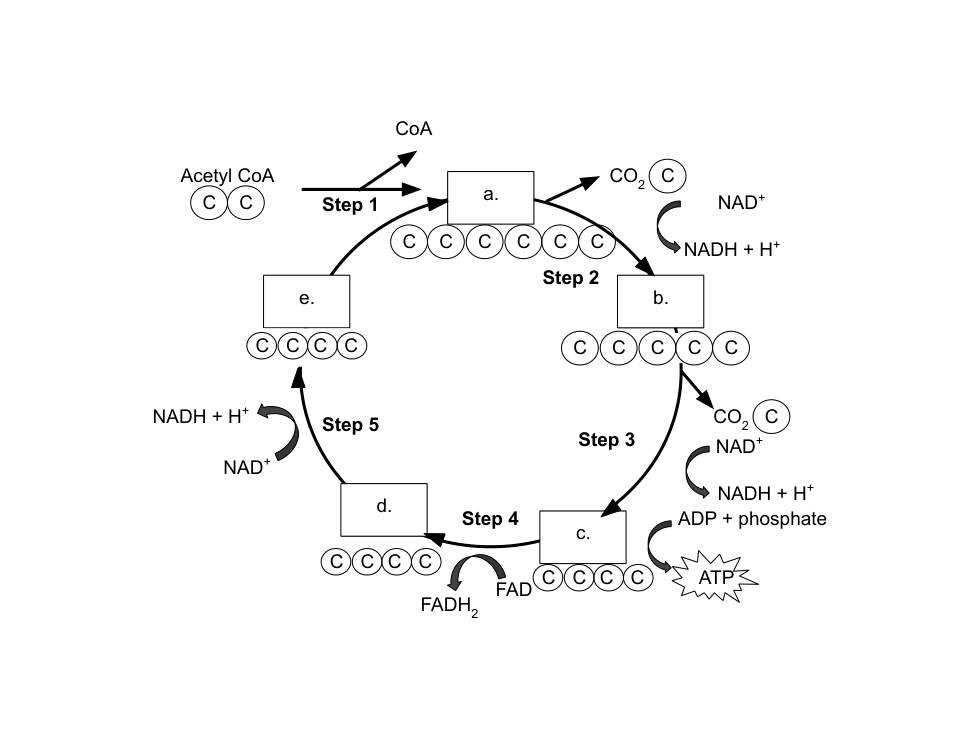
The Krebs cycle has 5 main steps. In eukaryotic cells, all 5 steps occur in the mitochondrial matrix.
Step 1. A 2-C molecule of acetyl CoA combines with a 4-C compound, oxaloacetic acid, to produce a 6-C compound, citric acid.
Step 2. Citric acid releases a CO2 molecule and a H atom to form a 5-C compound. The electron in the H atom is transferred to NAD+, reducing it to NADH.
Step 3. The 5-C compound formed in step 2 also releases a CO2 molecule and a H atom, forming a 4-C compound. Again NAD+ is reduced to NADH. In this step, a molecule of ATP is also synthesized from ADP.
Step 4. The 4-C compound formed in step 3 releases a H atom to form another 4-C compound. This time, the H atom is used to reduce FAD to FADH2. FAD, or flavin adenine dinucleotide, is a molecule very similar to NAD+. Like NAD+, FAD accepts electrons during redox reactions.
Step 5. The 4-C compound formed in step 4 releases a H atom to regenerate oxaloacetic acid, which keeps the Krebs cycle operating. The electron in the H atom reduces NAD+ to NADH.
Recall that in glycolysis one glucose molecule produces 2 pyruvic acid molecules, which can then form two molecules of acetyl CoA. Thus, one glucose molecule is completely broken down in two turns of the Krebs cycle. These two turns produce 6 NADH, 2 FADH2, 2 ATP, & 4 CO2 molecules.