Year 11 CHE Week 24 EXP 1 - Practicals revision
star
star
star
star
star
Last updated over 2 years ago
18 Nsɛmmisa
1
1
1
1
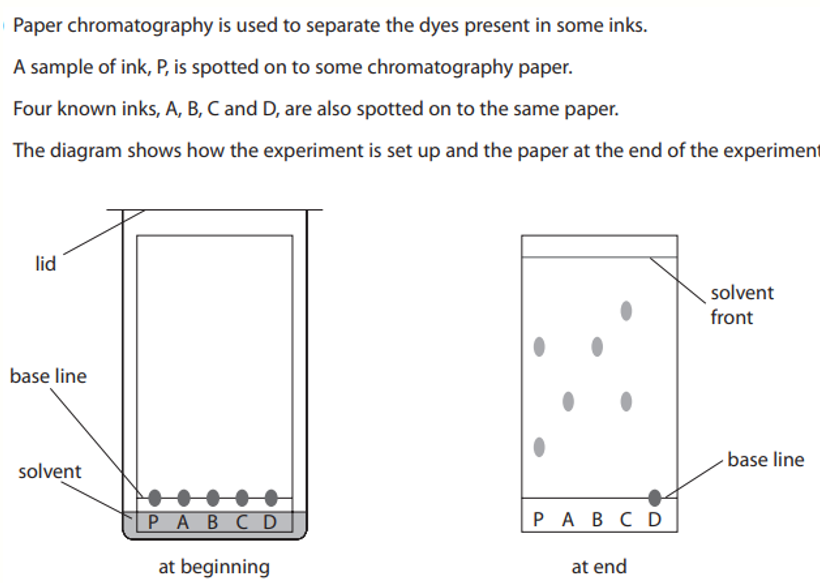
State why the solvent level should not be above the base line at the start of the experiment.
Explain which dye, present in one of the inks A, B, C or D, is also present in ink P
State why ink D does not move during the experiment.
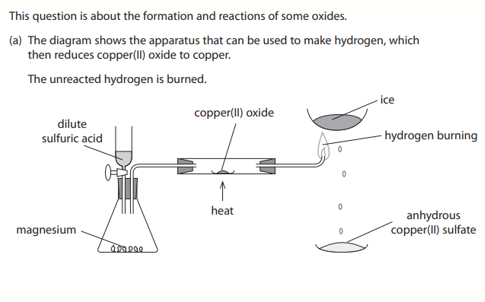
Explain one safety precaution that should be taken after adding the dilute sulfuric acid and before lighting the unreacted hydrogen gas (2)
State two observations that could be made when the dilute sulfuric acid reacts with the magnesium.(2)
State one observation that could be made when the hydrogen is passed over the heated copper(II) oxide
State the final colour of the copper(II) sulfate.
A student adds dilute sulfuric acid to a beaker containing calcium chloride solution. He obtains a mixture containing a precipitate of calcium sulfate in a solution of hydrochloric acid.
(a)Complete the equation for this reaction by inserting state symbol. (1)
CaCl2 (...) + H2 SO4 (.....) èCaSO4 (.....) + 2HCl(.....)
(c) The student carries out a flame test on the filtrate he obtains and observes a brick-red colour.
(i) Identify the ion responsible for this colour (1)
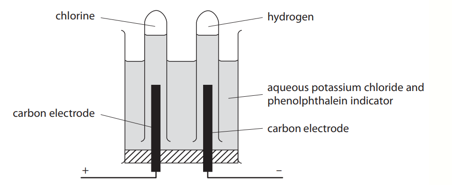
The diagram shows apparatus used to electrolyse aqueous potassium chloride in the laboratory.
(i)Chlorine is formed at the positive electrode. Describe a test for chlorine gas. (2)
(ii) Hydrogen gas is formed at the negative electrode. Write an ionic half-equation for the formation of hydrogen. (2)
(iii) The solution used in this electrolysis contains phenolphthalein. During the electrolysis, the colour of the solution around the negative electrode goes pink.
Explain why the solution goes pink, and give the formula of the ion responsible for causing the colour change. (2)
Suggest why this ion is present in the filtrate. (1)
(d) The student tests the filtrate for chloride ions by adding silver nitrate solution.
(i)State what he would observe in this test. (1)
(ii) State the name of the substance responsible for this observation. (1)
(iii) He reads in a textbook that dilute nitric acid should be added before the silver nitrate solution in the test. Suggest why the student does not need to add dilute nitric acid in the test. (1)
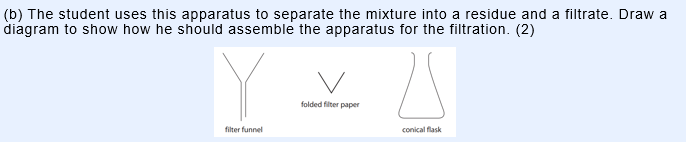
(e) The calcium sulfateresidue he obtains is impure because it contains some hydrochloric acid. Describe how he can obtain a pure dry sample of calcium sulfate from this residue (2)