
Log in
Sign up for FREE
arrow_back
Library

Global Climate Change REDemption

star
star
star
star
star
Last updated 12 months ago
15 questions
1
1
1
1
1
1
1
1
1
1
1
1
1
1
1
Question 1
1.

Question 2
2.

Question 3
3.

Question 4
4.

Question 5
5.

Question 6
6.

Question 7
7.

Question 8
8.

Question 9
9.

Question 10
10.

Question 11
11.

Question 12
12.

Question 13
13.

Question 14
14.

Question 15
15.

Which of the following best explains the impact of climate change on polar regions?
Polar regions are warming more quickly than other regions because warming decreases the coverage of high-albedo ground cover like ice and snow.
Polar regions are warming more slowly than other regions because atmospheric circulation wind patterns trap cold air at the poles.
Polar regions are warming more slowly than other regions because the ice and snow keep the air cool.
Polar regions are warming more quickly than other regions because more carbon dioxide can dissolve in colder water.
Based on the data in the graph, which of the following values best indicates the change in the present-day CO2 concentration as compared to the CO2 concentration approximately 200,000 years ago?
1.6 times greater
2.3 times greater
250 times greater
400 times greater
Which of the following best describes the relationship between the variables shown in the graphs?
CO2 concentrations and Antarctic temperatures have cycled approximately every 50,000 years, and present-day values for both variables are the highest they have been in 800,000 years.
CO2 concentrations and Antarctic temperatures have steadily decreased from 800,000 years ago, and present-day values for both variables are the lowest they have been in 800,000 years.
CO2 concentrations and Antarctic temperatures have steadily increased from 800,000 years ago, and the present-day value for CO2 concentration is the lowest it has been in 800,000 years.
CO2 concentrations and Antarctic temperatures have cycled approximately every 50,000 years, and the present-day value for CO2 concentration is the highest it has been in 800,000 years.
Which of the following equations best represents the chemical changes that occur during ocean acidification?
6CO2+6H2O →C6H12O2+6O2
CH4+2O2→CO2+2H2O
CO2+Ca++CO32−→CaCO3
CO2+H2O→2H++CO32−
Which of the following solutions can best reduce an anthropogenic cause of ocean acidification?
Install catalytic converters on cars and trucks
Switch from coal-burning power plants to nuclear power plants for electricity generation
Use biomass for heating homes and for cooking
Rotate crops planted in agricultural fields each year
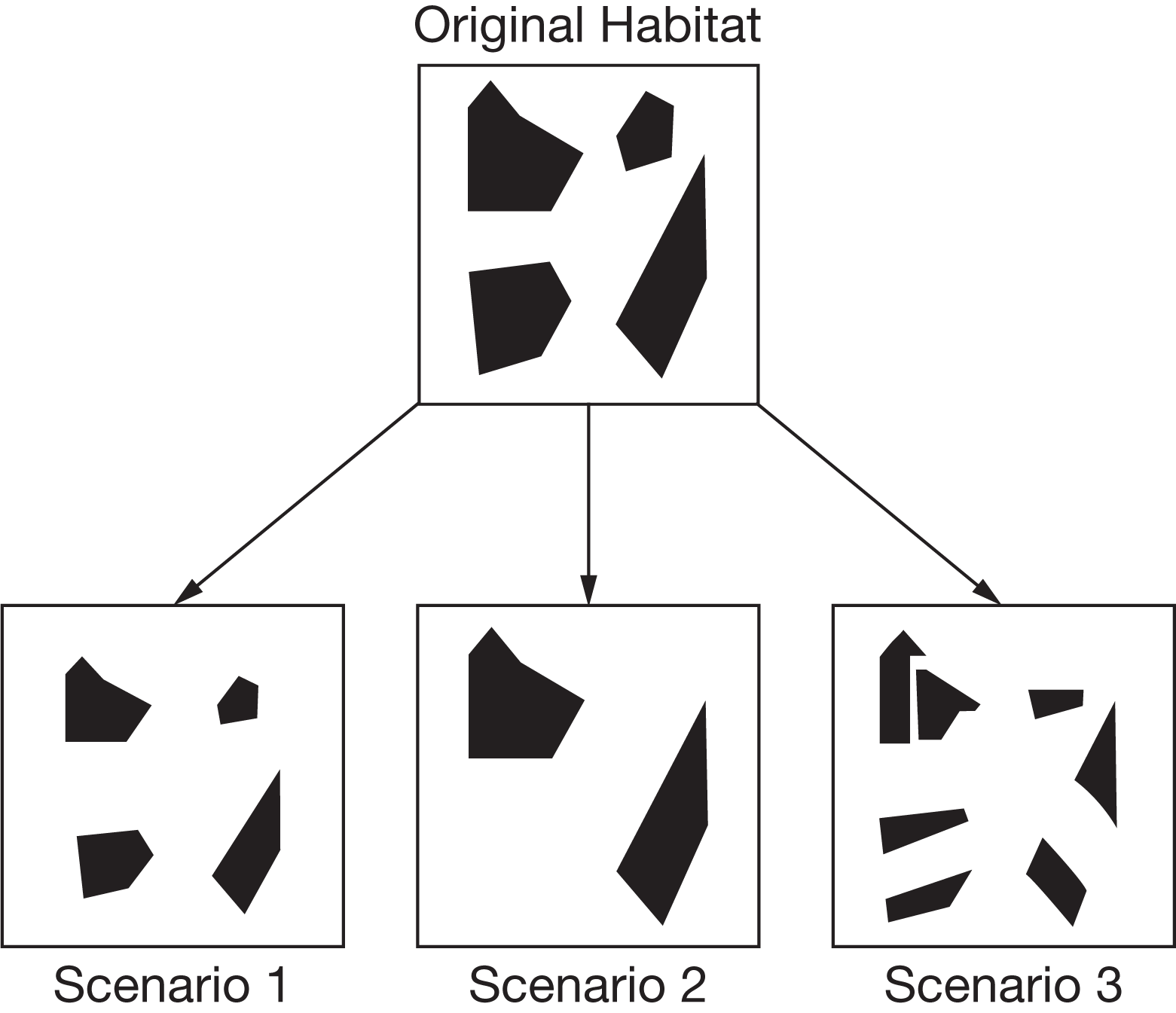
The diagram shows how a patch of habitat could possibly be altered.
Which of the following is a possible effect of global climate change as illustrated in Scenario 1?
Increased sea level would reduce the size of the habitat patches.
Decreased precipitation would eliminate habitat patches.
Decreased temperatures would cause unsuitable abiotic conditions.
Increased carbon dioxide availability spurs plant growth, which would increase habitat size.
The diagram shows how a patch of habitat could possibly be altered.
Which of the following would be most likely to occur in the scenarios that have experienced habitat loss and/or fragmentation in the diagram?
Decrease in the number of specialist species
Increase in genetic diversity of native species
Decrease in the abundance of invasive species
Increase in territory size of large mammals
The diagram shows how a patch of habitat could possibly be altered.
Which of the following would be the most likely explanation for the changes shown in Scenario 3?
The increased edge-to-interior ratio resulted in habitat fragmentation and the formation of smaller, more manageable parcels of land.
Habitat corridors were built to allow individuals between populations to mate, which helped to prevent inbreeding and reduce the genetic diversity often found in isolated populations.
Roads and electric power lines subdivided the landscape into smaller pieces and decreased the amount of available habitat.
Native species were replanted in the areas, which led to fewer niches.
The diagram shows how a patch of habitat could possibly be altered.
Which of the following correctly identifies the type of habitat change(s) shown within each potential scenario in the diagram?
All scenarios experienced habitat loss, but only Scenario 3 experienced habitat fragmentation.
All scenarios experienced habitat fragmentation, but only Scenario 2 experienced habitat loss.
Scenario 1 experienced habitat fragmentation, while Scenarios 2 and 3 experienced habitat loss only.
Scenarios 1 and 2 experienced habitat loss, while Scenarios 3 experienced habitat fragmentation only.
The spotted lanternfly is a herbivorous insect that is native to Asia and feeds on over 70 species of plants. The feeding behavior of the spotted lanternfly damages plants, and the nymph and adult lanternflies secrete sticky residues that exacerbate the damage to native plant species by promoting mold growth. The spotted lanternfly reproduces once during its lifetime by laying between 30 and 50 eggs, and the eggs hatch after a short amount of time. The range of the spotted lanternfly is increasing because the insects are transported to new environments by the movements of animals and people, and it is now found in many parts of the United States.

Which of the following best describes the spotted lanternfly in the United States?
The spotted lanternfly is a K-selected and invasive species.
The spotted lanternfly is a K-selected and endangered species.
The spotted lanternfly is anrr-selected and endangered species.
The spotted lanternfly is an r-selected and invasive species.
Chemical compound banned in most countries because of link to stratospheric ozone depletion.
Chlorofluorocarbons (CFCs)
Carbon dioxide (CO2)
Nitrogen oxides (NOx)
Nitrates (NO3−)
In 1978, the United States banned the use of CFCs in aerosols. Based on the data in the graph, which of the following best explains the effect of this ban as a solution to decrease global CFC production?
The ban on CFCs in aerosols in the United States was not effective on a global scale because it led to an increase in reports of skin cancer and cataracts in patients in the Southern Hemisphere from 1970 to 2000.
The ban on CFCs also led to a decrease in HCFC production beginning in 1980, reducing the reliance on chlorinated chemicals used in industrial processes and greatly reducing stratospheric ozone depletion.
The ban on CFCs led to a decrease of CFC-11 and CFC-12 production by more than 15% between 1978 and 1980, which supports the ban as an effective solution to reduce global CFC production.
The ban on CFCs in aerosols led to an increase in CFC-113 production for use in refrigerants and air conditioners in the United States, which led to a 10% overall increase in global CFC production between 1970 and 1980.
Which of the following statements best uses the data to support the claim that the Montreal Protocol was an effective solution for a global problem?
The Montreal Protocol led to a dramatic reduction in CFC production globally after 1987, which greatly reduced the concentration of chlorinated hydrocarbons present in the stratosphere and decreased the breakdown of stratospheric ozone. Based on the graph, the annual production of CFCs decreased significantly in the late 1980s to almost 0 tons by 2000.
The Montreal Protocol reduced stratospheric ozone depletion by increasing the reliance on CFCs in industrial processes. Based on the graph, the increase in global CFC production from 1960 to 1970 demonstrates the success of the protocol by substituting ozone-depleting substances with CFCs.
The Montreal Protocol monitored the production and sale of CFCs and HCFCs in the late 1990s to decrease tropospheric ozone pollution and photochemical smog. Based on the graph, CFCs and HCFCs leveled off at 100,000 tons produced in 2000.
The Montreal Protocol was passed in 1970 to increase the production of HCFCs, which led to decreased reliance on CFCs. Based on the graph, HCFC-22 production increased steadily from 1980 to 1990 and HCFC-141b increased from 1990 to 2000.
This layer of Earth’s atmosphere contains the ozone layer that absorbs the sun's ultraviolet rays.
Mesosphere
Thermosphere
Troposphere
Stratosphere
Which of the following human activities is most closely associated with depletion of the stratospheric ozone layer?
Mining of coal
Heating of homes and factories
Generation of electricity
Disposal of refrigerators and air conditioners