Log in
Sign up for FREE
arrow_back
Library

LT 6.1 a-c DNA Discovery, Structure and Replication Quiz

star
star
star
star
star
Last updated over 1 year ago
15 questions
6.1a I can compare a variety of DNA models and evaluate them for their effectiveness in explaining its structure and function. ​
1
4.1a
1
4.1a
1
4.1a
1
4.1a
1
4.1a
6.1b I can provide examples to illustrate how modern advances related to DNA structure and function illustrate the nature of science.
1
4.1b
1
4.1b
1
4.1b
1
4.1b
1
4.1b
6.1c I can describe the process of DNA replication.
1
4.2a
1
4.2a
1
4.2a
1
4.2a
1
4.2a
Question 1
1.

Question 2
2.

Question 3
3.

Question 4
4.

Question 5
5.

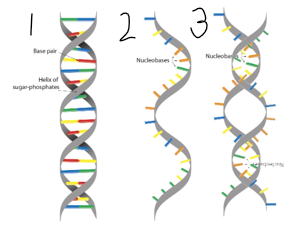
Look at the three possible DNA models shown below. Make a claim and provide evidence and reasoning to explain which model is the most accurate based upon today’s understanding of the structure.

Question 6
6.

Question 7
7.

Question 8
8.

Question 9
9.

Question 10
10.

Question 11
11.

Question 12
12.

Question 13
13.

Question 14
14.

Question 15
15.

Which diagram below best represents a segment of a normal DNA molecule?
Which statement best describes the structure of a DNA molecule
DNA is a single-stranded and curly molecule
DNA is single-stranded and straight molecule
DNA is a double-stranded molecule that looks like a spiral staircase
DNA is a double stranded molecule that is straight like a ladder
Which statement best describes a portion of the molecule represented below?
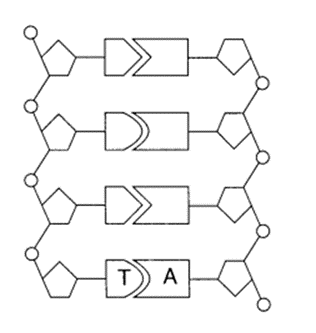
It contains uracil, which functions in protein synthesis
It consists of many ribose sugars
It consists of alternating phosphate groups and deoxyribose sugars.
It unites with amino acids in the cytoplasm
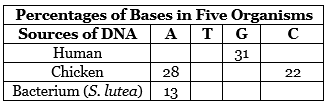
The above figure shows the results of measuring the percentages of the four bases in the DNA of three organisms. Some of the values are missing. Based on the base pairing rule, the percentages of adenine bases in Human DNA should be around which percentage?
70%
31%
38%
19%
Which of the following discoveries were the result of Erwin Chargaff's experiments?
The amount of adenine in a set of DNA is equal to the amount of guanine.
The four bases found in DNA are adenine, thymine, cytosine and guanine.
Each of the four bases are always found in equal quantities.
The concentrations of the four bases do not vary among species.
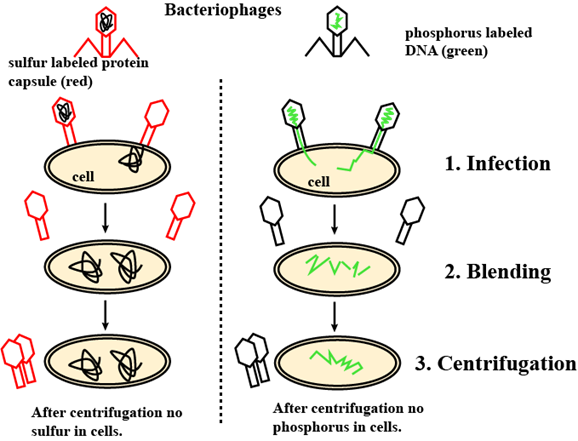
Hershey and Chase took advantage of the fact that there is a unique element in DNA and in proteins. They added a radioactive version of this element into two containers, making the DNA in one container glow and the proteins in the second container glow. Looking at the image below, how did they determine that the DNA was the molecule carrying information?

The radioactive protein was found inside the cell, using the information to control the infected cell.
The radioactive DNA was found separate from the infected cell, still carrying on as a separate organism.
The radioactive protein was found separate from the infected cell, still carrying on as a separate organism.
The radioactive DNA was found inside the cell, using the information to control the infected cell.
Chargaff measured the amount of each nitrogen base present in a double stranded molecule. His discovery of [A] = [T] and [C]=[G] was critical for Watson and Crick to determine what about the placement of bases in the double stranded molecule?
The covalently bonded nucleotides are always present in a specific sequence in one strand, causing their amounts to be equal.
Nitrogen bases are always located around the outside of the helix like a spiral staircase.
The nitrogen bases are paired up in the center of the molecule due to the covalent bonding between adenine and thymine, and cytosine and guanine.
The hydrogen bonds that form between adenine and thymine, and cytosine and guanine, cause them to pair in the double helix and always be present in even amounts.
In order to develop the model of DNA’s structure, Watson and Crick needed some vital information. One source of the information came from Chargaff’s Law which established the base-paring ratios. The other source came from Rosalind Franklin’s x-ray diffraction image. Why is the sharing of information in the scientific community vital in the development of the DNA model?
Without sharing of information, Rosalind Franklin would not have discovered DNA’s structure
Without the sharing of information, Chargaff would not have known how the nucleotides paired properly
Without the sharing of information, scientists would have different conflicting models of DNA’s structure.
Without the sharing of information, other scientists would have taken longer to develop the model of DNA’s structure.
Which of the following statements is true regarding the discovery of the double helix?
It was discovered that double-stranded DNA is not a parallel molecule.
James Watson, Francis Crick, Maurice Wilkins, and Rosalind Franklin were awarded the Nobel Prize in Medicine for their discovery of the single helix.
The experiments that led to the discovery of the double helix ultimately disproved Chargaff's rules regarding nitrogenous bases.
Rosalind Franklin’s x-ray crystallography provided Watson and Crick with important data that helped determine the structure of DNA.
Since replication is a semi-conserved process, this allows DNA to
accurately pass on genetic information during cell division because each DNA molecule is proofread for errors that occurred during replication
accurately pass on genetic information during cell division because each DNA molecule contains a strand with the original DNA sequence
accurately pass on genetic information during cell division because the original DNA molecule is stored as an unmodified genetic blueprint
accurately pass on genetic information during cell division because each DNA molecule contains a strand that is an exact complement of the original DNA sequence
The enzyme that unzips the DNA to prepare for replication
Ligase
DNA Polymerase
Synthase
Helicase
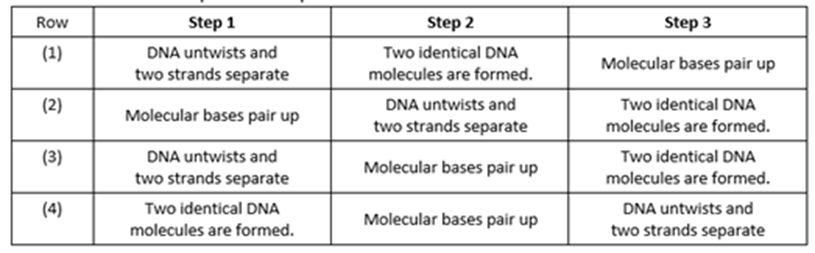
Which row in the chart shows the steps of DNA replication in the correct order?

3
4
2
1
Why must DNA replication occur in cells?
More copies of DNA allow a cell to become more complex
Cells need more DNA molecules in order to grow larger
Extra copies of DNA must be made in case some are destroyed or damaged
Cells formed through cell division must each have a copy of the DNA
If one strand of DNA is CGGTAC, the corresponding strand would be
GCCATG
TAACGT
CGGTAC
GCCAUC