Essential Question: What happens when you apply more than one transformation to a figure?
Learning Target: Students will be able to apply a sequence of transformations on a figure after completing this assignment.
Use complete sentences for credit.
Complete the entire document and show work for full credit.
Essential Question: What happens when you apply more than one transformation to a figure?
Learning Target: Students will be able to apply a sequence of transformations on a figure after completing this assignment.
Use complete sentences for credit.
Complete the entire document and show work for full credit.
Triangle ABC with vertices A(0, 7), B(7, 3), and C(1, 4):
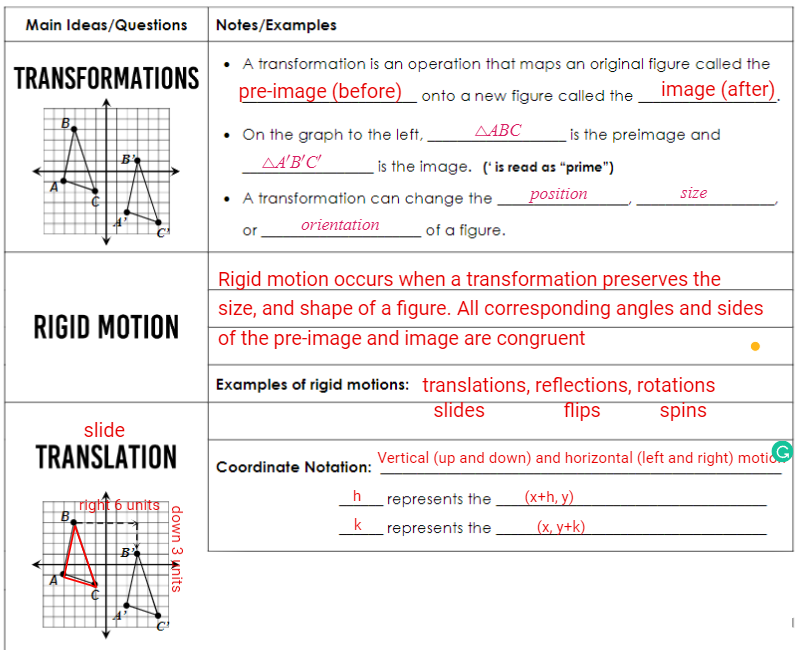
(x, y) → (x – 3, y – 4)
A'
B'
C'
Translate the triangle ABC with vertices A(-2, 3), B(6, -2), and C(0, 0) with the vector <6,-2>
A'
B'
C'
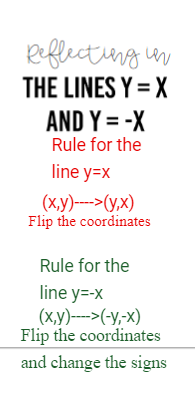
Triangle FGH with vertices F(1, 8), G(5, 7), and H(2, 3): y = x
F'
G'
H'
Triangle FGH with vertices F(1, 8), G(5, 7), and H(2, 3):
y = - x
F'
G'
H'
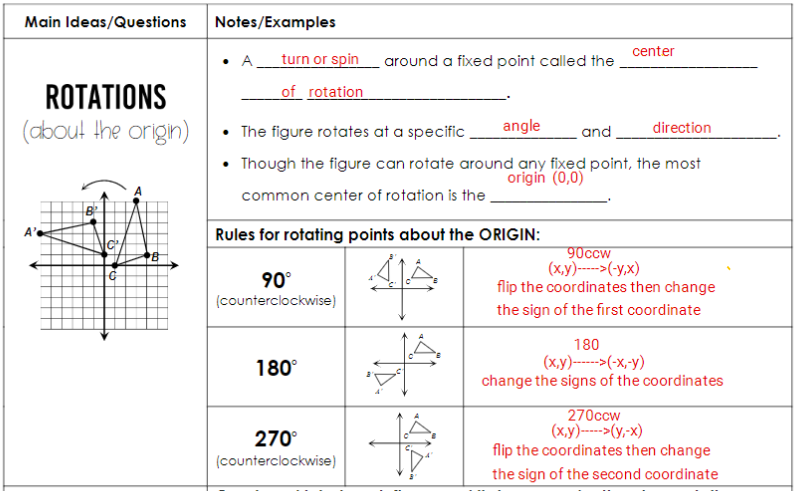
Triangle FGH with vertices F(-7, 8), G(-1, 1), and H(-8, 4): 90° counterclockwise
F'
G'
H'
Triangle FGH with vertices F(-7, 8), G(-1, 1), and H(-8, 4): 180°
F'
G'
H'
Triangle FGH with vertices F(-7, 8), G(-1, 1), and H(-8, 4): 270° counterclockwise
F'
G'
H'
Triangle GHI with vertices G(-1, 6), H(-1, 3), and I(-6, 6):
a) translation along the vector <-2, -5>
G'
H'
I'
b) reflection in the line y = x
G''
H''
I''
Triangle XYZ with vertices X(-3, 7), Y(-2, 1), and Z(-5, 2):
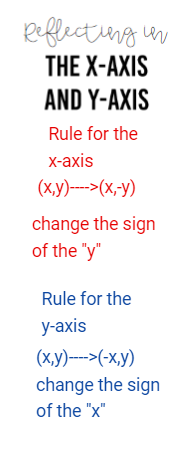
a) reflection in the x-axis
X'
Y'
Z'
b) rotation 90° counterclockwise
X''
Y''
Z''