Log in
Sign up for FREE
arrow_back
Library

Unit 7: Test Corrections

star
star
star
star
star
Last updated almost 2 years ago
15 questions
Required
1
5.9.C
Required
1
5.9.B
Required
1
5.9.B
Required
1
5.9.A
Required
1
5.9.A
Required
1
5.9.A
Required
1
5.9.A
Required
1
3.9.A
Required
1
5.9.A
Required
1
5.9.B
Required
1
5.9.B
Required
1
5.9.B
Required
1
5.9.B
Required
1
5.9.C
Question 1
1.

Question 2
2.

Question 3
3.

Question 4
4.

Question 5
5.

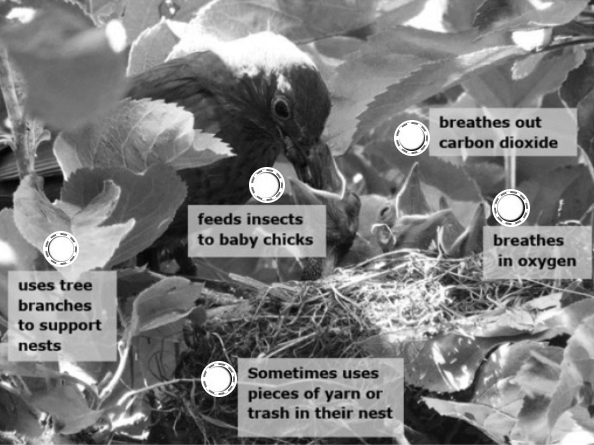
Below is an image of a mother bird feeding her chicks. Facts about bird activities are shown in the image.
Which of the facts are about how birds interact with living parts of their environment?

Choose TWO correct answers.

Question 6
6.

Question 7
7.

Question 8
8.

Question 9
9.

Question 10
10.

Question 11
11.

Question 12
12.

Question 13
13.

Required
1
5.9.C
Question 15
15.

Turtles look for quiet, dark beach areas on which to nest. Tourists on the beaches may bother the turtles. Also, the lights from hotels and businesses discourage females from nesting at night. If a female doesn't find a safe place to nest, she may lay her eggs in an unprotected area or in the ocean. In these cases, many of the hatchlings will not survive.
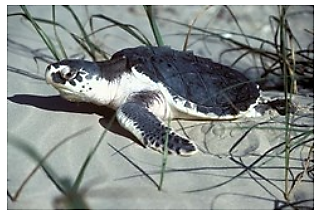

What other factor may prevent the turtles from finding safe places to nest?
Salt grasses growing on the beach
Wind blowing sand to form dunes
Turning off flashlights and lanterns
Pets running loose on the beach
Which of the following food chains shows the correct flow of energy between organisms?
Consumers → decomposers → producers
Decomposers → producers → consumers
Consumers → producers  → decomposers
Producers → consumers → decomposers
A mouse population became ill and decreased in numbers.  What will most likely happen to the owl population, which depends on mice for part of its food source?
The owl population will decrease because there is less food for it to eat.
The owl population will eat other animals, and its numbers will not change.
The owl population will increase because it no longer competes with the mice.
The owl population will stay the same as it eats food that the mice population would have eaten.
Organisms interact with living and non-living components in their environments daily. Which organisms are interacting with non-living components in their environments?
Select the four answers.
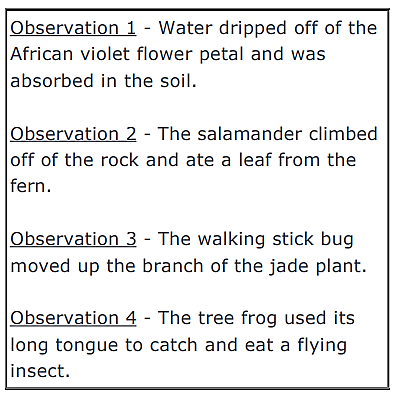
A student makes the following observations while looking at the classroom terrarium.


Which observation demonstrates an organism interacting with only non-living elements of its environment?
Observation 1
Observation 2
Observation 3
Observation 4
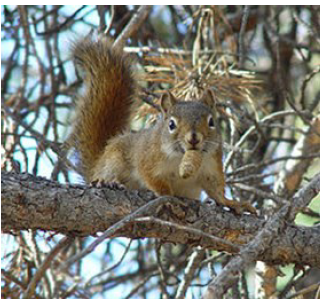
The picture shows a Pine squirrel sitting on a tree branch in a Temperate Forest biome.


Which factor most likely does NOT affect the Pine squirrel’s survival in the temperate forest biome?
Sunlight
Bacteria
Temperature
Soil
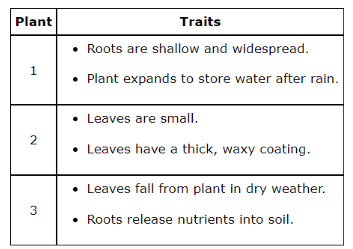
The table lists some traits of three plants.


All the plants listed in the table are MOST LIKELY adapted to which environment?
Swamp
Arctic
Desert
Forest
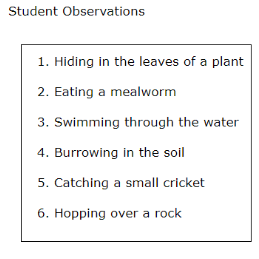
A teacher uses an aquarium to make a habitat for a frog. A list of student observations of the frog is shown.


Which student observations show the frog interacting with nonliving elements in its environment?
2 and 5
1 and 4
3 and 6
3, 4 and 6
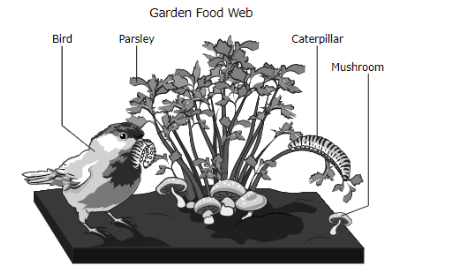
Students create a drawing of organisms in a garden. In their drawing, a bird eats a caterpillar. Another caterpillar is eating the leaves on a parsley plant. Mushrooms grow in the shadow of the parsley.


Complete the table to show the role each organism has in the food web, based on the students' drawing.
Choose the correct answer to each box.
Consumer
Decomposer
Producer
Bird
Mushroom
Caterpillar
Parsley
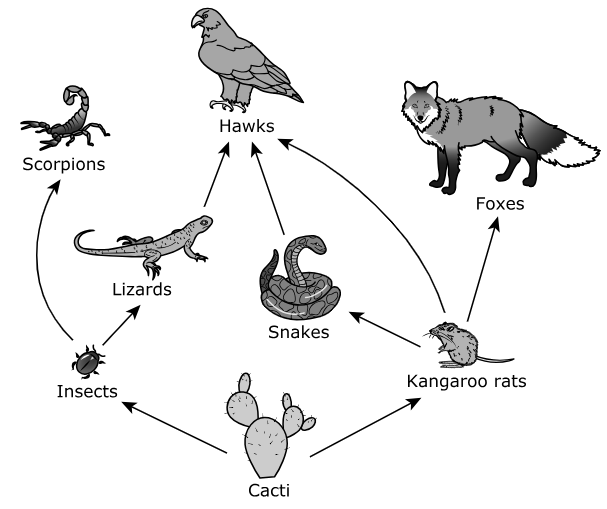
A desert food web is shown.


How many carnivores are represented in the desert food web?
2
3
4
5
Plants use the Sun's energy to manufacture —
leaves
carbon dioxide
food
water
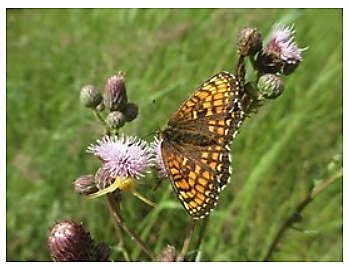
The picture shows a butterfly in a field of flowers.


What is the role of the butterfly in a food web?
It is a pollinator because it spreads plant pollen.
It is a consumer because it uses other organisms for energy.
It is a producer because it depends on plants for energy.
It is a carnivore because it eats other organisms for energy.
Question 14
14.

Axis deer are an invasive species of deer found in Texas. There are about 125,000 axis deer in Texas. Axis deer eat grasses, flowering plants, and shrubs. The diet and habitat of axis deer are often the same as those of other animals native to Texas.

Based on this information, how do axis deer most likely affect Texas ecosystems?
They cause populations of native plants to increase.
They overgraze the land, which causes soil erosion to increase.
They cause the predators of native animals to move to new locations.
They increase the availability of food, which causes an increase in herbivore populations.
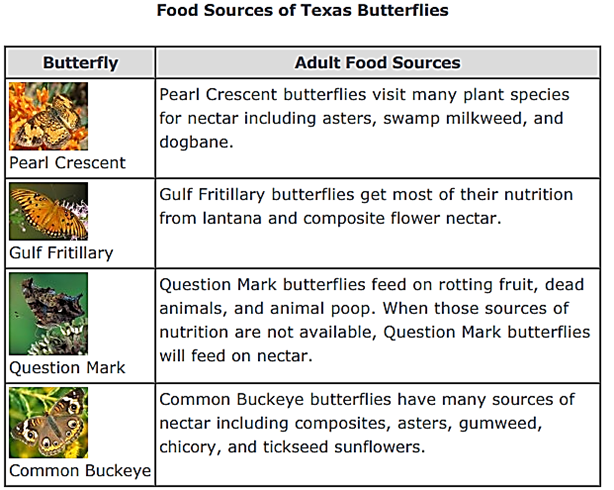
Using the information in the table, which butterfly species would be least affected by a drought that reduces the amount of available nectar?
Pearl Crescent
Gulf Fritillary
Question Mark
Common Buckeye