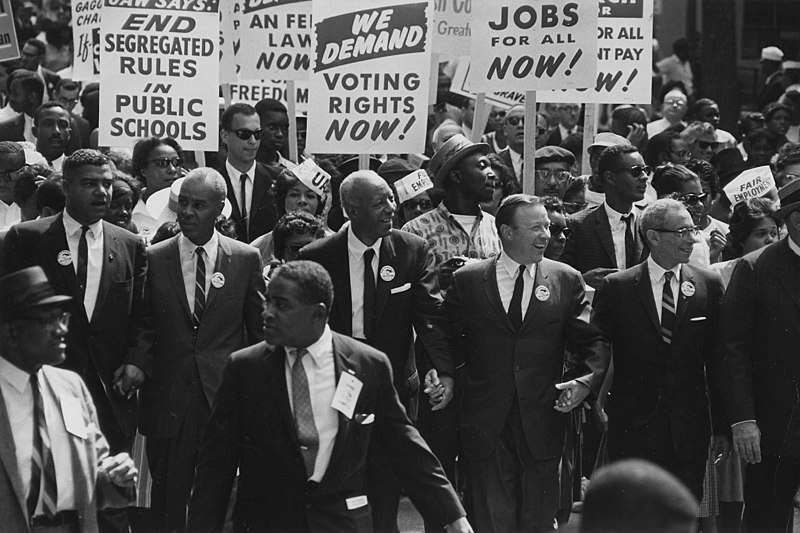
With your partner, decide who is Partner 1 and who is Partner 2. Trade off reading the paragraph. Answer the questions together. Submit your own assignment when completed.
During the Civil War, President Lincoln set in motion a series of government actions that planted the seeds of the major civil rights movement in the twentieth century. In 1863, he issued the Emancipation Proclamation, freeing slaves in the areas the Confederacy controlled. In 1865, the 13th Amendment abolished (ended) slavery throughout the nation. The 14th Amendment, ratified (approved) in 1868, granted citizenship to all persons born in the United States and promised equal rights as a citizen. The 15th Amendment, ratified in 1870, guaranteed black American men the right to vote. These amendments set the legal basis for full equality.
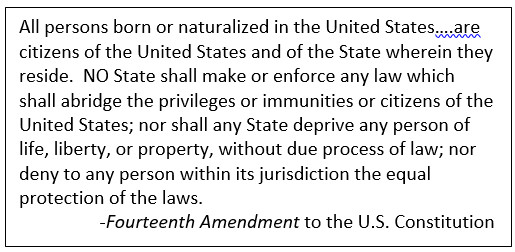
The main purpose of this amendment was to extend constitutional protections to -
After Reconstruction, southern state and local governments enacted laws that enforced racial segregation. Jim Crow laws denied black Americans equal rights. These laws prevented African Americans from sharing beaches, theaters, restaurants, railcars, and public bathrooms with whites. African American children could not attend school with white children. Jim Crow laws also set curfews for black Americans. enacting laws on signing contracts. Jim Crow laws existed in many southern states until the Civil Rights Act of 1964 and Voting Rights Act of 1965 were passed.
Which action opposed the civil rights advances that the Reconstruction amendments had promised?
Despite the 14th and 15th Amendments guaranteeing the civil rights of black Americans, their right to vote was systematically taken away by white supremacists and state governments in the south. Ignoring the15th Amendment, states deprived black Americans their voting rights by establishing poll taxes and literacy tests to make it harder for them to vote. Black voting fell off sharply because of intimidation, threats by white employers, and violence from the Ku Klux Klan, a ruthless secret organization bent on preserving white supremacy at all costs. The Ku Klux Klan and other white-supremacist organizations engaged in lynchings, beatings, and burnings to keep black Americans from having equal rights as citizens.
The 15th Amendment to the U.S. Constitution gave citizens the right to vote regardless of race, color, or former status as a slave. Later methods of depriving citizens of their 15th Amendment rights included -
After Reconstruction, Southern states passed laws requiring the segregation (keeping races separated) of races in public places. Plessy vs. Ferguson was an 1896 Supreme Court Case that upheld the constitutionality of these state segregation laws. The court ruled that "separate but equal" was constitutional. This meant states could segregate facilities to different races as long as facilities were equal, however, most times they were not. This Supreme Court case enforced segregation and was not overturned until the Brown vs. Board of Education court case in 1954.
In the late 1800s, the Supreme Court’s decision in Plessy v. Ferguson -
Ida B. Wells fought for equal rights during the Progressive Era. She advocated for equality by organizing anti-lynching campaigns. In 1909, W.E.B DuBois joined with other African Americans and whites interested in civil rights. They formed the National Advancement for the Association of Colored People, or the NAACP. The NAACP drew attention to inequality among races through existing laws and the court system. Another activist, Booker T. Washington wanted gradual equality, which was opposite to W.E.B.'s more immediate and aggressive approach. Booker wanted African Americans to have an education, focusing on vocational skills and job training. These early activists differed in their methods to achieve civil rights, similar to later civil rights leaders Martin Luther King, Jr. and Malcom X.
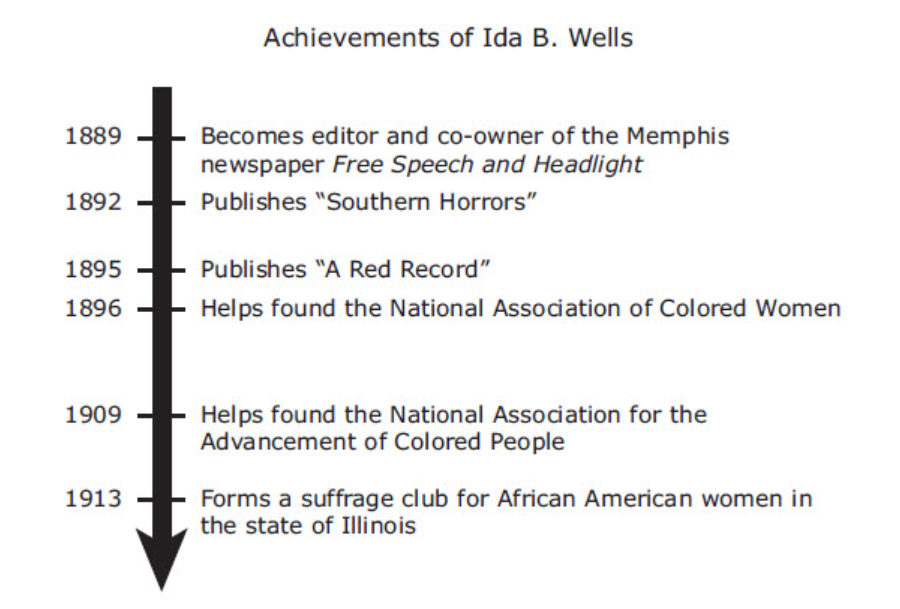
These achievements illustrate Ida B. Wells’s contributions as -
The Harlem Renaissance was a period of African American accomplishment in areas of writing, performances, music, etc. It took place in New York City and the major music contributed from the awakening was jazz. The themes of Harlem Renaissance writers and artists varied, but most focused on the African American experience and stressed racial pride and equality. The Harlem Renaissance directly contributed to the Civil Rights Movement.
Which of these cause-and-effect relationships is accurate?
Shirley Chisholm overcame gender and racial barriers to be elected to Congress. Jackie Robinson first rose to national prominence in the late 1940s when he helped bring an end to racial segregation in Major League Baseball.
Which statement describes one of Shirley Chisholm's most celebrated accomplishment?
Black Americans have been serving in American wars since the Revolutionary War. However, due to racism and discrimination, most black soldiers were not placed in active combat roles. Despite the contributions of segregated black units, it wasn't until 1944 that the army allowed black soldiers to engage in combat. The Tuskegee Airmen were a segregated unit of black pilots and airmen that fought in WWII. In 1947, Harry Truman addressed the struggle for equal rights at a meeting of the NAACP and promised action. In 1948, he signed Executive Order 9981 that finally desegregated the armed forces.
This excerpt is from an executive order issued by President Harry Truman in 1948. Which selection supports the idea that Executive Order 9981 served as a major catalyst for the Civil Rights Movement?
It is hereby declared to be the policy of the President that there
- President Harry Truman, Executive Order 9981, 1948
The following excerpt is from a letter to the editor published in a newspaper. Select ONE correct answer in each box to complete each sentence.

As a response to concerns like the one expressed in the excerpt, Harry S. Truman, issued in 1948. This action by Truman
Martin Luther King Jr. supported civil disobedience, nonviolent resistance, and desegregation. Ways that Martin Luther King tried to fight inequality was by protesting, strikes, boycotts and marches to challenge unethical and unjust laws. King helped organize the Southern Christian Leadership Conference, or the SCLC. The SCLC organized nonviolent protests across the country. Another civil rights organization that used civil disobedience was the Student Nonviolent Coordinating Committee, or the SNCC. The SNCC staged sit-ins at all white lunch counters, prompting sit-ins across the south.
Why was Martin Luther King, Jr., chosen as Time magazine’s 1963 “Man of the Year”?
While King worked with the SCLC, Malcolm X adopted a more militant approach to the Civil Rights Movement. Militant black activists, such as Malcolm X, denounced the nonviolent resistance of King and other moderate civil rights leaders. One militant group was the Black Panther Party, formed in 1966 by Huey P. Newton. It issued a ten-point program that called for an end to police brutality, payments to African Americans for centuries of suffering, etc. They dressed in uniforms or military-style clothing and sometimes carried weapons to defend their community. They focused on black separatism rather than pursuing integration.
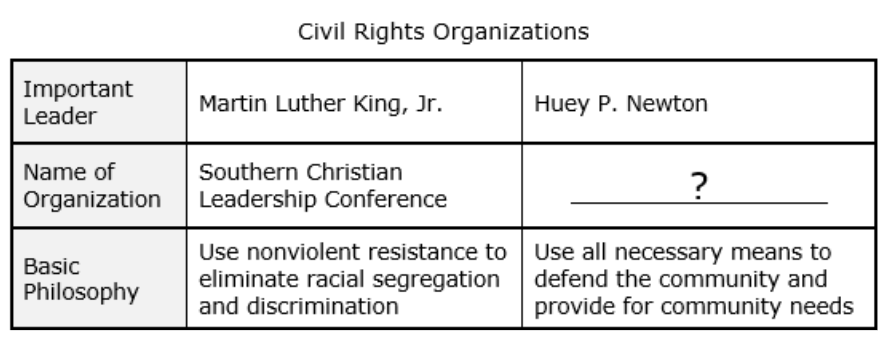
Which organization’s name correctly completes this table?
Rosa Parks refused to give up her seat on the bus to a white passenger in Montgomery, Alabama. Example of nonviolent protest and best example of civil disobedience. In response to Rosa Park’s arrest, African Americans began boycotting the Montgomery bus system. This boycott lasted over a year (thirteen months) and challenged segregation on public transportation. Freedom Rides were a series of protests throughout the south which sought to overturn racial segregation on public transportation. The Supreme Court had previously ruled segregation as unconstitutional, but laws were seldom enforced.
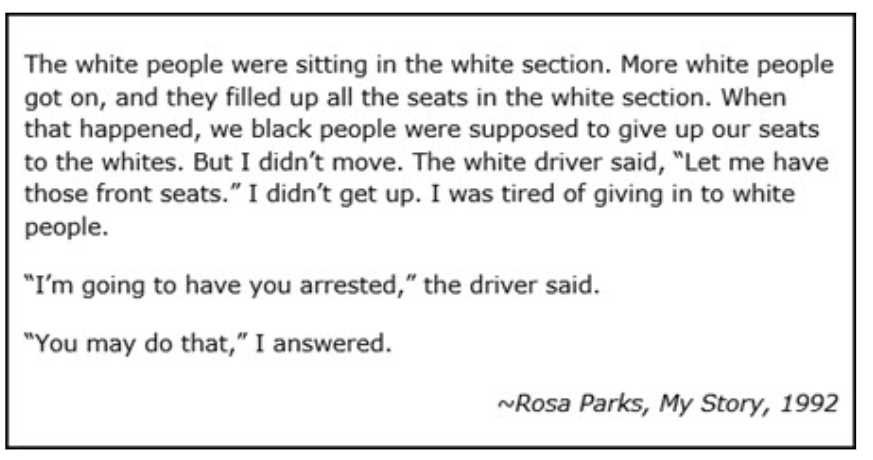
How did the event described by Rosa Parks in this excerpt affect the Civil Rights movement?
In reaction to the passage of the 13th, 14th, and 15th Amendments to the U.S. Constitution, many states passed Jim Crow laws. The purpose of these laws was to -
During the early 1900s, Booker T. Washington supported a moderate strategy for attaining civil rights for black Americans, while W.E.B. DuBois called for a more aggressive, immediate approach. During the 1960s, a similar difference emerged between -
Jackie Robinson first rose to national prominence in the 1940s when he -
The Civil Rights movement’s strategy of nonviolent protest and civil disobedience was most widely advocated throughout the 1960s by -

Which organizations correctly complete this table?
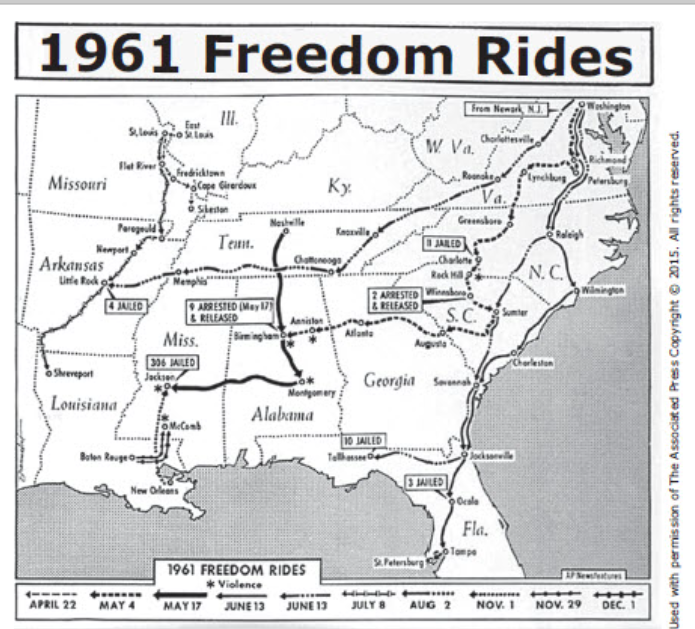
What was the goal of the protests depicted on this map?