Civil Rights Nonviolent Resistance

Last updated almost 2 years ago
10 questions

Vocabulary

Nonviolent Resistance - the practice of achieving goals such as social change through symbolic protests

Civil Disobedience - the refusal to obey the demands or commands of a government or business, without resorting to violence

Militant Activism - individuals who want to bring about change through armed self-defense

Brown v. Board of Education

The infamous Supreme Court case determined that segregation in public school was unconstitutional because it was an unequal education. Thurgood Marshall, a civil rights lawyer, argued the case for the NAACP in May 1954. The Brown v. Board of Education decision overturned Plessy v. Ferguson and marked the end of legal segregation in public schools. The court held that desegregation in public schools should be conducted with "deliberate speed", although many states in the south delayed the court's order to desegregate schools. Brown v. Board of Education was a key turning point in the Civil Rights Movement.
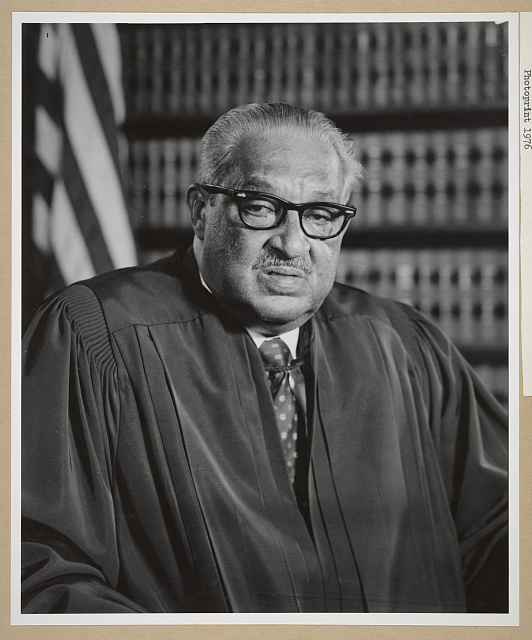
Thurgood Marshall would later become the first black Supreme Court Justice.
Required
2
Brown v. Board of Education overturned __________, resulting in the __________ of public schools.

Montgomery Bus Boycott

The Montgomery Bus Boycott was a nonviolent protest that took place from December 5, 1955 to December 20, 1956 in Montgomery, Alabama. In 1955, African Americans were required by city ordinance to sit in the back half of the bus, and to yield their seats to white riders.

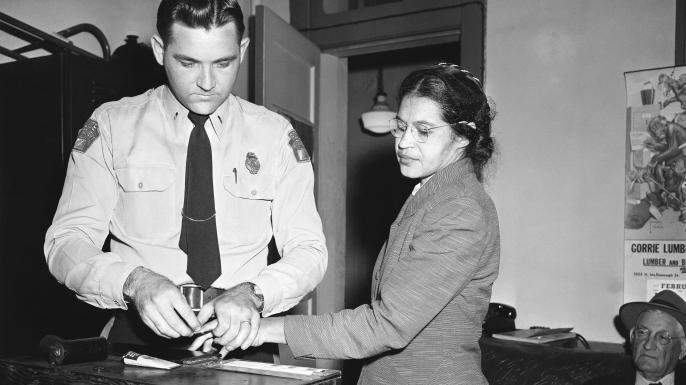
On December 1, 1955, Rosa Parks refused to give up her seat to a white rider. Parks was arrested and fined for her actions (her actions were a type of nonviolent resistance called civil disobedience). In response, a new minister in town, Martin Luther King, Jr. organized a boycott of city buses. African Americans chose to walk, ride bikes, and carpool. African Americans made up 75% of Montgomery's bus riders. The boycott immensely impacted the city's bus revenue and drew national publicity. On December 20, 1955 the US Supreme Court ruled that state or local laws that segregated seating on buses was unconstitutional.
Required
1

Whose civil disobedience and subsequent arrest led to the Montgomery Bus Boycotts?

The Little Rock Nine

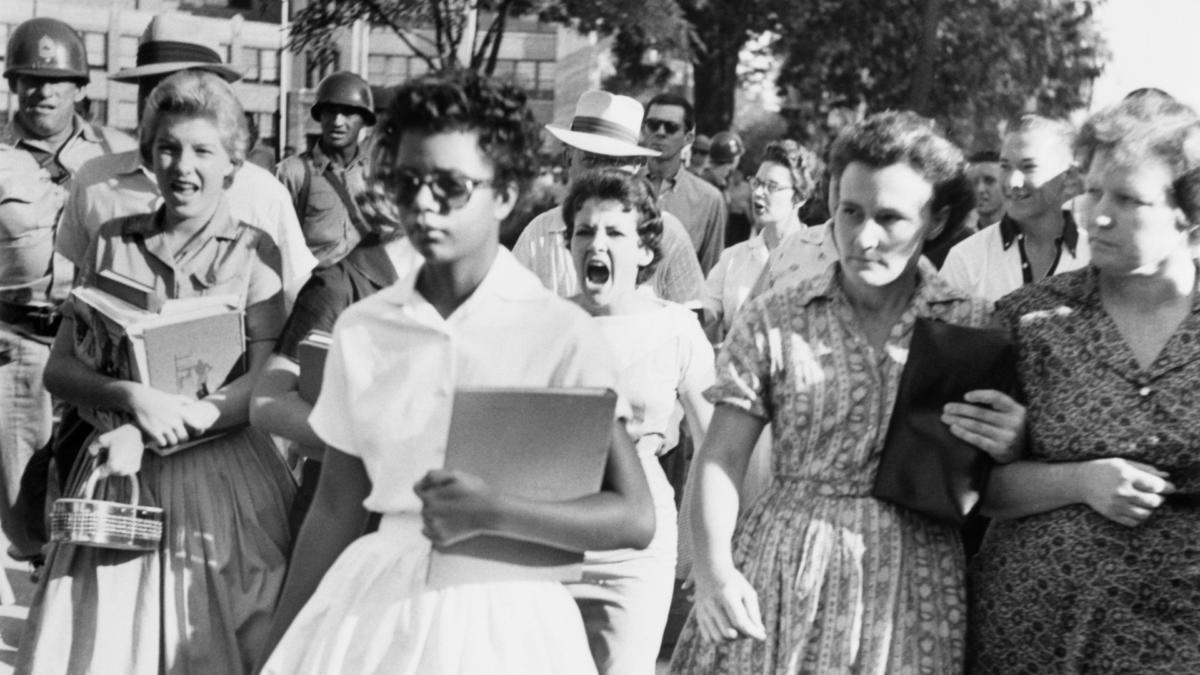
The Civil Rights Movement scored a tremendous victory in 1954 when the US Supreme Court ruled in the case of Brown v. Board of Education that segregation of public schools is illegal. On September 3, 1957, nine African American students, known as the Little Rock Nine, arrived at Central High School - a formerly segregated school - in Little Rock, Arkansas to begin their classes.

They were met with a threatening mob of white protesters. Arkansas Governor Orval Faubus had also sent the Arkansas National Guard to block the students from entering the school. President Dwight Eisenhower ordered Faubus to allow the students in, but Faubus ignored the order. A couple of weeks later the Little Rock Nine tried again and made it into the school. Violence erupted and their safety was threatened so Eisenhower sent federal troops to escort the students to class. The Little Rock Nine faced constant harassment and discrimination, however, their courageous actions drew national attention to the issue of desegregation.
Required
2

Which two statements are true about the confrontation centered around the Little Rock Nine?

Lunch Counter Sit-Ins

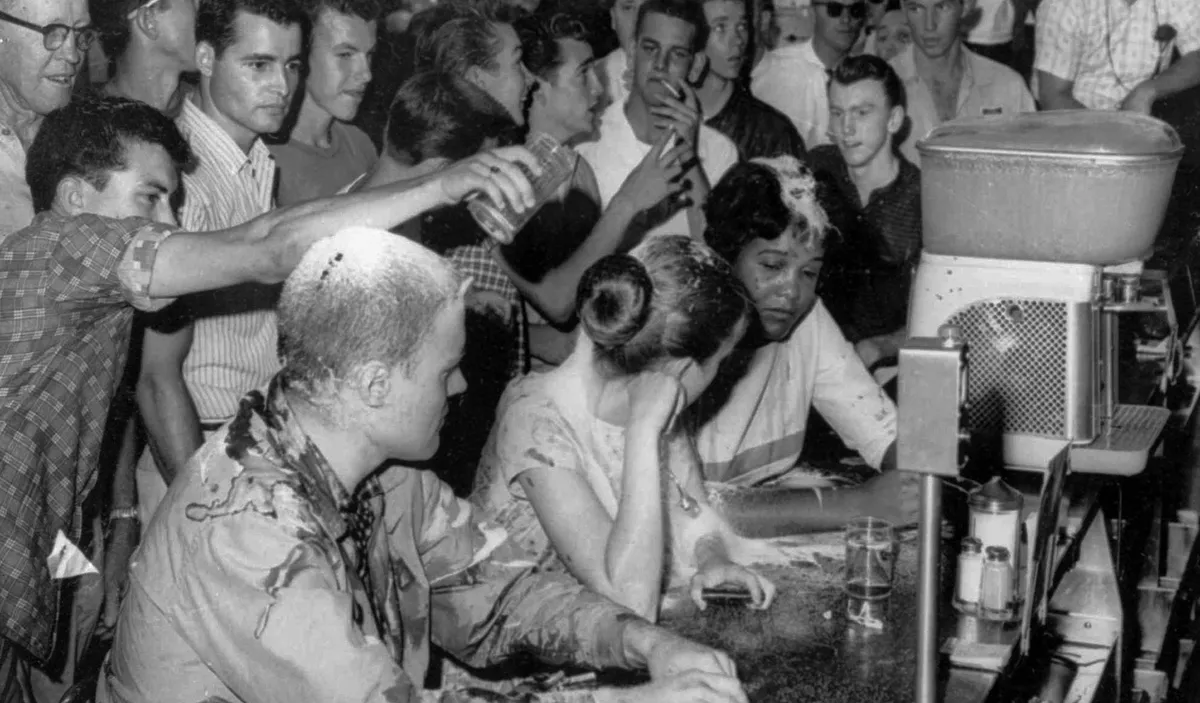
One of the most efficient forms of nonviolent protest was the sit-in, or sitting in protest. On February 1, 1960, four black students sat at a whites-only lunch counter in Greensboro, North Carolina. Although the lunch counter staff refused to serve them, the students returned each day with more and more people.

The students were often taunted, shoved, and bombarded with food. The Student Nonviolent Coordinating Committee (SNCC) was formed to organize sit-ins across the south. Eventually the store owners desegregated their businesses to prevent further disruption. Sit-ins aroused sympathy from Americans as they watched the protesters being harassed on the television.
Required
1

What type of nonviolent resistance are sit-ins?

Freedom Riders

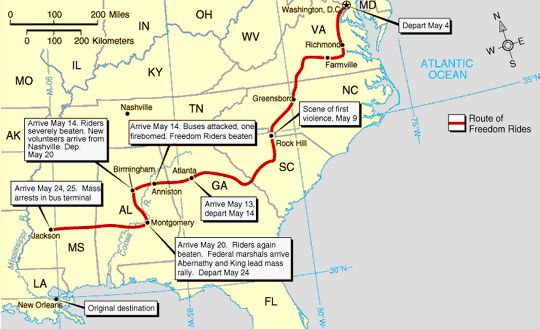
In May 1961, the Congress of Racial Equality (CORE) sent blacks and whites to ride together as Freedom Riders on interstate buses to segregated stations in the south. They planned to refuse to obey racial restrictions. The Freedom Riders faced some violent attacks, but they continued riding. When Freedom Riders approached Anniston, Alabama they were met by an angry mob of 200 white people. The mob threw a bomb on the bus, but the Freedom Riders escaped the burning bus. Despite escaping the bus, they were beaten by the mob. Photographs of the burning bus and bloodied Freedom Riders appeared in newspapers across the country. Later that year, the Interstate Commerce Commission began enforcing desegregation in bus depots. Another nonviolent protest worked.

Required
2
Freedom Riders proved that __________ worked when the Interstate Commerce Commission began enforcing __________ in bus depots.

March on Birmingham

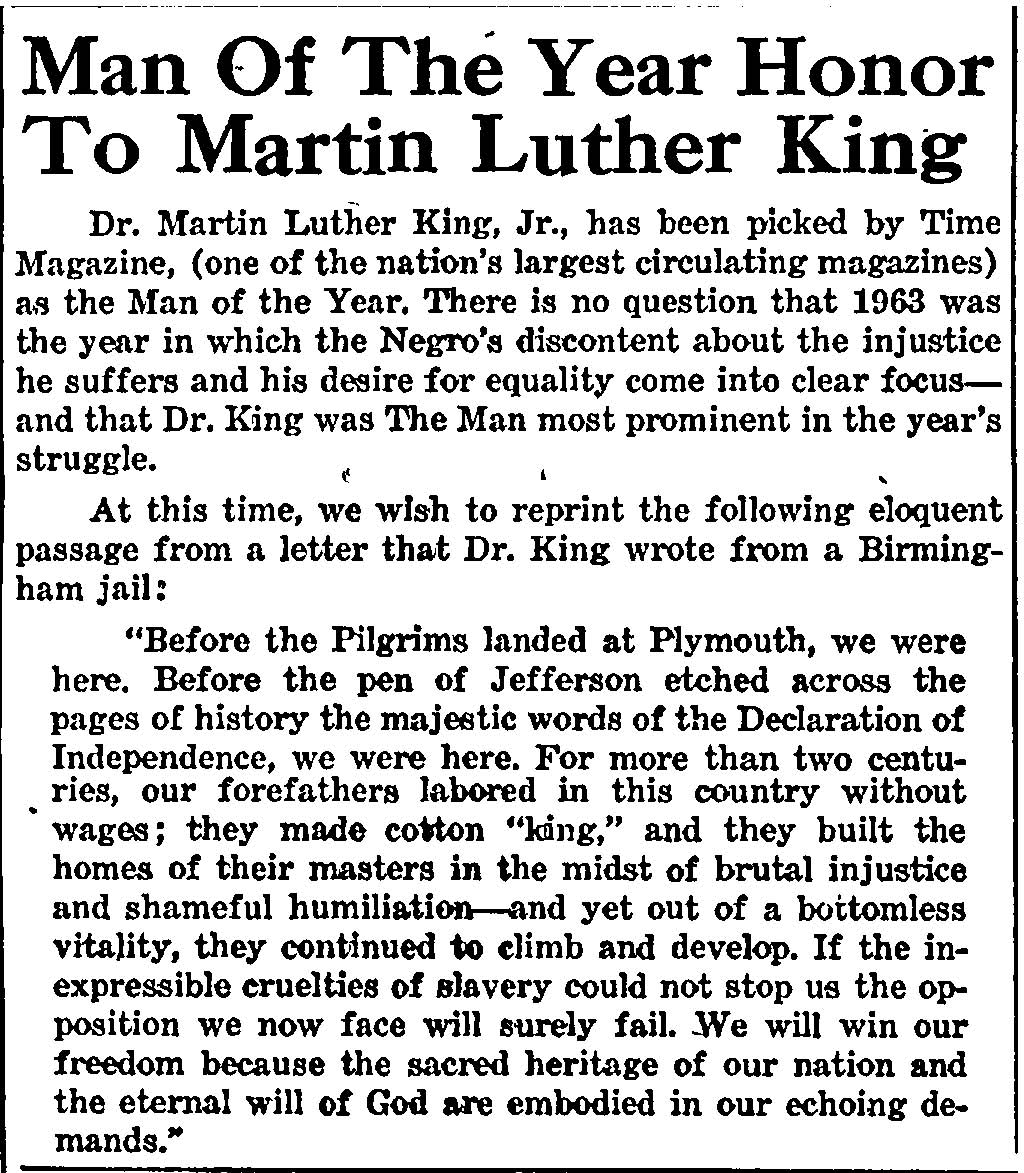
In the spring 1963, the Southern Christian Leadership Conference (SCLC), founded by MLK, staged a major nonviolent protest in Birmingham, Alabama. Its members urged business owners to end segregation in restaurants, stores, and facilities. Birmingham police attacked nonviolent protesters with high-pressure water hoses and police dogs. When the news shared images of the violence on television, the public was shocked. During these protests, MLK was arrested and spent over a week in jail. It was during this time that he wrote his famous "Letter From a Birmingham Jail", in which he laid out his philosophy of nonviolence.


Required
1

What is the reason the article gives for MLK being chosen as Time Magazine's Man of the Year?

March on Washington

JFK spoke on television about the need for civil rights and introduced a bill on the issue. In support of this bill, MLK led 250,000 people in the March on Washington on August 28, 1963. During this march, MLK gave his famous "I Have a Dream" speech on the steps of the Lincoln Memorial.

Required
2
"I have a _______ that one day this nation will rise up and live out the true meaning of its creed: "We hold these truths to be self-evident, that all men are created _______ ."

Selma to Montgomery March

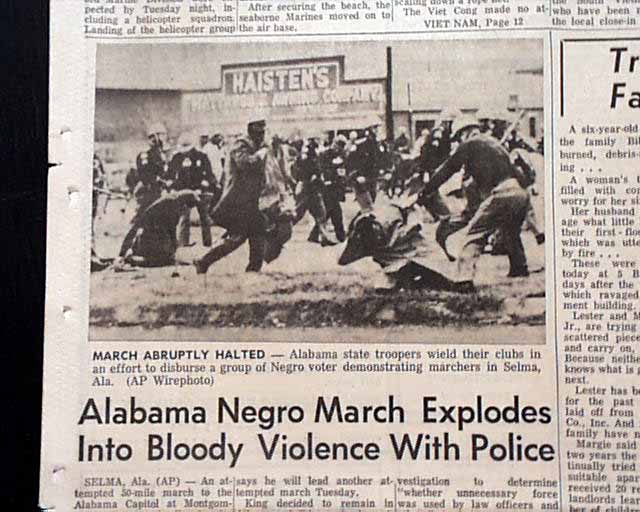
Once desegregation became federal law, the civil rights movement tackled voting rights. In the summer of 1964, after the 24th Amendment banned poll taxes and literacy tests, the SNCC organized voter registration drives to register black voters. During these voter registration drives, three black students were murdered by the Ku Klux Klan.

On March 7, 1965, MLK and the SCLC led a 54-mile march from Selma, Alabama to the state capital of Montgomery to support the voter registration drives. 600 nonviolent protesters attempted to cross the Edmund Pettus Bridge, however, law enforcement officers - wielding whips, clubs and tear gas - rushed the protesters, beating them back after they passed over the county line. The brutal scene was captured on television, enraging many Americans. The event became known as “Bloody Sunday.”
Required
1

What did all of these Civil Rights events have in common?

Nonviolence Opposition

Some civil rights leader, such as Malcolm X, blamed the slow pace of reform on nonviolence protests and civil disobedience. He proposed a more militant approach, that blacks should embrace violence for self-defense and separate to form their own society. Although Malcolm X was assassinated in 1965, he inspired the Black Power Movement, which SNCC leader Stokely Carmichael popularized. The Black Power Movement promoted cultural pride, racial equality, and justice. Huey P. Newton founded the Black Panther Party, which carried arms and demanded equality in housing, education, and employment.

However, as nonviolent protests lost momentum, the frustration about the slow pace of change created unrest. Race riots took place in major urban areas, like Watts (in Los Angeles), Harlem, Chicago, and Detroit every summer from 1965 to 1968. When MLK was assassinated on April 4, 1968, massive waves of looting and violent rioting broke out across the nation.
Required
9

Categorize these events as school integration efforts, peaceful protests, or militant activism

  • Lunch Counter Sit-Ins
  • March on Washington
  • Black Panthers
  • Brown v Board of Education
  • Montgomery Bus Boycotts
  • Freedom Riders
  • Little Rock Nine
  • Race Riots
  • Black Power Movement
  • Nonviolent Resistance
  • Militant Activism
  • School Integration Efforts
Required
0

Write a paragraph that addresses these questions:

A. Why do you think nonviolent protests and civil disobedience were so effective?
B. How did the media (newspapers, television, radio) influence public opinion of the Civil Rights Movement?