In this lesson we will practice skills to help us graph polynomial functions.
1 point
1
Question 1
1.
Review Inputs/Outputs for Linear Equations
Complete the T-Chart to find coordinates and use the coordinates to graph the line.
1 point
1
Question 2
2.
Review Inputs/Outputs for Linear Equations
Complete the T-Chart to find coordinates and use the coordinates to graph the line.
1 point
1
Question 3
3.
Review Inputs/Outputs for Linear Equations
Complete the T-Chart to find coordinates and use the coordinates to graph the line.
1 point
1
Question 4
4.
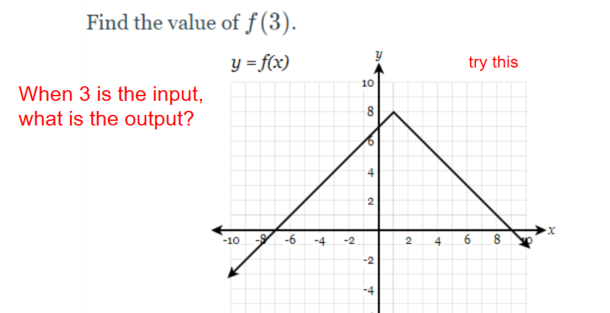
Evaluate Functions From a Graph
Use the graph to find the value of y when x = 3.
f(3) = _______
1 point
1
Question 5
5.
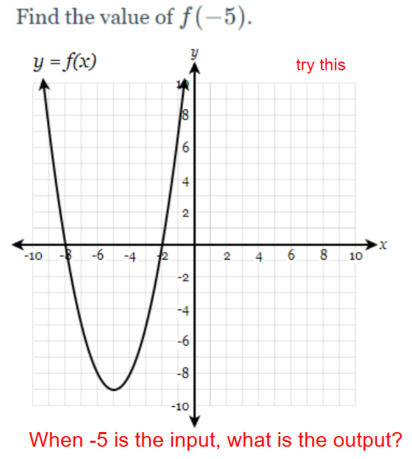
Evaluate Functions From a Graph
Use the graph to find the value of y when x = -5.
f(-5) = _______
1 point
1
Question 6
6.
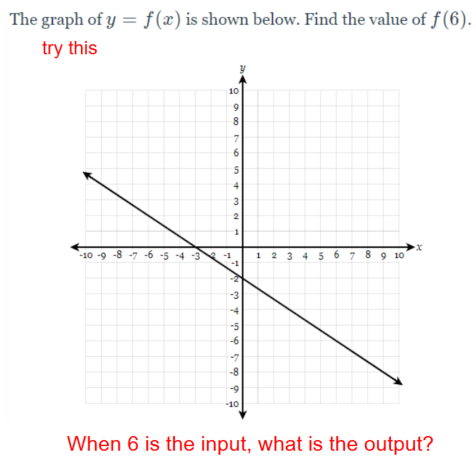
Input vs. Output on a Graph
f(6) = _______
1 point
1
Question 7
7.
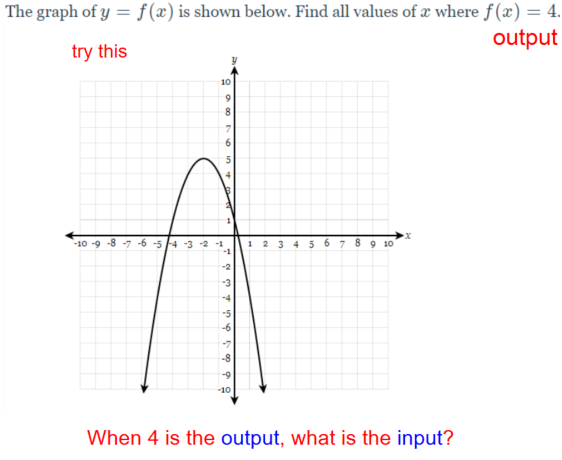
Input vs. Output on a Graph
x = _______ , when f(x) = 4.
1 point
1
Question 8
8.
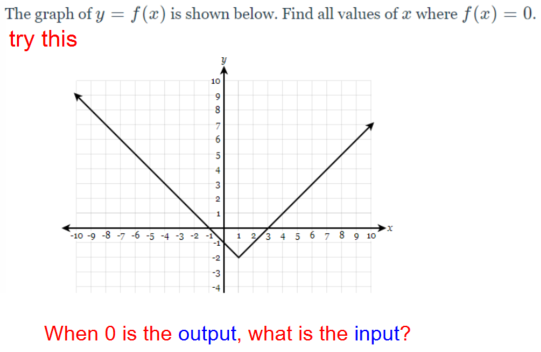
Input vs. Output on a Graph
x = _______ , when f(x) = 0.
VOCABULARY
1 point
1
Question 9
9.
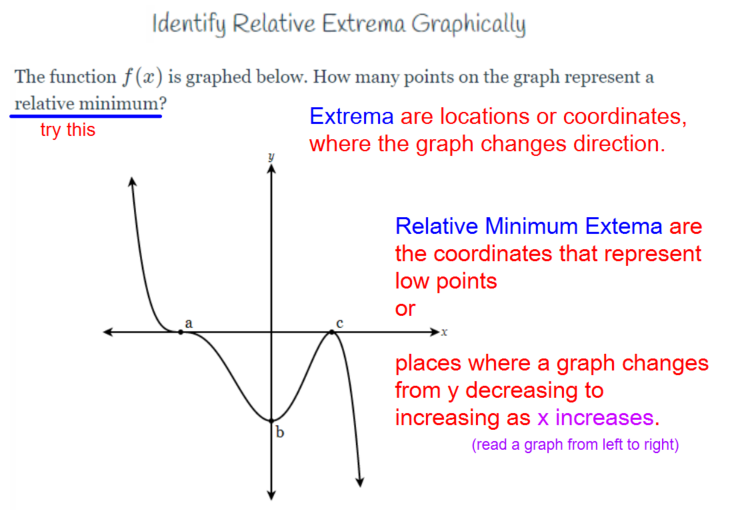
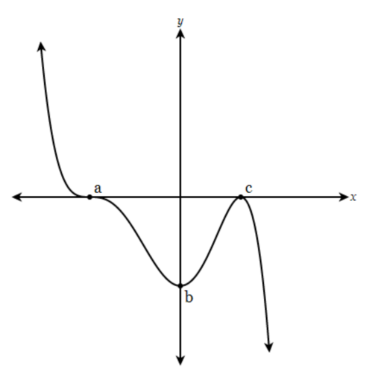
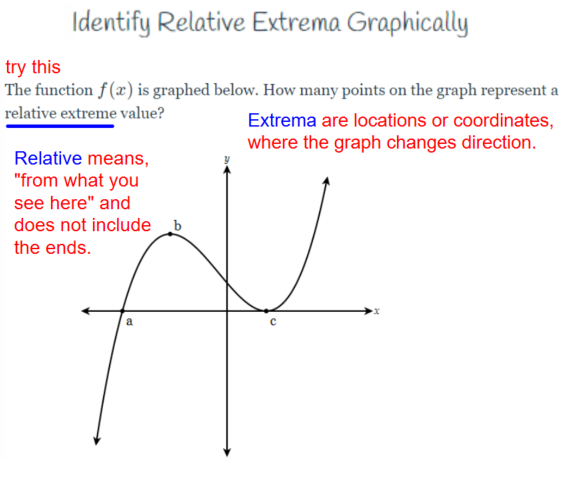
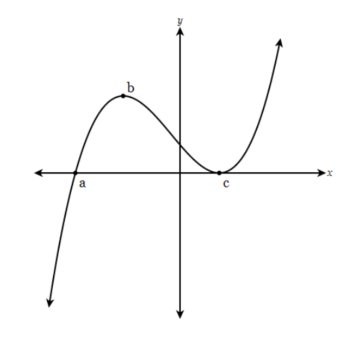
The function f(x) is graphed below. How many points on the graph represent a relative minimum?
1 point
1
Question 10
10.
The function f(x) is graphed below. How many points on the graph represent a relative extrema?
1 point
1
Question 11
11.
Identify the graph that represents a quadratic function:
1 point
1
Question 12
12.
Which of the following is an example of a quadratic function?
1 point
1
Question 13
13.
What is the axis of symmetry of a quadratic function?
1 point
1
Question 14
14.
The equation 𝑦 = (𝑥 − 2)2 represents a quadratic function.
What is the vertex of this function?
1 point
1
Question 15
15.
Which is NOT a possible number of solutions to a quadratic equation?
1 point
1
Question 16
16.
Which of the following represents a quadratic function in standard form?
1 point
1
Question 17
17.
What is the shape of the graph of a quadratic function?
1 point
1
Question 18
18.
Which of the following is NOT a characteristic of a quadratic function?
1 point
1
Question 19
19.
A ball is thrown into the air with an initial velocity of 30 meters per second. The height of the ball (in meters) can be modeled by the quadratic function ℎ(𝑡) = −5𝑡 2 + 30𝑡 + 5, where t represents time in seconds. Determine the maximum height the ball reaches and the time it takes to reach that height.
Solution:
The maximum height would be _______ meters at _______ seconds.
1 point
1
Question 20
20.
A model rocket is launched from the ground with an initial velocity of 40 meters per second. The height of the rocket (in meters) above the ground after 𝑡 seconds is given by the function ℎ(𝑡) = −5𝑡 2 + 40𝑡.
a. Determine the maximum height the ball reaches and the time it takes to reach that height.
Solution:
The maximum height would be _______ meters at _______ seconds.
b. Determine the time it takes for the rocket to reach the ground after being launched.
Solution:
The rocket will return to the ground at _______ seconds.
1 point
1
Question 21
21.
A ball is thrown off a cliff with an initial velocity of 25 meters per second. The height of the ball (in meters) above the ground after 𝑡 seconds is given by the function
ℎ(𝑡) = −4.9𝑡 2 + 25𝑡 + 20. (Round answers to the nearest tenth.)
a. Determine the maximum height the ball reaches and the time it takes to reach that height. (Round answers to the nearest tenth.)
Solution:
The maximum height would be _______ meters at _______ seconds.
b. Determine the time it takes for the rocket to reach the ground after being launched. (Round answers to the nearest tenth.)
Solution:
The rocket will return to the ground at _______ seconds.
1 point
1
Question 22
22.
A farmer is constructing a rectangular pen for his animals. He wants to enclose a total area of 200 square meters using one side of the pen as a barn wall. The width of the pen (in meters) is represented by the quadratic function 𝑤(𝑥) = 𝑥 2 − 6𝑥 + 8, where x represents the length of the pen. Determine the dimensions of the pen that will maximize the width.