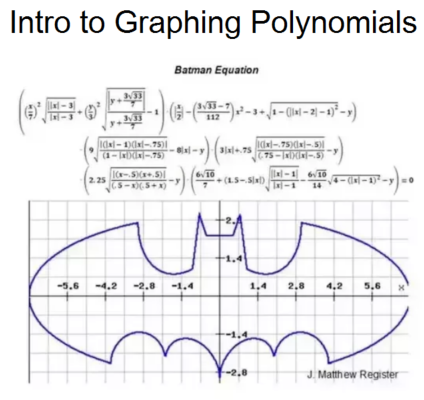
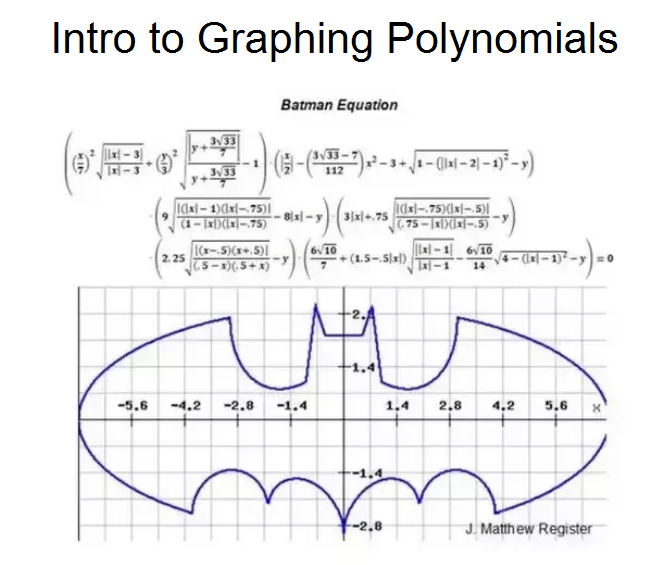
In this lesson we will practice skills to help us graph polynomial functions.
Review Inputs/Outputs for Linear Equations
Complete the T-Chart to find coordinates and use the coordinates to graph the line.
Review Inputs/Outputs for Linear Equations
Complete the T-Chart to find coordinates and use the coordinates to graph the line.
Review Inputs/Outputs for Linear Equations
Complete the T-Chart to find coordinates and use the coordinates to graph the line.
Evaluate Functions From a Graph
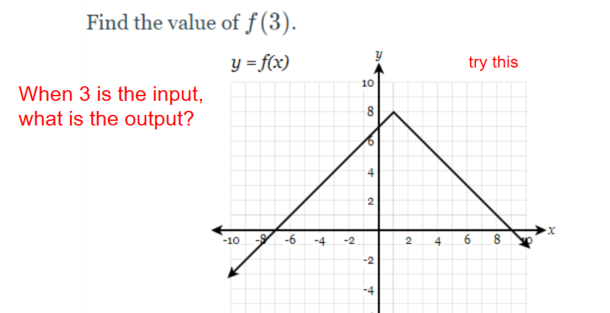
Use the graph to find the value of y when x = 3.
f(3) =
Evaluate Functions From a Graph
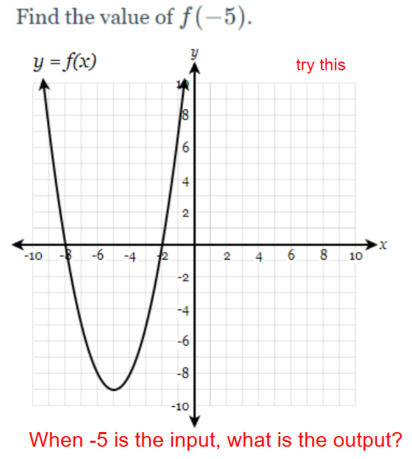
Use the graph to find the value of y when x = -5.
f(-5) =
Input vs. Output on a Graph
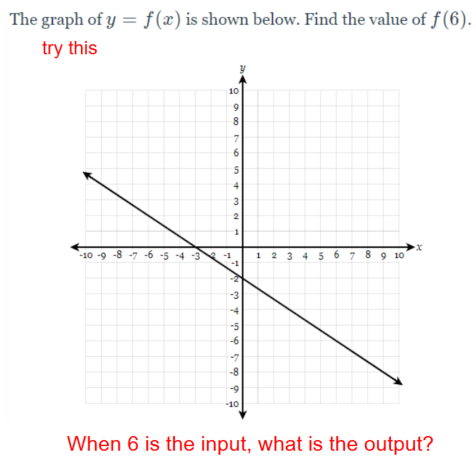
f(6) =
Input vs. Output on a Graph
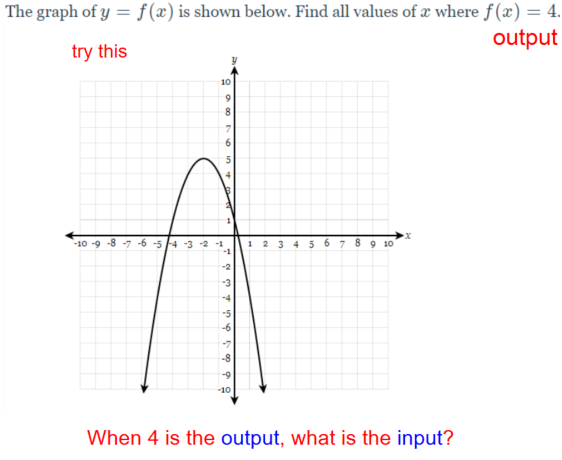
x =
Input vs. Output on a Graph
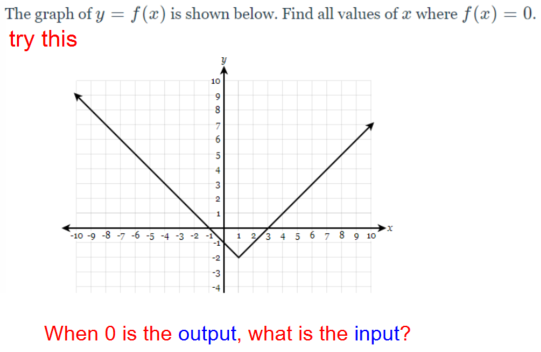
x =
VOCABULARY
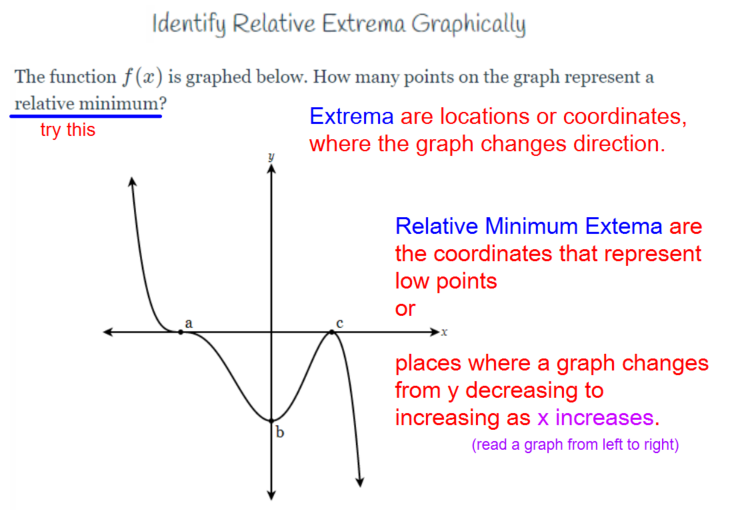
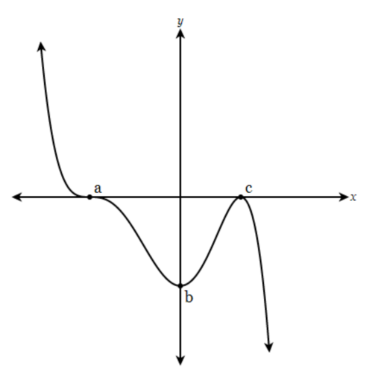
The function f(x) is graphed below. How many points on the graph represent a relative minimum?
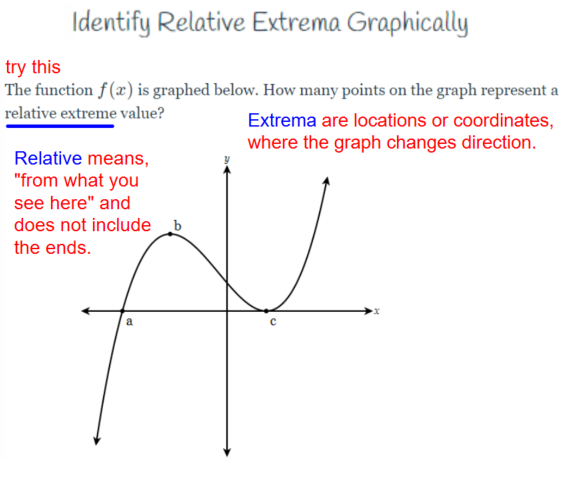
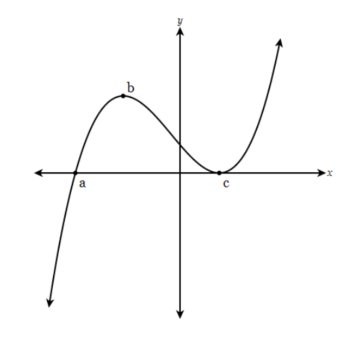
The function f(x) is graphed below. How many points on the graph represent a relative extrema?
Identify the graph that represents a quadratic function:
Which of the following is an example of a quadratic function?
What is the axis of symmetry of a quadratic function?
The equation π¦ = (π₯ β 2)2 represents a quadratic function.
What is the vertex of this function?
Which is NOT a possible number of solutions to a quadratic equation?
Which of the following represents a quadratic function in standard form?
What is the shape of the graph of a quadratic function?
Which of the following is NOT a characteristic of a quadratic function?
A ball is thrown into the air with an initial velocity of 30 meters per second. The height of the ball (in meters) can be modeled by the quadratic function β(π‘) = β5π‘ 2 + 30π‘ + 5, where t represents time in seconds. Determine the maximum height the ball reaches and the time it takes to reach that height.
Solution:
The maximum height would be
A model rocket is launched from the ground with an initial velocity of 40 meters per second. The height of the rocket (in meters) above the ground after π‘ seconds is given by the function β(π‘) = β5π‘ 2 + 40π‘.
a. Determine the maximum height the ball reaches and the time it takes to reach that height.
Solution:
The maximum height would be
b. Determine the time it takes for the rocket to reach the ground after being launched.
Solution:
The rocket will return to the ground at
A ball is thrown off a cliff with an initial velocity of 25 meters per second. The height of the ball (in meters) above the ground after π‘ seconds is given by the function
β(π‘) = β4.9π‘ 2 + 25π‘ + 20. (Round answers to the nearest tenth.)
a. Determine the maximum height the ball reaches and the time it takes to reach that height. (Round answers to the nearest tenth.)
Solution:
The maximum height would be
b. Determine the time it takes for the rocket to reach the ground after being launched. (Round answers to the nearest tenth.)
Solution:
The rocket will return to the ground at
A farmer is constructing a rectangular pen for his animals. He wants to enclose a total area of 200 square meters using one side of the pen as a barn wall. The width of the pen (in meters) is represented by the quadratic function π€(π₯) = π₯ 2 β 6π₯ + 8, where x represents the length of the pen. Determine the dimensions of the pen that will maximize the width.
(Round your answers to the nearest tenth.)
Solution:
The length of the pen is
The width of the pen is