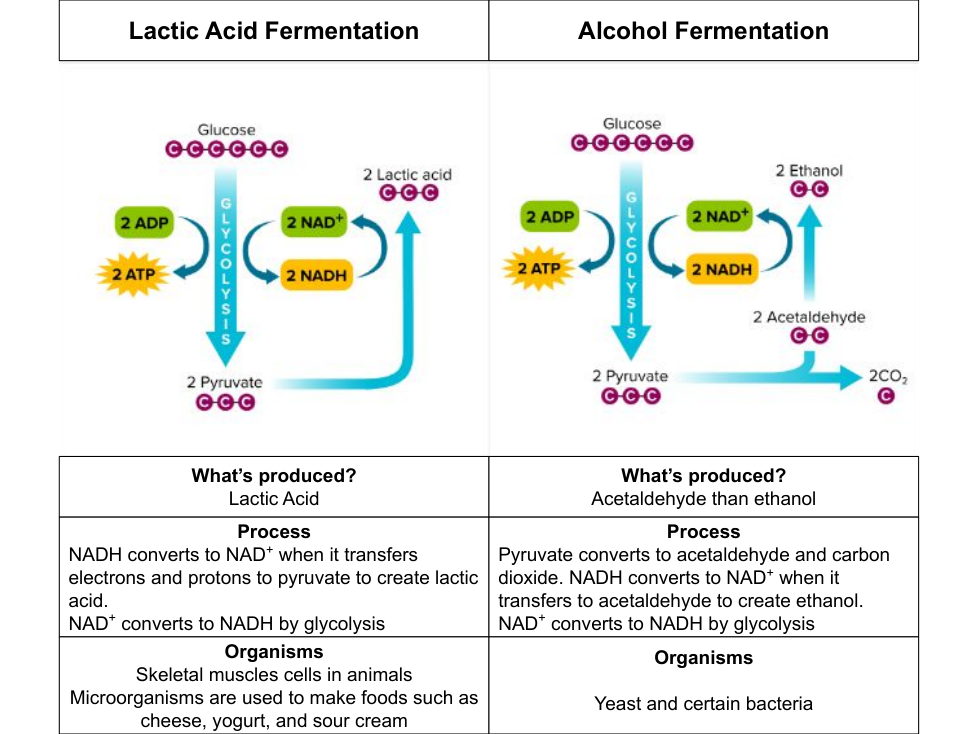
When oxygen levels are low, like during a sprint, your body will attempt to create more energy anaerobically. Because the products for glycolysis eventually run out, there is a secondary process called fermentation that helps to replenish those products, and allows some cells to function for a short period of time when oxygen levels are low. During fermentation, the pyruvate made during glycolysis converts to lactic acid, which can build up in your muscles, causing soreness and fatigue.
Some prokaryotes are anaerobic organisms-they grow and reproduce without oxygen. In some cases, these cells continue to produce ATP through glycolysis. However, there are problems with solely relying on glycolysis for energy. Glycolysis provides only 2 net ATP for each molecule of glucose, and a cell has a limited amount of NAD+.. Glycolysis will stop when all the NAD+ is used up if there is not a process to replenish NAD+. The anaerobic pathway that follows glycolysis is anaerobic respiration, or fermentation. Fermentation occurs in the cytoplasm and regenerates the cell's supply of NAD+ while producing a small amount of ATP. The two main types of fermentation are lactic acid fermentation and alcohol fermentation.
Lactic Acid Fermentation
In lactic acid fermentation, enzymes convert the pyruvate made during glycolysis to lactic acid. This involves the transfer of high-energy electrons and protons from NADH to lactic acid molecules. In the process, NADH is converted to NAD+. Skeletal muscles produce lactic acid when the body cannot supply enough oxygen, such as during periods of strenuous exercise. When lactic acid builds up in muscle cells, muscles become fatigued and might feel sore. Lactic acid also is produced by several microorganisms that are used to produce many foods, including cheese, yogurt, and sour cream.
What is the byproduct of lactic acid fermentation in cells?
During intense exercise, lactic acid fermentation occurs in muscles to...
Which type of respiration does not require oxygen?
Lactic acid fermentation occurs when there is a lack of...
What is the main product of alcohol fermentation in cells?
What is the end goal of alcohol fermentation in organisms?
Both lactic acid fermentation & alcohol fermentation regenerate NAD+.
An organism can go long periods of time without oxygen by resorting to lactic acid fermentation.
done by yeast
produces lactic acid
done by skeletal muscles
regenerates NAD+
produces alcohol
anaerobic
Lactic acid fermentation
Alcohol fermentation