Log in
Sign up for FREE
arrow_back
Library
Trouble (Poetry)
By Jovana Menkevich
star
star
star
star
star
Share
share
Last updated almost 2 years ago
12 questions
Add this activity
1
1
1
1
1
1
1
1
1
1
1
zoom_in
Question 1
1.
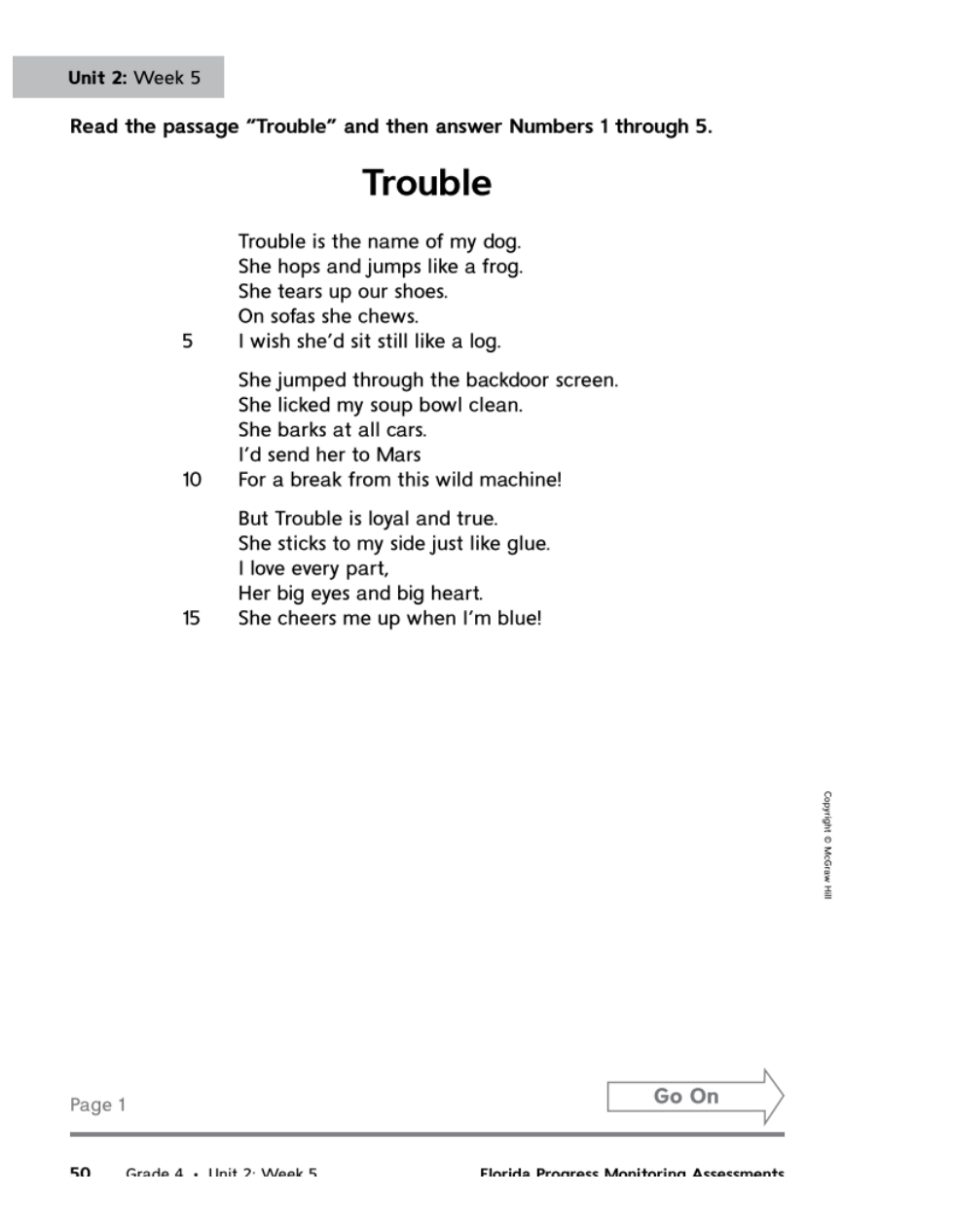
Read lines 8-9 from the passage.
"She
barks
at all
cars.
I'd send her to
Mars.
Which
two
effects does this use of assonance have on the feel of the poem?
It creates internal rhyme.
It links the stanzas together.
It supports the lighthearted tone.
It exaggerates the words' meaning.
It presents the speaker's perspective.
Question 2
2.
Which phrase describes the speaker's perspective in the poem?
Dogs may cause problems, but they are great friends.
Dogs are a lot to handle, so they aren't worth having.
Dogs destroy things, so they should be kept in a cage.
Dogs are wild animals, but they are easy to train as pets.
Question 3
3.
Which lines from the poem support the answer in question 2?
She tears up our shoes./ On sofas she chews. (lines 3-4)
She jumped through the backdoor screen/ She licked my soup bowl clean. (lines 6-7)
She barks at all cars/ I'd send her to Mars. (lines 8-9)
But Trouble is loyal and true/ She sticks to my side just like glue. (lines 11-12)
Question 4
4.
Why does the author say that Trouble hops and jumps "like a frog"?
to show how Trouble feels
to show how Trouble looks
to show how Trouble smells
to show how Trouble sounds
Question 5
5.
Select
two
sentences that describe what the speaker thinks about Trouble.
Trouble is loyal.
Trouble acts lazy.
Trouble behaves well.
Troubles was trained well.
Trouble causes problems.
zoom_in
1
Question 7
7.
What type of figurative language does the poet use in question 6?
metaphor
onomatopoeia
personification
simile
Question 8
8.
Read the lines from the passage.
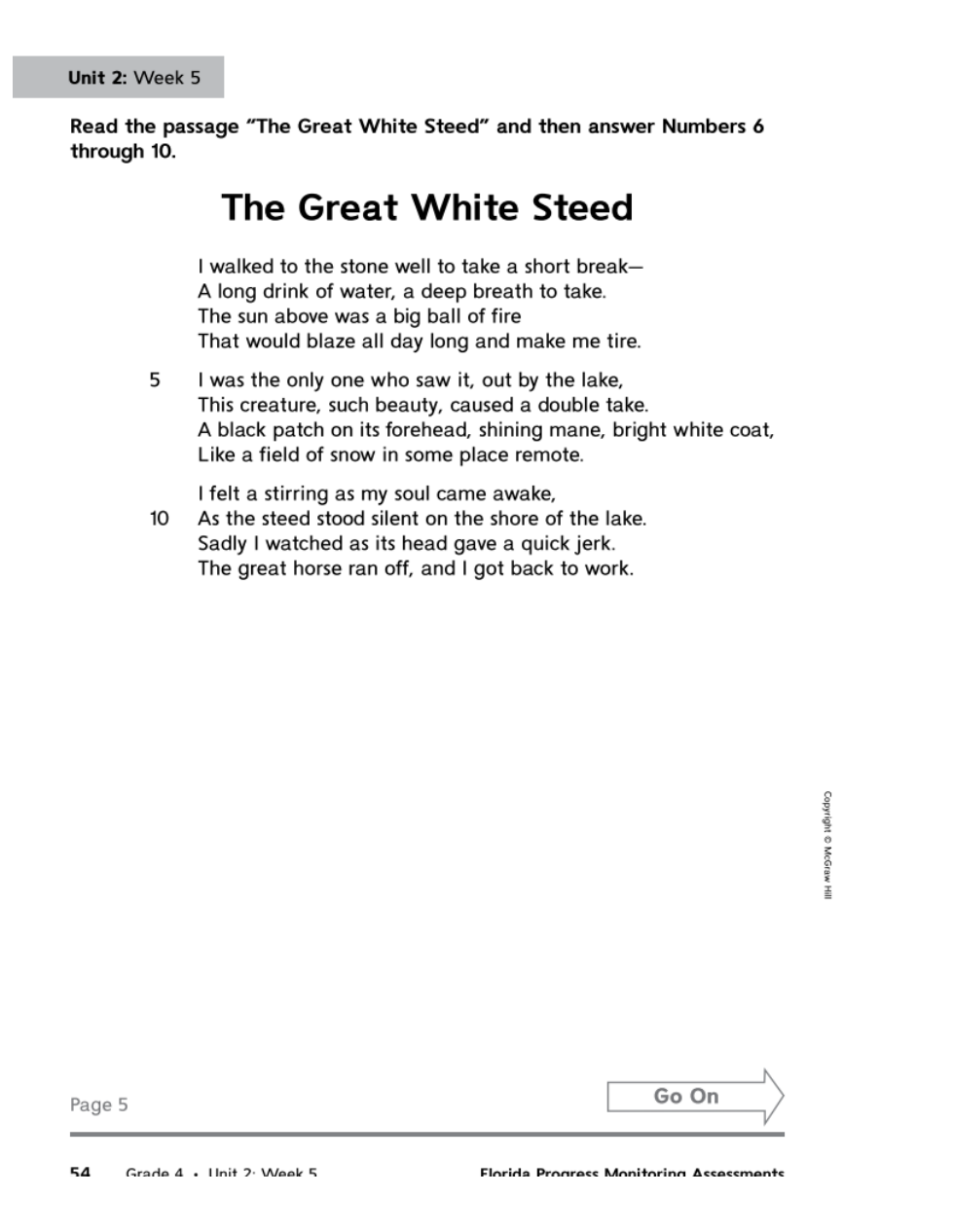
"A black patch on its forehead, shining mane, bright white coat,
Like a field of snow in some place
remote
." (lines 7-8)
What does the word
remote
mean in this context?
distant
mean
tool
unlikely
Question 9
9.
Read lines 7 and 8 again.
"A black patch on its forehead, shining mane, bright white coat,
Like a field of snow in some place
remote
." (lines 7-8)
Which simile is a clue to the answer in question 8?
black patch
on its forehead
bright white coat
like a field of snow
Question 10
10.
In which
two
ways is the passage a lyric poem?
It includes end rhymes.
It describes character dialogue.
It contains several long stanzas.
It expresses thoughts and feelings.
It has seven syllables in the second lines.
Question 11
11.
What is the purpose of the rhyming pattern in the first stanza?
It expresses the poem's theme.
It expresses the speaker's message.
It draws attention to the poem's setting.
It draws attention to the horse's features.
Question 12
12.
Read line 7 from the poem.
"A black patch on its forehead,
shining
mane,
bright white
coat,"
What is the purpose of the use of assonance in
shining, bright, and white
in the poem? Choose
two
answers.
It describes the mood.
It expresses the speaker's emotions.
It compares and contrasts central ideas.
It emphasized the description of the horse.
It explains the meaning of the word "coat".
Question 6
6.
Reade this line from the passage.
"The sun above was a big
ball
of fire" (line 3)
What does
ball
mean in this context?
a part of the foot
a solid round shape
a game with players
a fancy dancing event