Ɛhia
1
The diagram shows a mitochondrion. All the arrows are associated with the process of...
The diagram shows a mitochondrion. All the arrows are associated with the process of...
Ɛhia
1
The diagram shows a mitochondrion. All the arrows are associated with the process of...
Which of the following is the correct sequence of events during cellular respiration?
Identify each process of cellular respiration
| Draggable item | arrow_right_alt | Corresponding Item |
|---|---|---|
Fermentation | arrow_right_alt | Produces NADH and FADH2 and 2 ATP |
Krebs Cycle | arrow_right_alt | Anaerobic portion of respiration that takes place in the cytoplasm |
Glycolysis | arrow_right_alt | Following glycolysis, this process takes place in the absence of oxygen |
Which description best identifies this type of cellular transport?

Identify the following solutions.

Students are investigating cellular transport. In their investigation, an animal cell is placed in an isotonic solution. What is the MOST LIKELY description of what students will observe during their investigation?
Students created flowcharts to show select types of cellular transport that occurs across the plasma membrane. Which flowchart correctly shows the types of cell membrane transport?
Which of the following is NOT found in a prokaryotic cell?
Categorize each statement as belonging to photosynthesis or cellular respiration.
Contains the Krebs Cycle
Produces oxygen
Breaks down glucose
Makes glucose
Contains the Calvin Cycle
Releases energy from sugar
Produces carbon dioxide
Stores energy in sugar
Uses carbon dioxide
Takes place in the mitochondria
Photosynthesis
Cellular Respiration
Categorize the descriptions to their location in the chloroplast.
Light-independent location
Outputs O2, NADPH, ATP
Outputs glucose
Structure within the chloroplast that contains the pigment chlorophyll and traps light energy
Light-dependent location
Inputs CO2
Thylakoid
Stroma

Identify each structure
| Draggable item | arrow_right_alt | Corresponding Item |
|---|---|---|
C | arrow_right_alt | Protein |
E | arrow_right_alt | Carbohydrate |
B | arrow_right_alt | Hydrophobic Tail |
A | arrow_right_alt | Channel Protein |
F | arrow_right_alt | Hydrophilic head |
D | arrow_right_alt | Cholesterol |
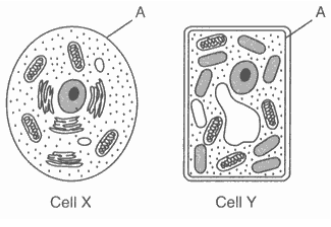
The diagram below represents two cells, X and Y.
Which statement is correct concerning the structure labeled A?
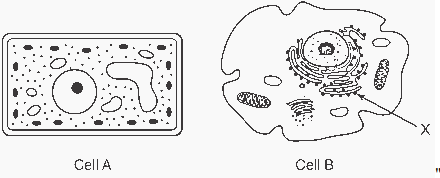
Which state best describes these cells?

Which structure contains digestive enzymes to break down wastes from the cell?
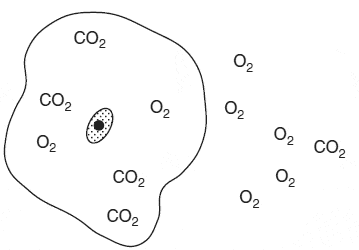
The diagram below represents a cell in water. Formulas of molecules that can move freely across the cell membrane are shown. Some molecules are located inside the cell and others are in the water outside the cell.
Based on the distribution of these molecules, what would most likely happen after a period of time?
Which statement is NOT a part of the cell theory?
In which situation would an egg shrink?
The letter X most likely represents...
Which structure packages proteins into membrane-bound vesicles for excretion?
Which structure of the cell shown aids in cellular division?