An insect called the European corn borer can reduce the amount of corn from corn crops. To protect corn from this insect, scientists genetically modified corn plants. The scientists inserted a gene into the genome of corn plants. The gene codes for the production of a toxin that can kill the corn borer.
What will most likely happen within the corn borer population over time?
1 point
1
Question 2
2.
A Siamese cat has both dark and light fur on its body, as shown. The production of the protein that determines fur color is dependent upon temperature. The fur on the body of the cat is lighter colored because its body is warmer than its head, feet, and tail.
Which of the following best describes how fur color is determined in a Siamese cat?
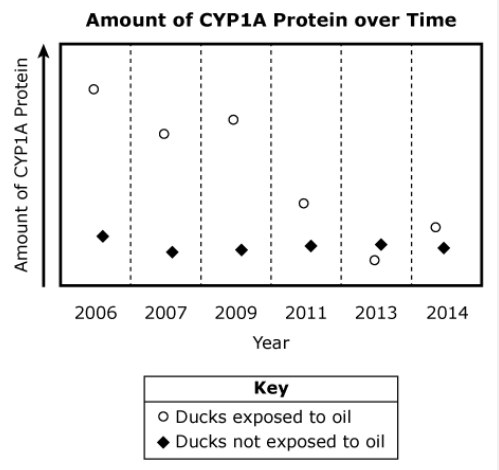
CYP1A is a protein in organisms that breaks down toxic substances such as those found in oil. The amount of CYP1A protein in an organism depends on the expression of the CYP1A gene. Prior to 2006, there was a large oil spill off the coast of Alaska that affected many organisms. From 2006 to 2014, scientists measured the amount of CYP1A protein in ducks sampled from two populations. One population was exposed to oil from the spill, and the other population was not exposed to oil. The results are shown.
1 point
1
Question 3
3.
These results show that, between 2006 and 2009, the amount of CYP1A protein in ducks exposed to oil was __________ the amount of CYP1A protein in ducks not exposed in oil.
1 point
1
Question 4
4.
In 2014, the amount of CYP1A protein in ducks exposed to oil was __________ the amount in 2006. This evidence suggests that the amount of oil in the environment most likely __________ from 2006 to 2014.
1 point
1
Question 5
5.
The CYP1A gene codes for the CYP1A protein.
Select from the drop-down menus to correctly complete the sentence.
After the CYP1A gene is __________ the mRNA is __________ to produce CYP1A protein.
In North America, the populations of six species of bats have decreased by up to 99% since 2006. These decreases in population sizes are largely due to white-nose syndrome (WNS). WNS is caused by a fungus that infects the skin on bats’ wings, ears, and noses. The infected skin, which often appears white, loses more water than healthy, normal skin.
One species of bat affected by WNS is the little brown bat. This bat has a very small mass (about 14 g) and hunts for flying insects at night. Females typically give birth to one offspring per year.
In preparation for winter, little brown bats eat more insects to build up fat reserves in their bodies. In winter, they hibernate, which decreases body temperature, breathing rate, and metabolic rate. The bats do not eat while they are hibernating.
Little brown bats typically wake up only for brief periods of time during hibernation. When a bat does wake up, its body temperature increases as it flies around.
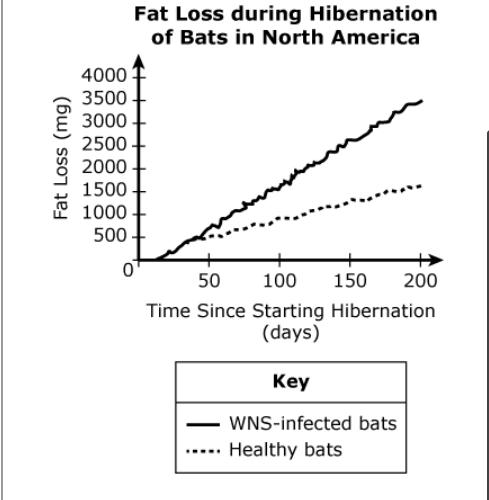
WNS affects the number of times that a bat wakes up during hibernation. Healthy bats wake up once every 20 days, and about 80% survive hibernation. Bats infected with WNS wake up once every 9 days, and only about 4% survive hibernation.
The graph shows the amount of fat lost during hibernation in healthy bats and in WNS‑infected bats in North America.
1 point
1
Question 6
6.
How will the genetic diversity of North American bats most likely change due to white nose syndrome (WNS)?
1 point
1
Question 7
7.
In a population of little brown bats infected with WNS, scientist found some bats that are resistant to WNS. Resistance to WNS may be inherited.
If resistance to WNS is an inherited trait, will the trait increase, decrease or stay the same in the population over time?
1 point
1
Question 8
8.
WNS causes damage to tissue on the wings, ears, and noses of bats. Which of the following processes most directly helps repair this damaged tissue?
1 point
1
Question 9
9.
Which of the following could explain why a little brown bat population is slow to recover after many bats in the population die during an outbreak of WNS?
1 point
1
Question 10
10.
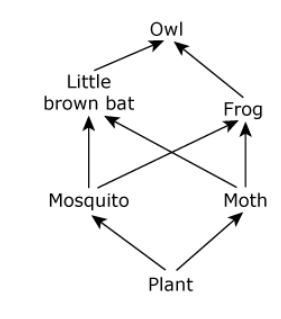
According to the food web, little brown bats belong to which of the following trophic levels?
1 point
1
Question 11
11.
A decrease in the population size of which of the following would MOST directly reduce the bats' ability to survive hibernation?