If I had a pair of trick dice and I calculate the experimental probability of rolling a sum of 11 as 500/1000 or 1/2. An unsuspecting mark would look at my dice and say the chance of getting an 11 is 2/36 or 1/18. There are still 36 different possible permutations of rolls with my two dice and two permutations that add to 11, why isn't the real theoretical probability not 2/36?
probability is based on math. To calculate it you divide the by the. probability is based on actual events. To calculate it you divide theby the
Vocab time! the set, or list, of possibilities for a probability is called the sample space. You will note that it is a set not a sequence. explain the difference between a set and a sequence?
Given fair dice, the larger the pool of trials, the closer the experimental probability should be to the theoretical probability
On a standard dice, what is the theoretical probability of rolling an even number?
If you want to find the probability of two different events both happening, you need to do what with the probabilities of each individual event happening
how many different ways are there to roll a 12 with two dice?
how many ways are there to roll a 6?
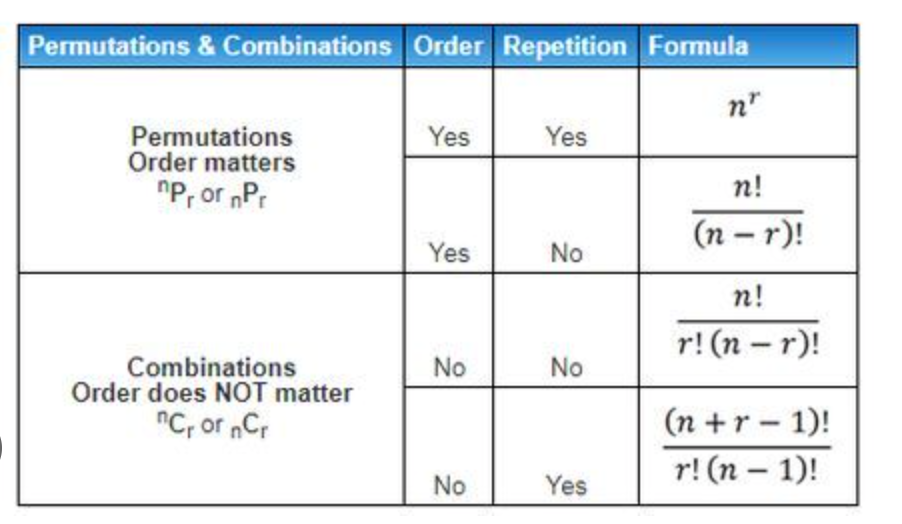
When you create the sample space for how to make a 6 with two dice, you will note that (2,4) is a different option than (4,2). If the order doesn't matter, this is called a combination. If the order does matter, it is called a permutation. You consider every permutation when determining the number of possible outcomes of a dice role. consider the possibilities if you roll two dice. You can see there are 36 permutations. How many combinations are there?
come up with two examples of when you need to figure out probabilities for dependent events (board games are a good source here)
come up with two examples of figuring out probabilities for two or more independent events.
How many different permutations are there for three dice rolled
Lets say you are randomly assigning roles for scenes from Romeo and Juliette in your class of 30. You are assigning 5 roles. how many entirely different casts could you possibly come up with? You start with the probability of choosing one of your 30 to start with. what is that probability?
you then consider what the probability is of picking any particular person for the second role. so - first is this second event dependent or independent?
what is the probability of choosing any particular person as the second role?
what is the probability of choosing any particular person as the third role?
What pattern are you seeing for dependent events?
For situations like this, you start seeing repeated multiplication where you are multiplying numbers that are counting down. You will note that this looks a little bit like sequences as series. Except, instead of adding, we are now multiplying, because when are finding the probability of separate events both happening, whether or not they are dependent, you multiply. So here is what that looks like.
This is called pi notation,( notice the capital pi, cause thats not confusing) . This doesn't really come up that often, and there is a convenient and simpler notation for the most common case called the factorial.
do you have any questions?
So you can see that if I wanted to know how many permutations I can have with 6 kids in 6 roles, the answer would be 6! = 720
But what if I have 30 kids and 5 roles, which of the following would give me
?
sort which one is a combination or a permutation.
number of ways you can split a class of 20 into groups of two
the number of ways you can cast 4 girls as the march sisters Meg, Jo, Beth and Amy out of an audition pool of 20
the possibilities of passwords with lowercase letters and numerals
choosing 3 ingredients out of 12 as toppings for pizza
choosing 12 jury members out of a jury selection pool of 100 citizens
choosing 6 numbers out of 69 options for the lottery
How many words can you make out of a set of 7 different scrabble tiles
combination
permutation
OK! Now that we have a basic view of the difference between permutations and combinations, and we know that the equation for n choose k is
now we can put together what we know about algebra, series and combinations to make some irritating algebra a little bit better.
You know from binomial theorem, that the first term for
is
and the fourth term is
how is this read?
You know from binomial theorem, that the first term for
is
and the third term is
calculate
how are you feeling
difference between theoretical probability and experimental probability
how to calculate experimental probability
relationship between experimental probability, theoretical probability and sample size
what is a sample space
permutation vs combination
independent vs dependent events
the difference of probability "with replacement and without replacement"
how to use factorials
binomial theorem - when to use it
binomial theorem - how to calculate it
I've got this
I'm fuzzy
so confused