Review: You are near a large planet in space. You calculate the force of gravity between you and the planet using newton's law of gravitation
where r is the distance between you and the planet.
the Electrical equivalent of this would be which of the following.
1 point
1
Question 2
2.
What made you choose the answer you chose above?
1 point
1
Question 3
3.
The way force and energy works with Electrostatics is very similar to the way force and energy work with gravity. There is, however, some differences. Which of the following are differences in the way they work
1 point
1
Question 4
4.
"Two point charges, Q1​=+.3C and Q2​=−.5C, are placed 10 centimeters apart in air. Calculate the magnitude of the electrostatic force between them."
To solve this problem, you can use Coulomb's Law:
Where:
F is the electrostatic force,
k is Coulomb's constant, approximately 8.99×10^9 Nm^2/C^2,
Q1​ and Q2​ are the magnitudes of the charges, and
r is the distance between the charges.
1 point
1
Question 5
5.
The previous problem showed absolute values to show that the magnitude of the force is always positive. What is the direction of that force?
1 point
1
Question 6
6.
When you calculate the potential energy of an object, you use the equation PE=mgh,
Where m is the mass of the object
g is the acceleration due to gravity
and h is
1 point
1
Question 7
7.
the gravitational potential energy can be described as
1 point
1
Question 8
8.
You will remember that work is defined as the transfer of energy when a force is applied on an object and moves it a certain distance. The equation is
Work = Force \cdot distance
and it has the units of energy. And the work-energy theorem says that work is the change of kinetic energy. Lets look at that newton's gravitation again.
oh look, that work is the same as PE=mgh
ok, what does all this have to do with electricity?
The easiest way to understand the electrostatic force is to see it as being very similar to the gravitational force, and that it works the same way. if I have a charge creating an electric field, and place another charge on that field, the equation to find the force on that charge has almost the exact same equation as if I have a planet with a gravitational field and an object placed in that gravitational field, and i use Newtons law of universal gravitation to find the gravitational force on that object. different constant, mass instead of charge, but otherwise identical. and the same idea for Potential energy - i don't really care about the amount of potential energy an object has in relation to the center of the earth. or sea level. I only care about the work done from where it drops to where it lands, so I set the 0 at whatever surface i want, and measure the distance from that surface to the object. Here is where things get hairy in my analogy. You don't calculates the potential gravitational energy of an object using the center of the planet, because you're talking about dropping an object into a mined shaft you drilled down to the center of the earth and calculating the potential energy using the radius of the earth to calculate the kinetic energy as it reaches the center won't work because
1 point
1
Question 9
9.
Unlike a planet, in electrostatics we use point charges, not hunks of rock 6 million meters across. These point charges might have volume, but they are so small we don't really care. so there is a maximum amount of potential energy a charge can have, if
where r is distance between q_1 and q_2, and
in this case d is the distance between the two charges is r
This work is called the potential electric energy and is given the letter U or sometimes U_e
1 point
1
Question 10
10.
ok, this week we are going over Chapter 22 - electric current. Rather than read the book, I would like to offer several videos, this stuff may be dense, though, reading the book might be useful.
do you have any questions?
1 point
1
Question 11
11.
So, emf stands for electromotive force, but is not actually a force. If I were to change it, I might call it the electromotive height. Why might I pick that?
1 point
1
Question 12
12.
what would you change emf to?
1 point
1
Question 13
13.
If I dropped a ball off the cliff and before it hit the ground it hit the tines of a waterwheel and spun the wheel, explain what that would mean for what happened to the potential gravitational energy of the ball before it was dropped.
1 point
1
Question 14
14.
how is the above question analogous to resistance in a circuit?
1 point
1
Question 15
15.
Ok, we just had 13 questions that are stepping you through what voltage is (and this is a tough thing for students to wrap their minds around frequently, which is why I also went over this in class, and will do so again), the video will step you through what is current
1 point
1
Question 16
16.
OK, we will explain how AC and DC are different later, what is your understanding of the difference?
1 point
1
Question 17
17.
This video explains resistance, ohms law and power.
do you have any questions?
Ohms law tells you that Voltage = current x resistance
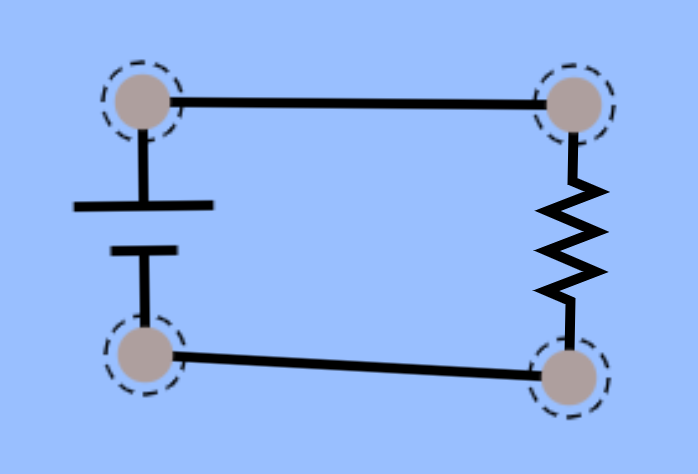
so for any. circuit like this where there is a voltage source, one path and one resistor of some sort
given two of the following - V, I or R, you can find whichever one you don't have using the equation V=IR
Required
1 point
1
Question 18
18.
A toaster with a 20 ohm heater element would produce a current of ______ A when connected to a 120 volt circuit.
Required
1 point
1
Question 19
19.
A 12 volt indicator lamp would have a resistance value of ______ ohms to produce a current of 0.5 amps.
Required
1 point
1
Question 20
20.
______ amperes will be present when a 30 ohm resistor is connected to a 6 volt source.
All of those are true for simple circuits like the diagram shown above, but typically our circuits are more complicated. For instance:
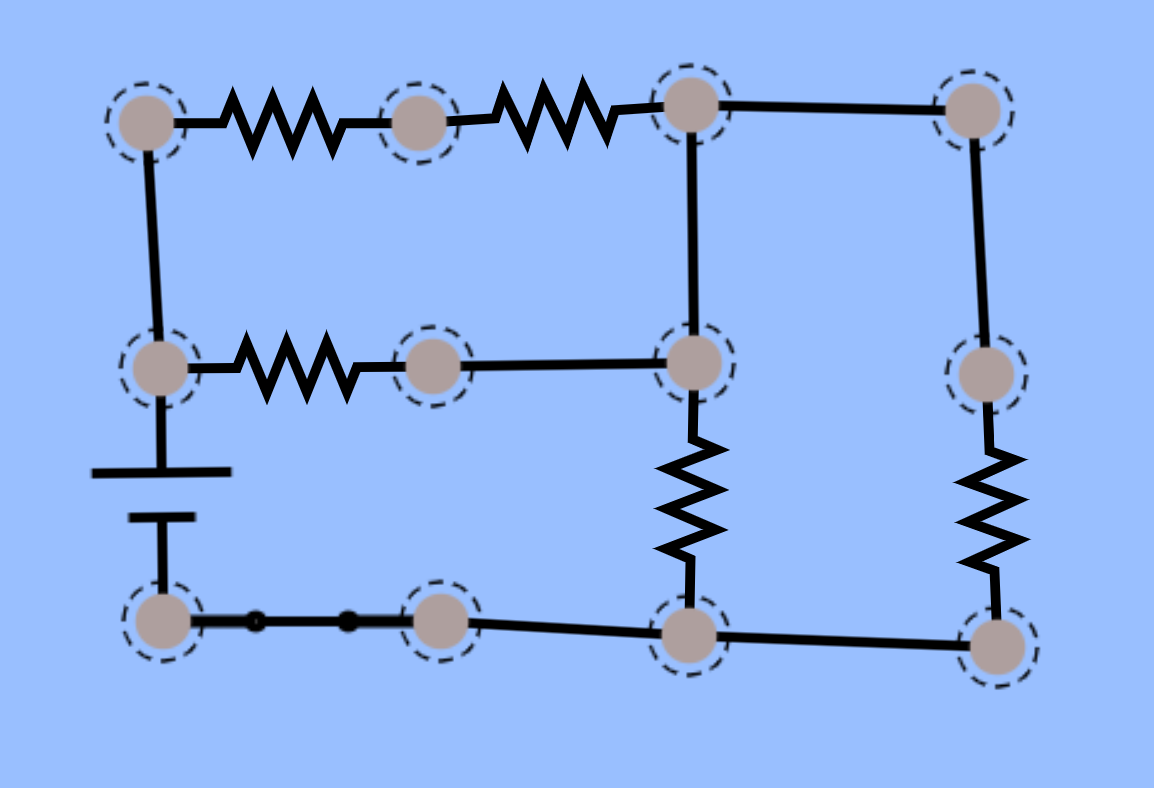
Even though each of the these resistors have the same resistance, the current that passes through each resistor is not necessarily the same, the voltage difference from one side of a resistor to the other side of the resistor is not necessarily the same as for one side to the other of another resistor. YET, if I know 2 of the following: Voltage across, Current through or resistance of any particular resistor, I can find the missing value for just that resistor using Ohms law. Next week we will work on being able to find the current across all the resistors, and the voltage drop across all resistors for this circuit by only knowing all the resistances of the resistors and either the voltage of the battery or the current across the battery.
Required
1 point
1
Question 21
21.
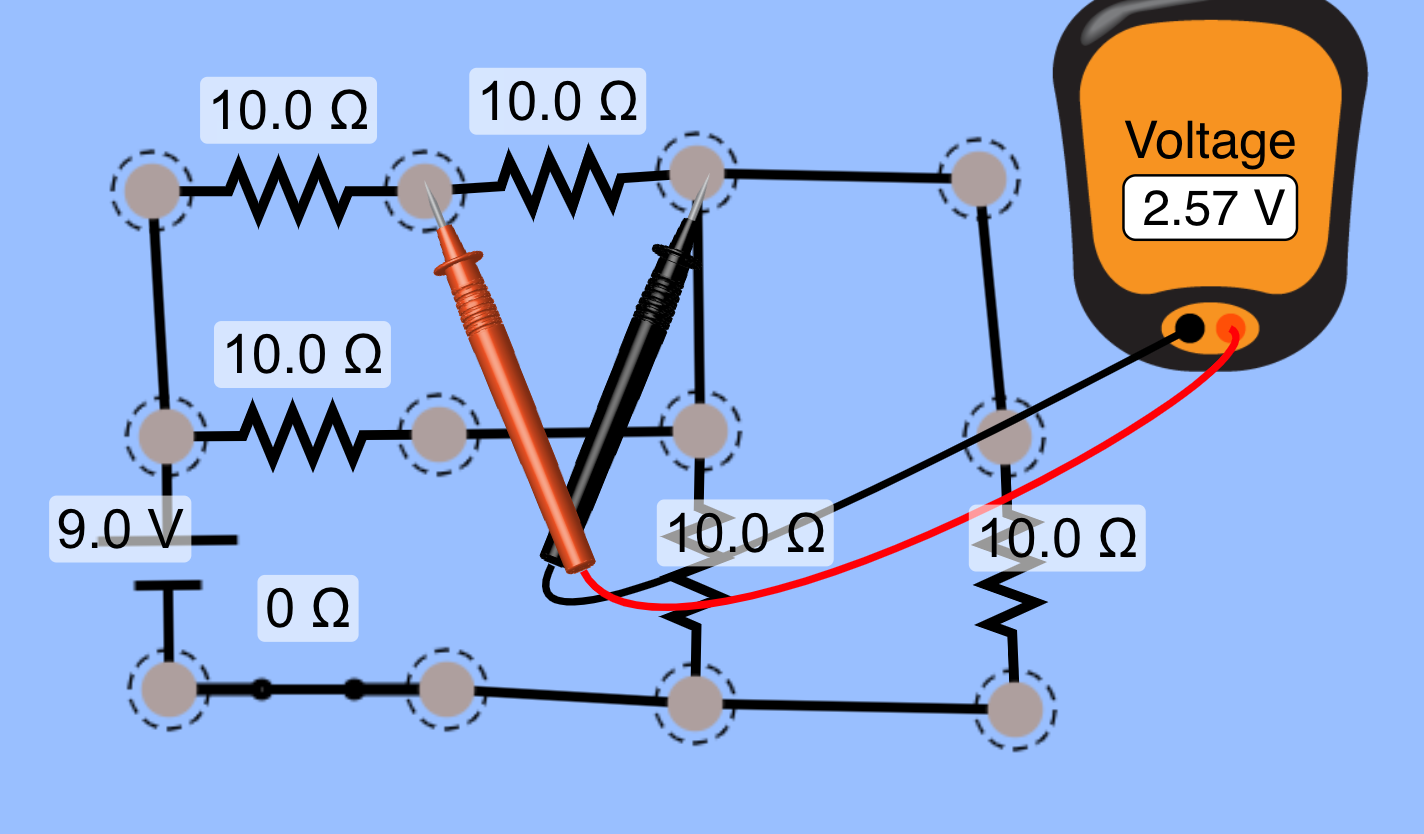
The resistance of a resistor is 10.0 Ohms. The voltage across that resistor is 2.57 V. What is the current across that resistor? Use V=IR just like before
Required
1 point
1
Question 22
22.
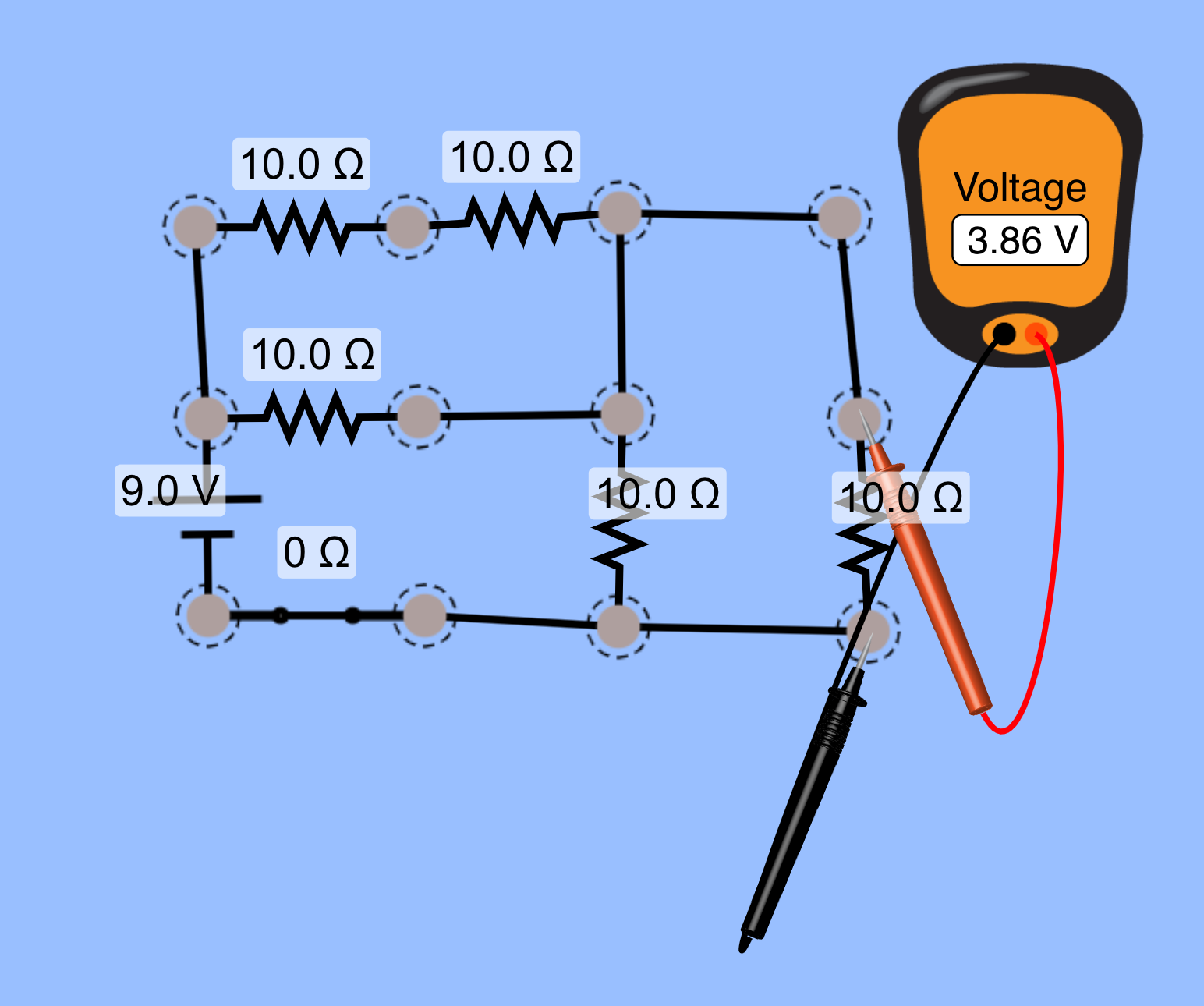
notice that this is exactly the same circuit, but the voltmeter is showing a different voltage. The resistor is the same, what is the current going across this resistor?
Required
1 point
1
Question 23
23.
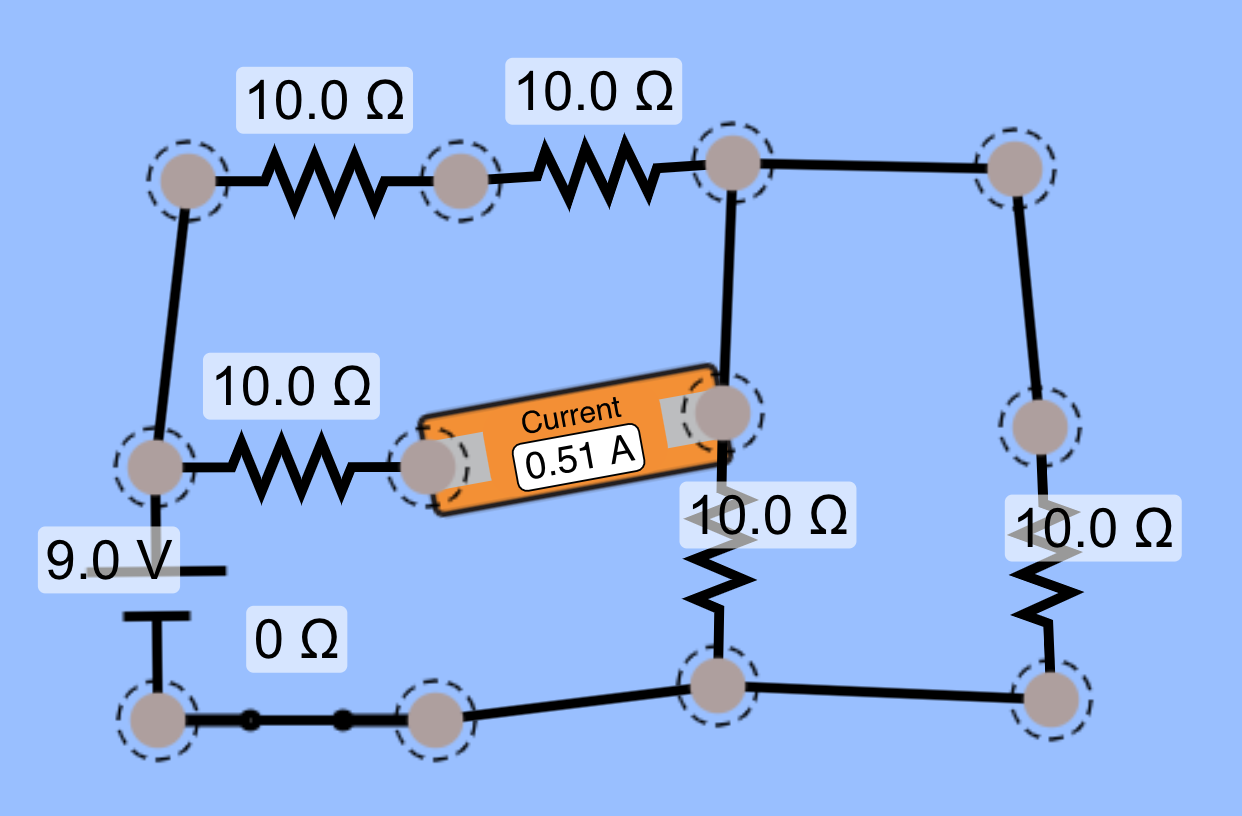
The current along this particular line and going though this resistor (the 10.0 ohm resistor that is touching the battery) is 0.51 Amps. Using V=IR what is the voltage across this resistor?
1 point
1
Question 24
24.
Using the values you have gotten, are each of the resistors (which all have the same resistance) using the same amount of power?
1 point
1
Question 25
25.
a 10 ohm resistor attached to a 3.0 V battery uses how much power? Use the equation V=IR and P = IV
1 point
1
Question 26
26.
what is voltage?
Difference between EMF and Voltage
why EMF is less like a force, and more like the height of a ball when measuring the Potential energy