Log in
Sign up for FREE
arrow_back
Library
The Tunguska Impact- 100 Years Later
By Teri Gonzalez
star
star
star
star
star
Share
share
Last updated 1 day ago
10 questions
Add this activity
zoom_in
zoom_in
zoom_in
1
2
3
4
zoom_in
1
1
1
1
Question 4
4.
What print feature does the author use to distinguish the eyewitnesses account from the author's words?
5
6
8
7
zoom_in
1
1
1
1
9
10
zoom_in
1
Question 9
9.
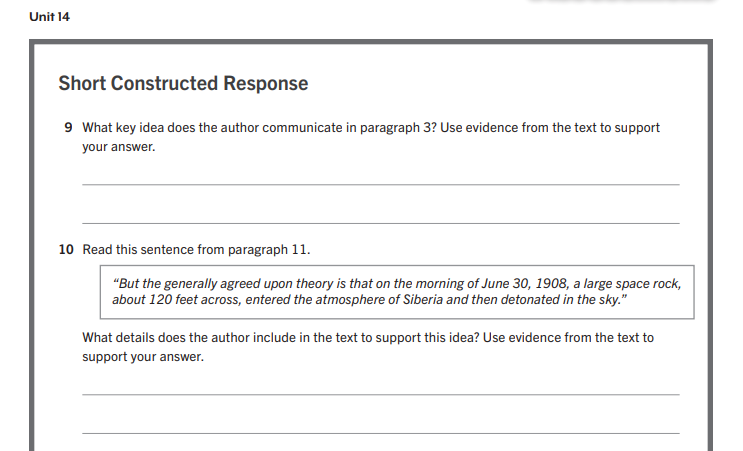
What key idea does the author communicate in paragraph 3? Use evidence from the text to support your answer.
1
Question 10
10.
What details does the author include in the text to support this idea? Use evidence from the text to support your answer.
Question 1
1.
The details in paragraph 5 support the main idea that -
A.) Kulik was more interested in locating a meteorite than investigate the impact
B.) Kulik's team was uncertain about the exact location of the impact
C.) harsh conditions were to blame for the impact
D.) no scientific research was done immediately following the impact
Question 2
2.
Which conclusion do these sentences support?
A.) Most large asteroids that enter Earth's atmosphere land harmlessly in remote areas.
B.) Scientists feel it is imperative to prepare for the next time an asteroid enters the atmosphere.
C.) Asteroids that are capable of causing extensive damage to Earth are relatively rare.
D.) It has become much easier for scientists to predict where and when asteroids will land.
Question 3
3.
Which phrase from paragraph 13 best serves as a context clue for the word
annihilate
in paragraph 12?
A.)
that is why
B.)
no impact crater
C.)
great majority
D.)
is consumed
Question 5
5.
Which idea is supported by details in paragraph 9?
A.) The members of Kulik's expedition had trouble communicating with the local people.
B.) Hearing the accounts of local people drastically changed scientists' view of the events at Tunguska.
C.) Most local people experienced the Tunguska impact in the form of a heat blast.
D.) Local people gradually overcame their reluctance to talk to scientists about the blast.
Question 6
6.
The author organizes the information in paragraph 10 mainly by-
A.) describing how the impact affected people from far to near
B.) providing background information about the Siberian climate in its order of importance
C.) detailing the events that took place that day in chronological order
D.) comparing and contrasting the Tunguska impact with another massive explosion
Question 7
7.
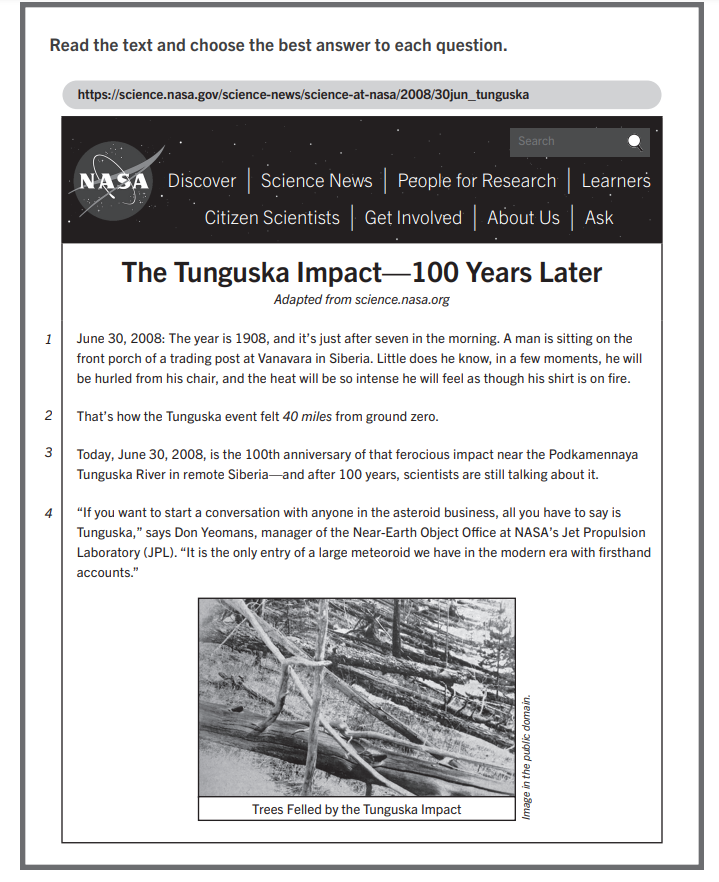
Which of the following are reasons the author includes the photograph of the trees felled by the Tunguska impact? Select
TWO
correct answers.
A.) To help the reader picture the scenario described in paragraph 1
Question 8
8.
What is the author's message in the text?
A.) Despite the amount of data collected from the site, scientists cannot prevent similar incidents.
B.) Citizens of urban areas are protected from natural disasters.
C.) Scientists are predicting another catastrophic astrological event in a couple hundred years.
D.) Though astrological phenomena rarely impact Earth, they may have devastating effects.
B.) To help the reader understand why the asteroid fell in this particular location
C.) To show the type of evidence scientists encountered at the scene of the impact
D.) To highlight the remoteness of the area affected by the impact
E.) To visually convey information provided in paragraph 7 and 8