By the end of this activity, you will be able to:
Determine a bullet trajectory, given two reference points.
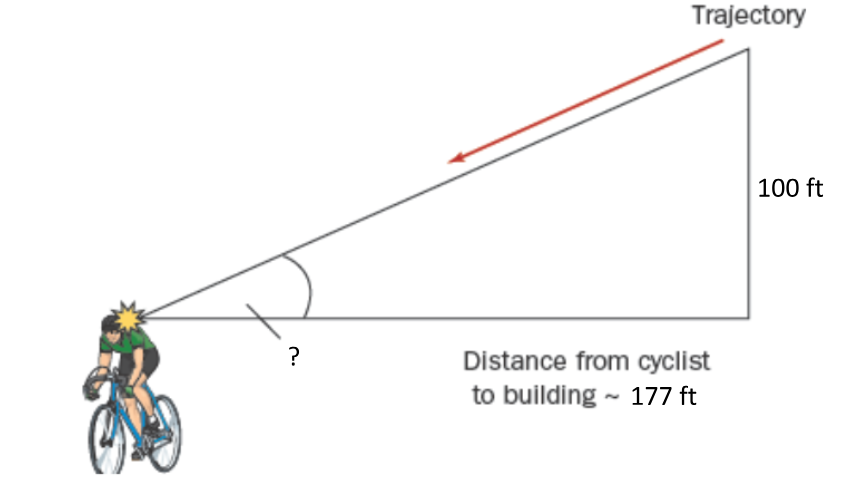
Calculate the angle of elevation, given two reference points.
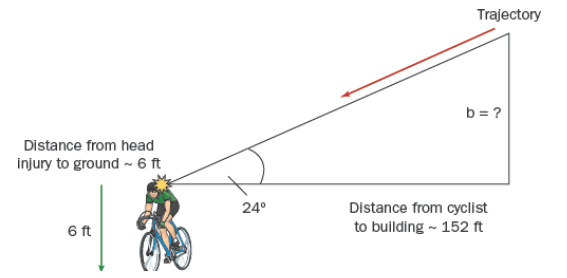
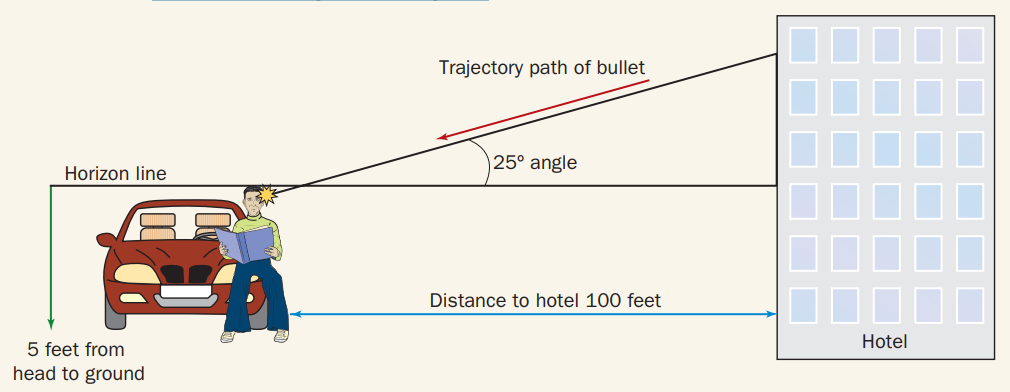
Estimate the location of a shooter using the law of tangents after analyzing sketches and measurements from a crime scene.
Someone shouts, “Shots fired!” But who fired? And from where? To answer these questions, the investigators begin by identifying the trajectory or path of the bullet.
To track the bullet’s trajectory, a line is drawn connecting two points along the bullet’s known path. These two points could be an entry wound (A) and exit wound (B) on a victim (Figure 1) or a bullet hole in a car window and an entry wound on someone inside the car (Figure 2).
The angle of elevation is the angle created by the bullet’s trajectory and the horizon. To determine the angle of elevation, draw a horizontal line (parallel to the horizon) that intersects the trajectory, and measure the angle formed by these two lines.
Compare determining trajectories from two fixed objects such as a hole in a wall and a hole in a window with determining the trajectory of a bullet from entrance and exit wounds. Why would the evidence of bullet trajectory be less reliable based on entrance and exit wounds sustained by a victim as opposed to the entrance and exit holes in walls or windows?
Describe the significance of determining the trajectory of a projectile when trying to solve a crime. What information about a crime can be gained once the bullet trajectory path is established?
During autopsies, bullets need to be recovered and submitted to the police as evidence. Investigators have been known to drag rivers to recover a firearm. Describe the type of evidence that could be recovered from firearms, bullets, and cartridge casings that could help link evidence to a particular firearm or person.