Log in
Sign up for FREE
arrow_back
Library

Applying Variables and Calculations for Hardy-Weinberg Formula: Visual

star
star
star
star
star
Last updated almost 2 years ago
34 questions
Note from the author:
This activity has students study a visual of a population in Hardy-Weinberg equilibrium, apply allele and genotype terminology, the variables of Hardy-Weinberg, and walks them through calculating Hardy-Weinberg.

Includes a visual pie-chart calculator: students can input p and q values and see the genotype and phenotype frequencies for the population.

Numerous hints included. Paul Andersen's video on HWE is referenced.

This is intended to follow students work with understanding the formula (see "Understanding Hardy-Weinberg Formula".)

This is designed to be independent practice completed alongside a series of Pear Practice activities that are whole-class. Before beginning, students should have been introduced to the Hardy-Weinberg formula. I do so in my classroom by introducing the underlying concepts before they ever see the math.

The problems on the Practice Calculation page come from Tiffany Jones' formative, also available in the public library.

The Visualization app is made through Excel. You may download and host your own copy if you would like to make minor changes.

For support or suggested edits, message teneal.metcalf@fwisd.org
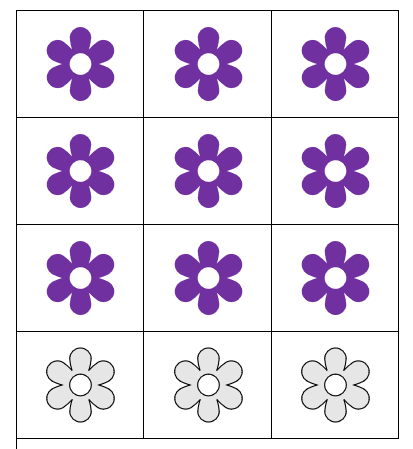
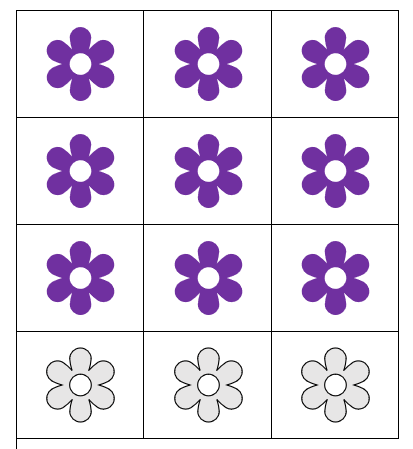
A Population of Purple and White Flowers in Hardy-Weinberg Equilibrium
Lecture Video & Notes Space
Guided Calculation Walkthrough with Visual Calculator
Practice Calculations
1
Question 1
1.
For the population of flowers at left, where purple is dominant to white...

There are 12 organisms and thus
  • 12 total__________ and
  • 24 total__________.
1
Question 2
2.
Purple is dominant to white in this population of flowers. Label accordingly.
Other Answer Choices:
can conceal the recessive allele
always homozygous
4
5
The video is optional but walks you through the way to solve problems directly. Alternatively, you can attempt the problems using the information below- there are numerous hints in the first set!

0
Question 5
5.

I am watching the optional video

0
Question 6
6.

Optional space for upload of physical notes or typed notes

The Hardy-Weinberg Theorem basically states that if no evolution is occurring, then the allele frequencies will remain in equilibrium in each succeeding generation of sexually reproducing individuals. In order for equilibrium to remain in effect (i.e. that no evolution is occurring), then the following five conditions must be met:
  1. No mutations must occur so that new alleles do not enter the population.
  2. No gene flow can occur (i.e. no migration of individuals into, or out of, the population).
  3. Random mating must occur (i.e. individuals must pair by chance)
  4. The population must be large so that no genetic drift (random chance) can cause the allele frequencies to change.
  5. No selection can occur so that certain alleles are not selected for, or against.

We can use the Hardy-Weinberg equation to estimate the frequency of alleles and genotypes in a population. According to this equation:
  • p = the frequency of the dominant allele
  • q = the frequency of the recessive allele
For a population in genetic equilibrium:

And, So,

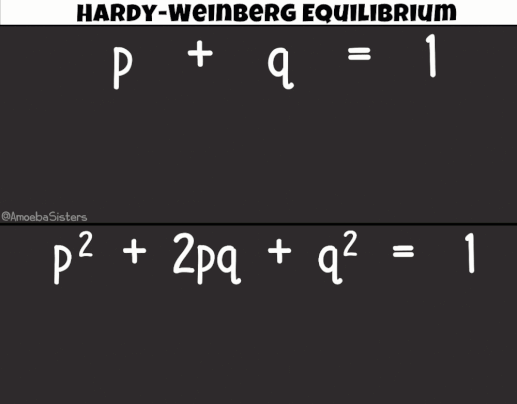
  • p + q = 1.0 (The sum of the frequencies of both alleles is 100%.) (p + q)2 = 1
  • p2 + 2pq + q2 = 1

The three terms of this binomial expansion indicate the frequencies of the three genotypes:
  • p2 = frequency of AA (homozygous dominant)
  • 2pq = frequency of Aa (heterozygous)
  • q2 = frequency of aa (homozygous recessive)

Notice that allele frequencies are represented by p and by q, whereas genotype frequencies of individuals are represented by p2, 2pq and q2.

Answer the following questions using the Hardy-Weinberg equation. Be sure to express the relative frequencies as decimals (i.e., 0.16) and percentages as percentages (i.e., 16%)

**NOTE: The system has the "correct" answers denoted by the above format**
The visual calculator at left shows allele and genotype and phenotype frequencies, once you input your p and q values.

If it does not load, click here: https://scienceprimer.com/hardy-weinberg-equilibrium-calculator
1
5
1
1
1
1
1
1

Within a population of butterflies, the color brown (B) is dominant over the color white (b) and 40% of all butterflies are white.

1
Question 15
15.

The frequency of recessive allele:

1
Question 16
16.

The frequency of the dominant allele:

1
Question 17
17.

The percentage of the “Bb” genotype:

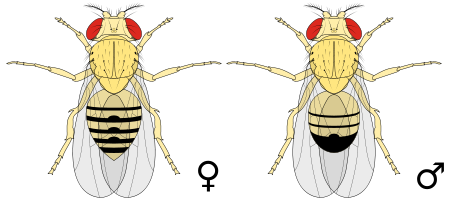
In a population of fruit flies, 250 are homozygous dominant for red eyes and 500 are heterozygous for red eye. The remaining 250 flies have white eyes.

1
Question 18
18.

The frequency of the recessive allele:

1
Question 19
19.

The frequency of the dominant allele:

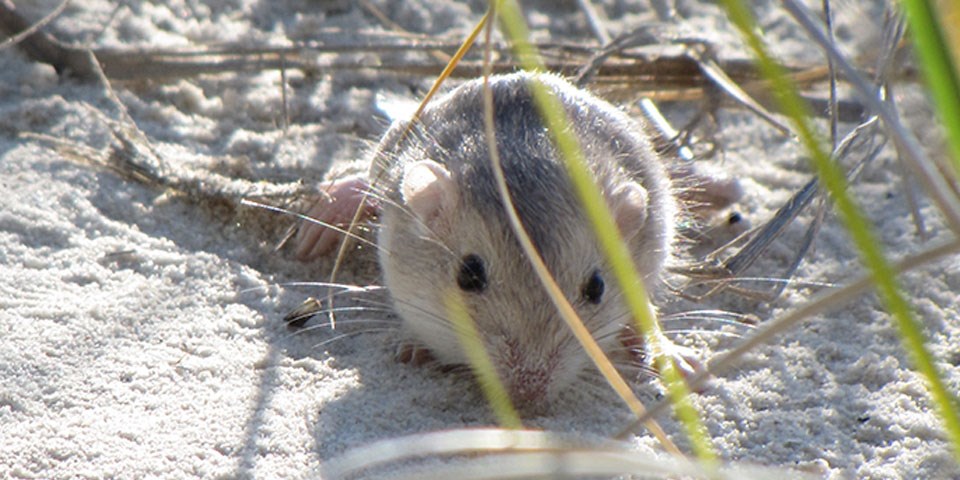
Brown fur is dominant to white fur in mice. In a population of mice, 64% have brown fur and 36% have white fur.

1
Question 20
20.

The frequency of the dominant allele:

1
Question 21
21.

The frequency of the recessive allele:

1
1
1

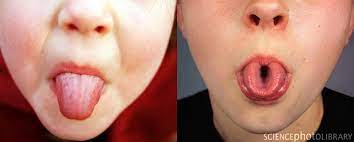
In humans, tongue rolling is dominant to non-rolling. In a population of 1000 individuals, 910 can roll their tongues while 90 cannot.

1
Question 25
25.

The frequency of the dominant allele:

1
Question 26
26.

The frequency of the recessive allele:

1
1
1

Approximately 1% of a given human population is lactose intolerant, a recessive condition.

1
Question 30
30.

The frequency of the dominant allele:

1
Question 31
31.

The frequency of the recessive allele:

1
1
1
Question 3
3.
The white flowers must be__________.

The purple flowers may be
  • concealing a __________allele and thus have the __________genotype
  • true-breeding, and therefore __________
Question 4
4.
Answer all blanks in decimal format to two places.

When you have recessive phenotypes visible, you can calculate all alleles and genotypes in the population starting from that fact, since you know the genotype of the recessive phenotype.

To find the frequency of homozygous recessive genotype, count the recessive phenotype and divide by the total organisms in the population. 3 white flowers divided by 12 total flowers.


q2=_______

To find q, frequency of the recessive allele you can do a square root function.

q=_______.

Because there are only two types of alleles in the population, you can use q to find p, the frequency of the dominant allele. p+q = 1, so 1-q=p.

p= _______.

Now that you've done all this work, you can finally sort out the frequency of the homozygous dominant and heterozygous genotypes. You could not before, because the dominant phenotype can have either genotype.

To find the frequency of the heterozygous genotype, multiply 2pq.

2pq=_______

To find the frequency of the homozygous dominant genotype, square p.

p2 = _______

You've now found all the Hardy-Weinberg variables. You can partially confirm your math is right by adding up genotypes to equal 1, and adding up alleles to equal 1. If your addition doesn't work, you've made an error somewhere.
Question 7
7.

You must be able to perform HWE calculations without this app; Use the visual calculator to check your work and help you 'see' what the variables you have just completed represent.

Check the resources you will have available to you during the AP Exam.

You have sampled a population in which you know that the percentage of the homozygous recessive genotype (aa) is 36%.

Using that 36%, you will calculate expected frequencies.
Question 8
8.


The following in-line choice question walks you through the steps you will perform to solve the math for the next several questions.

The 36% of the population that has a homozygous recessive genotype (aa) is represented by the HWE variable __________.

I can directly solve for the __________allele by performing a square root function on q^2.

The sum of the dominant and recessive allele in the gene pool is represented by p+q=1, and I now have q. I can thus find __________, the frequency of the dominant allele.

I can now find the frequency of the homozygous dominant organism, or __________, by multiplying p*p.

Finally, because the sum of genotypes is represented by p2+2pq+q2 = 1, I can find the frequency of the __________.
Question 9
9.

You have sampled a population in which you know that the percentage of the homozygous recessive genotype (aa) is 36%.

The frequency of the “a” allele:

Question 10
10.

The frequency of the “A” allele:

Question 11
11.

The frequency of the “aa” genotype, to the second decimal place:

Question 12
12.

The frequency of the “AA” genotype:

Question 13
13.

The frequency of the “Aa” genotype:

Question 14
14.

Set up the calculator at left with the p & q values you found, then check that the genotype frequencies match what you calculated.

The HWE calculator will not be available on the test, but visualizing this way may help you process the math.

Screenshot the allele, genotype, and phenotype frequencies pie charts and upload them here. You are welcome to use this calculator again to check your work and visualize what is happening as you solve the problems on the next page.

Question 22
22.

The percentage of mice that are homozygous dominant:

Question 23
23.

The percentage of mice that are heterozygous:

Question 24
24.

The percentage of mice that are homozygous recessive

Question 27
27.

The percentage of the population that is homozygous dominant:

Question 28
28.

The percentage of the population that is heterozygous:

Question 29
29.

The percentage of the population that is homozygous recessive:

Question 32
32.

The percentage of the population that is homozygous dominant:

Question 33
33.

The percentage of the population that is heterozygous

Question 34
34.

The percentage of the population that is homozygous recessive