Log in
Sign up for FREE
arrow_back
Library

Understanding the Hardy-Weinberg Formula: Independent Reinforcement

star
star
star
star
star
Last updated almost 2 years ago
7 questions
Note from the author:
This follows an introduction to conditions of Hardy-Weinberg. Students should be familiar with Punnett squares and the variables of HWE before beginning. They do not need to have seen the formula yet.

Meant to be delivered directly after a whole-class Pear Practice to take the place of lecture.

Students can also reinforce using Pear Practice here:
0
5
2
2.5
0
Question 1
1.

Question 2
2.

Write what you recall from Pear Practice. Then view the hint for essential ideas you should include.

Absent students: Go to Pear Practice, My Classes, Hardy Weinberg Understanding..., and complete the entire intro. It might be a little confusing because it is randomized when being done independently. While I have feedback coded in, it is not equivalent to my lecture and support as students worked; you are welcome to message me and let me know you would like to visit and do the lesson as originally designed.

Complete the next section for the answer, then bold or color-code or highlight any conditions you failed to list. Leave mistakes in place, show your corrections.

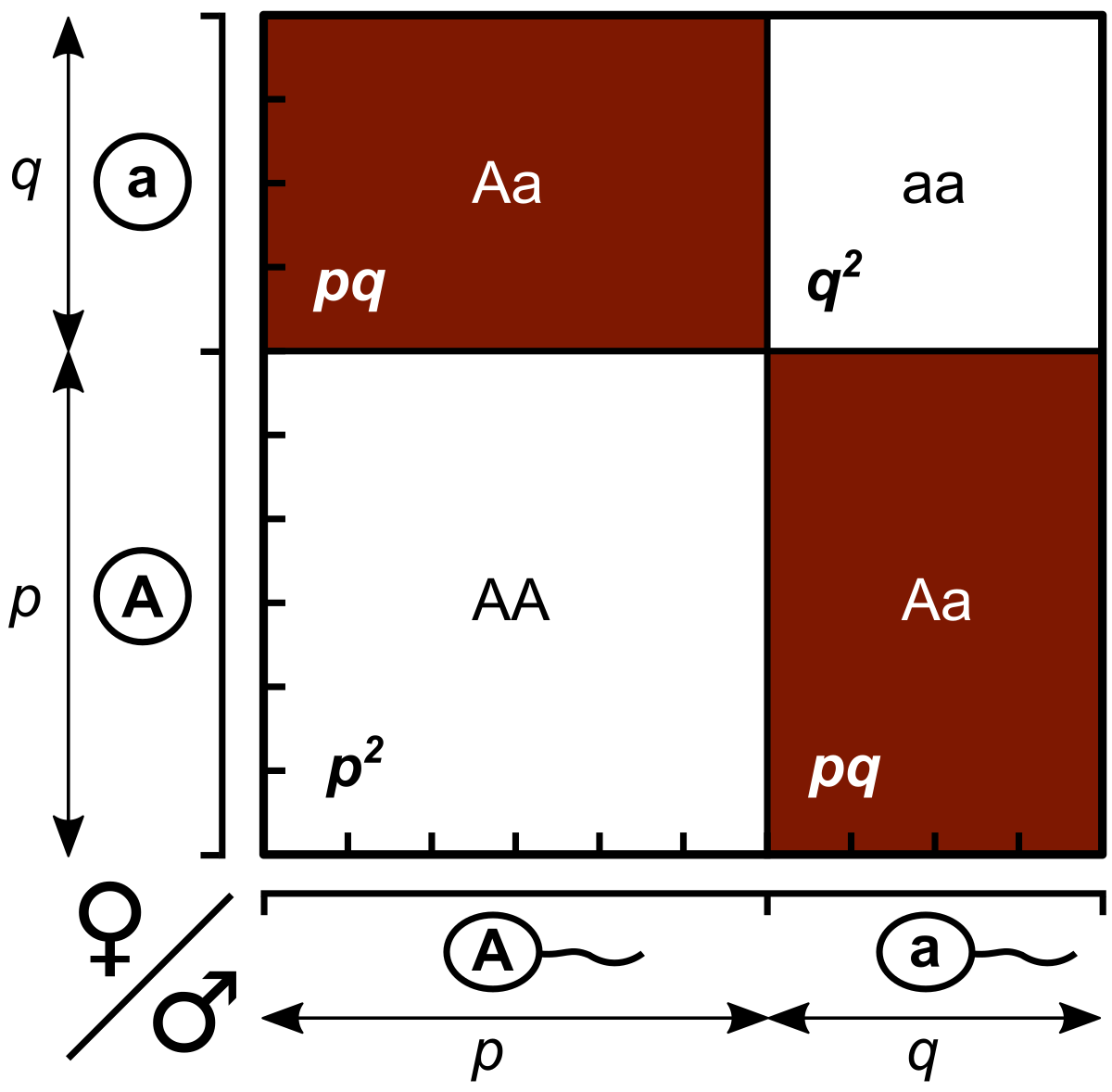
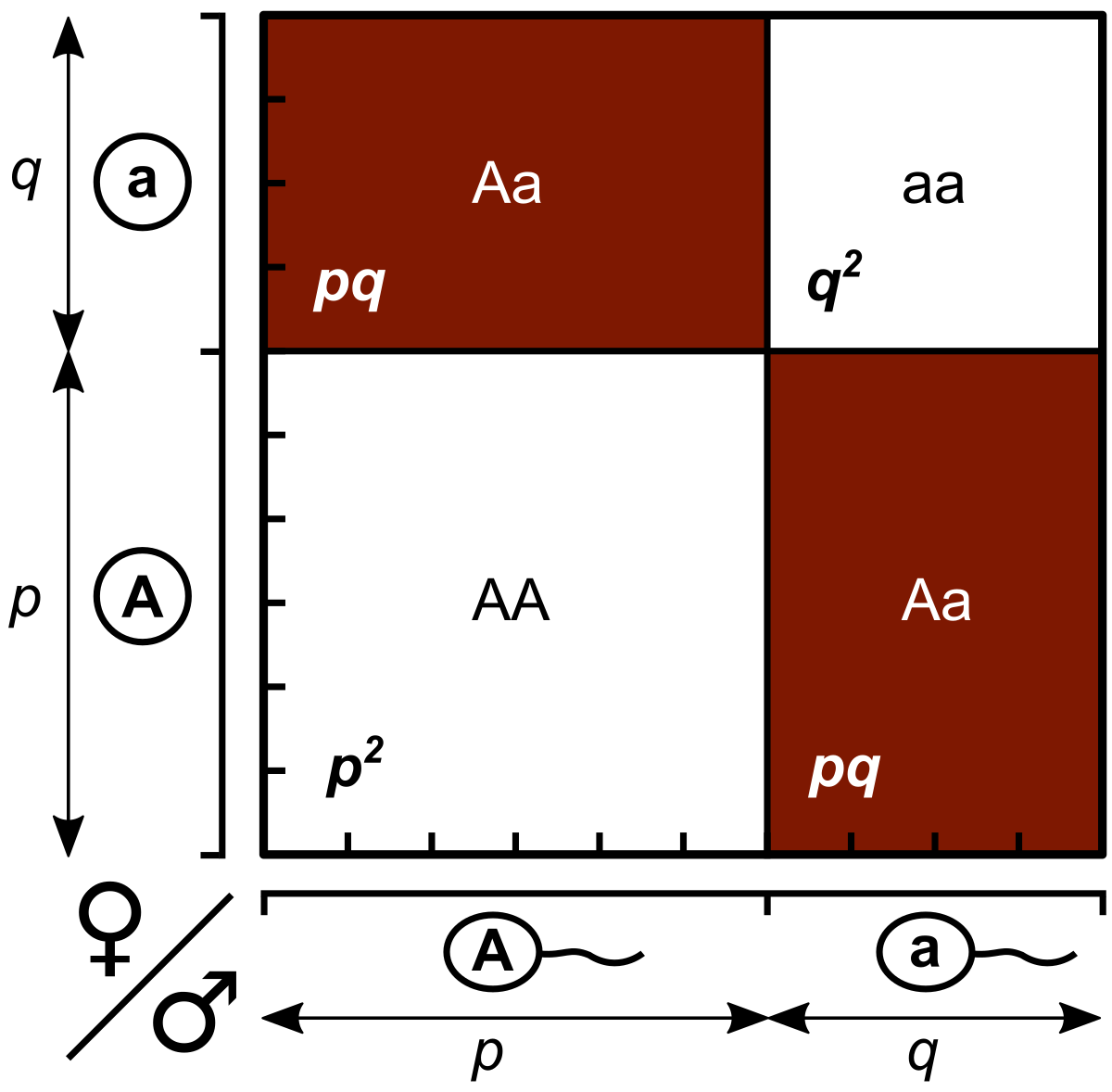
This is a model of Hardy-Weinberg equilibrium, applied to the familiar Punnett Square model.
Without further information, select all statements that appear to be supported by the diagram.

They may be directly supported, or inferred by a combination of your background knowledge and what you see. Some true statements are facts about Punnett squares that will influence our understanding of this model as applied to a population.


Many answers have feedback! Feel free to check and uncheck to see the explanations.
3
3
Question 5
5.
Describe the components of the formulae for HWE.
Other Answer Choices:
100% genotypes
sum alleles in gene pool
sum genotypes in population
100% alleles
Question 6
6.
Describe the components of the formulae for HWE.
Other Answer Choices:
recessive homozygotes
dominant homozygotes
recessive allele frequency
heterozygotes
dominant allele frequency
Question 7
7.

I want further practice on the variables and meaning of the parts of the formula.

Note: The formula will be available on a formula sheet on the exam and you will have a graphing calculator to work with.

Would you like to replay the Pear Practice done in class on 3.21 that helped us understand the reasoning behind the formula? Those questions looked like this:
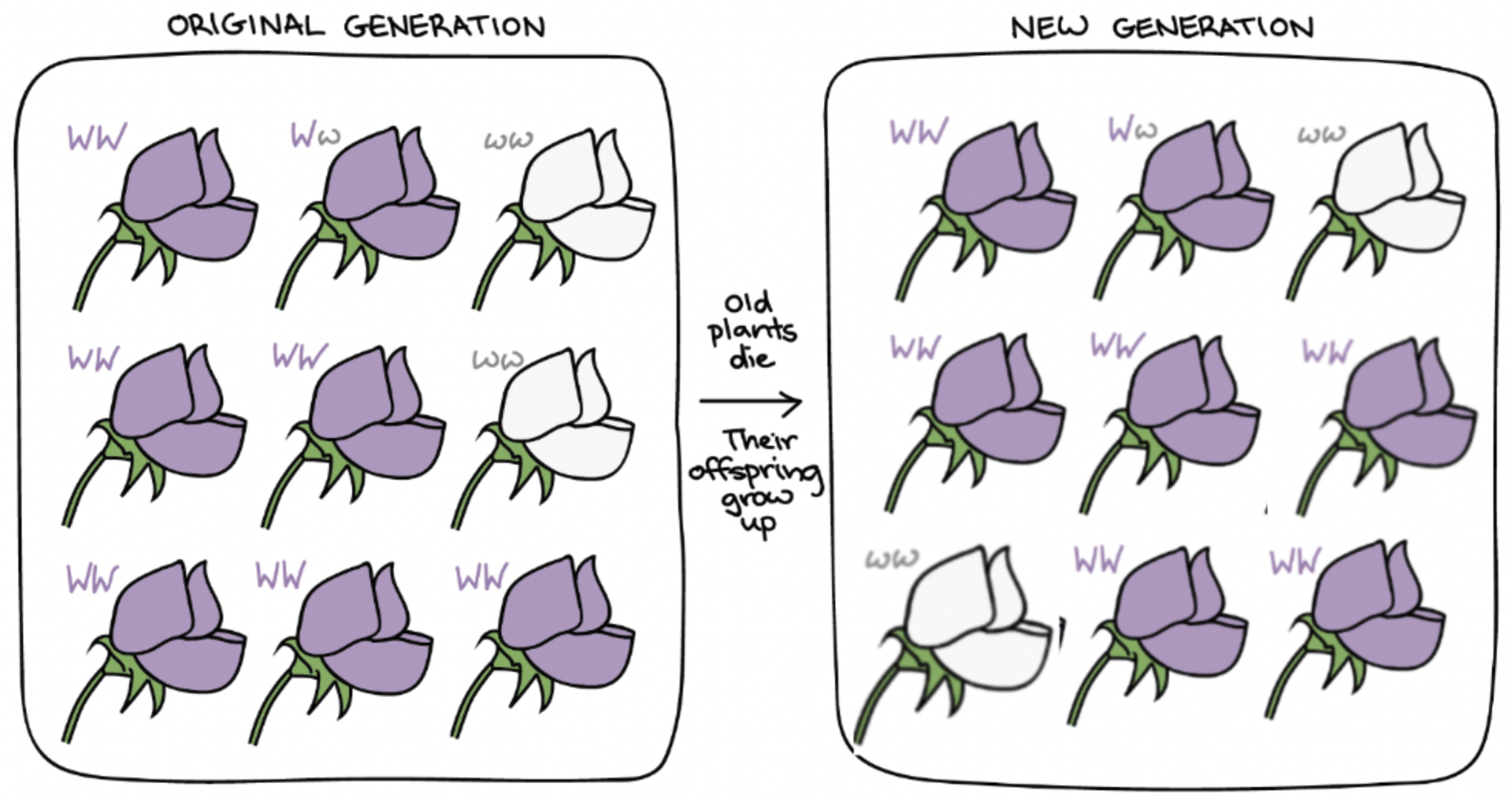


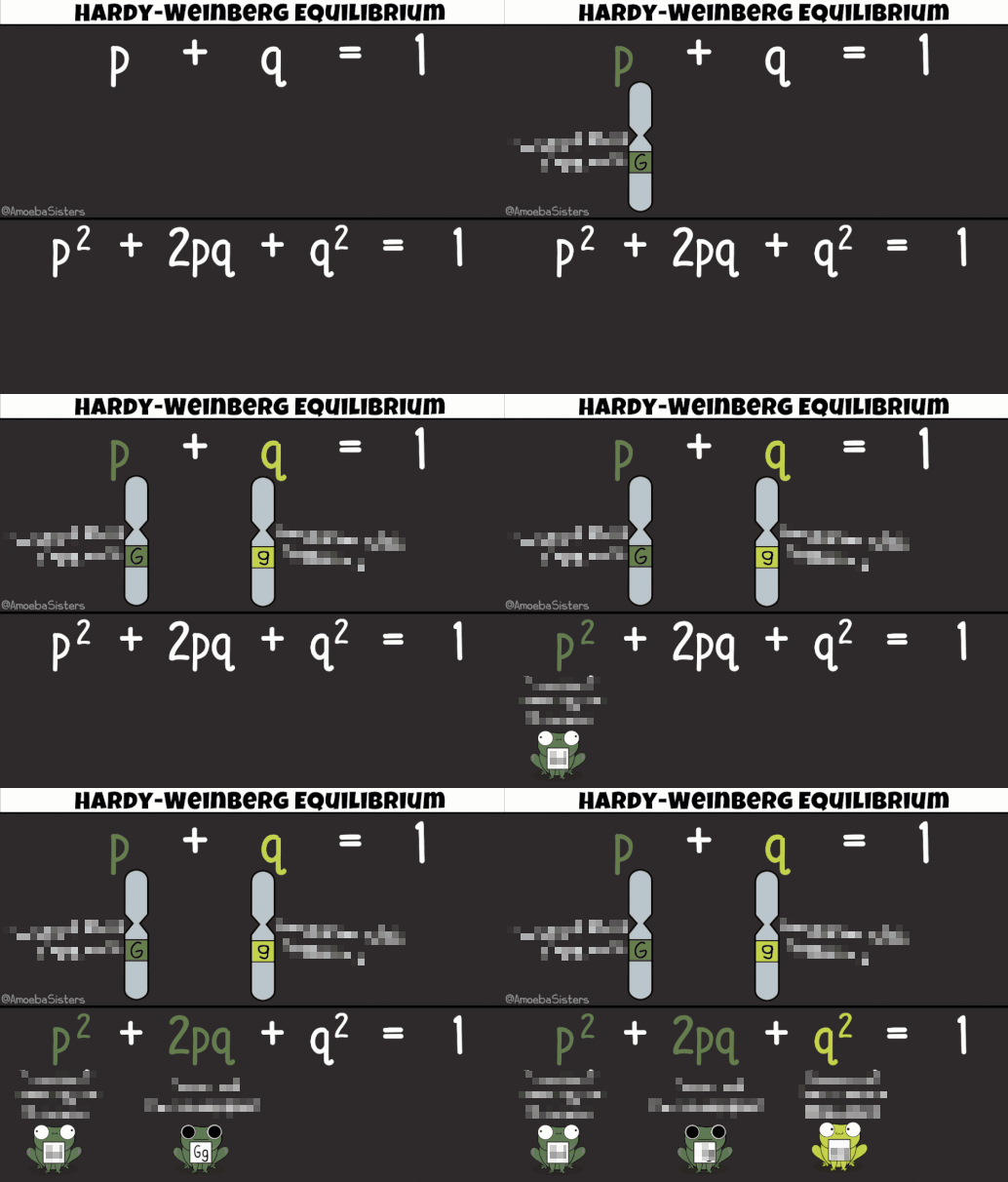
If so, go see Classes/Understanding the Hardy-Weinberg Formula in your practice set. It is NOT required; the content from that set is briefly overviewed below, and there is a second set that JUST focuses on retrieval practice of the formula itself.
Other... (send a message)
No, I understood everything I needed from the Pear Practice
No, while I don't think I understood everything I needed from the Pear Practice, I don't think replaying is going to help
Question 3
3.

Question 4
4.

No, I'm not quite comfortable with the formula but I don't have time for this practice
Other
Select true statements...
p must be 50%
p^2 + q^2 + 2pq = 100%
If there are 100 alleles (for 50 organisms) in the population, and 60 of them are dominant, 40 of them must be recessive.
If there are 100 organisms in the population, and 24 of them are homozygous recessive, 76 must be homozygous dominant.
All of the genotypes (AA, aa, and Aa) must add up to 100%.
p^2 + q^2 + pq = 100%
Select true statements...
When the parents are heterozygotes, the offspring are most likely to have the dominant genotype.
If the frequency of the dominant allele in the population is .6, the frequency of the recessive allele in the population must be .4.
If the frequency of the recessive allele in the population is .4, then the frequency of the recessive genotype in the population will be .08
If the frequency of the recessive allele in the population is .4, then the frequency of the recessive genotype in the population will be .16
When the parents are heterozygotes, the offspring are most likely to have the dominant phenotype.
If the frequency of the recessive genotype is .16, then the frequency of the heterozygous and homozygous dominant genotypes must be .84.