Please don't start this until we discuss it in class. You can discuss these with other people, but everyone should write their own answers to these questions. This is a red assignment so AI should not be used at any point.
Why would observing how many or whether the leaf disks were able to float to the top of the cup help you determine how much photosynthesis was occurring in the leaf disks? Explain. This should involve addressing material we covered in class about photosynthesis and refer to which step(s) are producing the gas and what occurs in those steps.
Paste a screenshot of a line graph of your data from the lab. Be sure to include accurate axis labels, a detailed title, an accurate key, etc. Be sure your screenshot is only of the graph and doesn't include any background of your desktop/Google Sheet and is very clear.
Look at your graph/data and analyze it (address why you think the data turned out the way it did addressing information you know about photosynthesis). Be sure to use specific data from the graph and vocabulary.
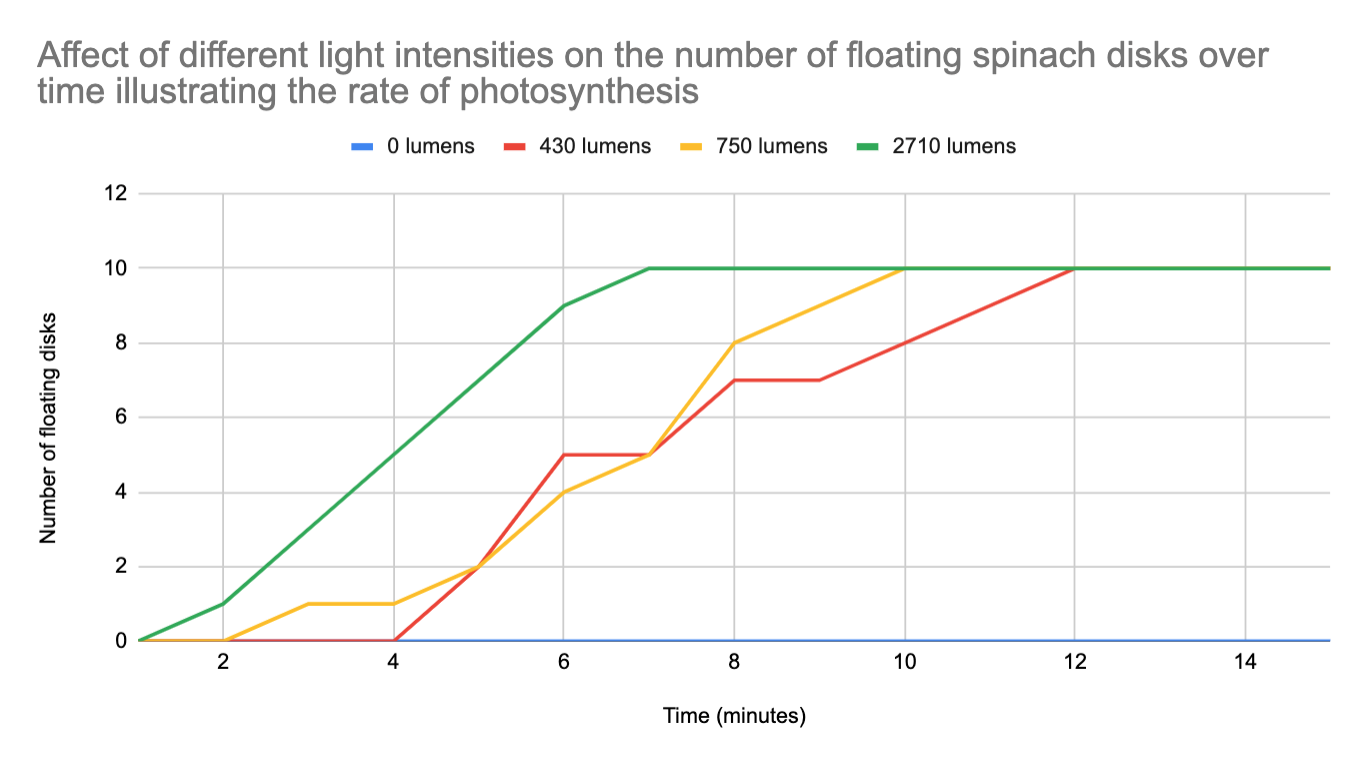
The graph below illustrates the affects of different light intensities on the rate that the spinach disks rise. The set up for the experiment is very similar to what you performed in class, but it's important to note that all of the cups had 1/8 teaspoon of baking soda.
Note: lumens is a unit that represents how much light there is.
Also note that the 0 lumens line stays at 0 floating disks for the whole graph (it's hard to see the blue line on the graph).
Look at the graph above and analyze it (address why you think the data turned out the way it did addressing information you know about photosynthesis). Be sure to use specific data from the graph and vocabulary.
Design a new experiment using the same overall procedure (leaf disks in a solution) in which you manipulate a new variable (pick a different variable that isn't the presence of sodium bicarbonate or light intensity). Write a paragraph about the procedure (you don't need to write steps but rather an overall process) and what you might expect to occur and why.