Log in
Sign up for FREE
arrow_back
Library
AoW: "How to Live in Less Fear"
By Amelia Decker
star
star
star
star
star
Share
share
Last updated almost 2 years ago
10 questions
Add this activity
Instructions
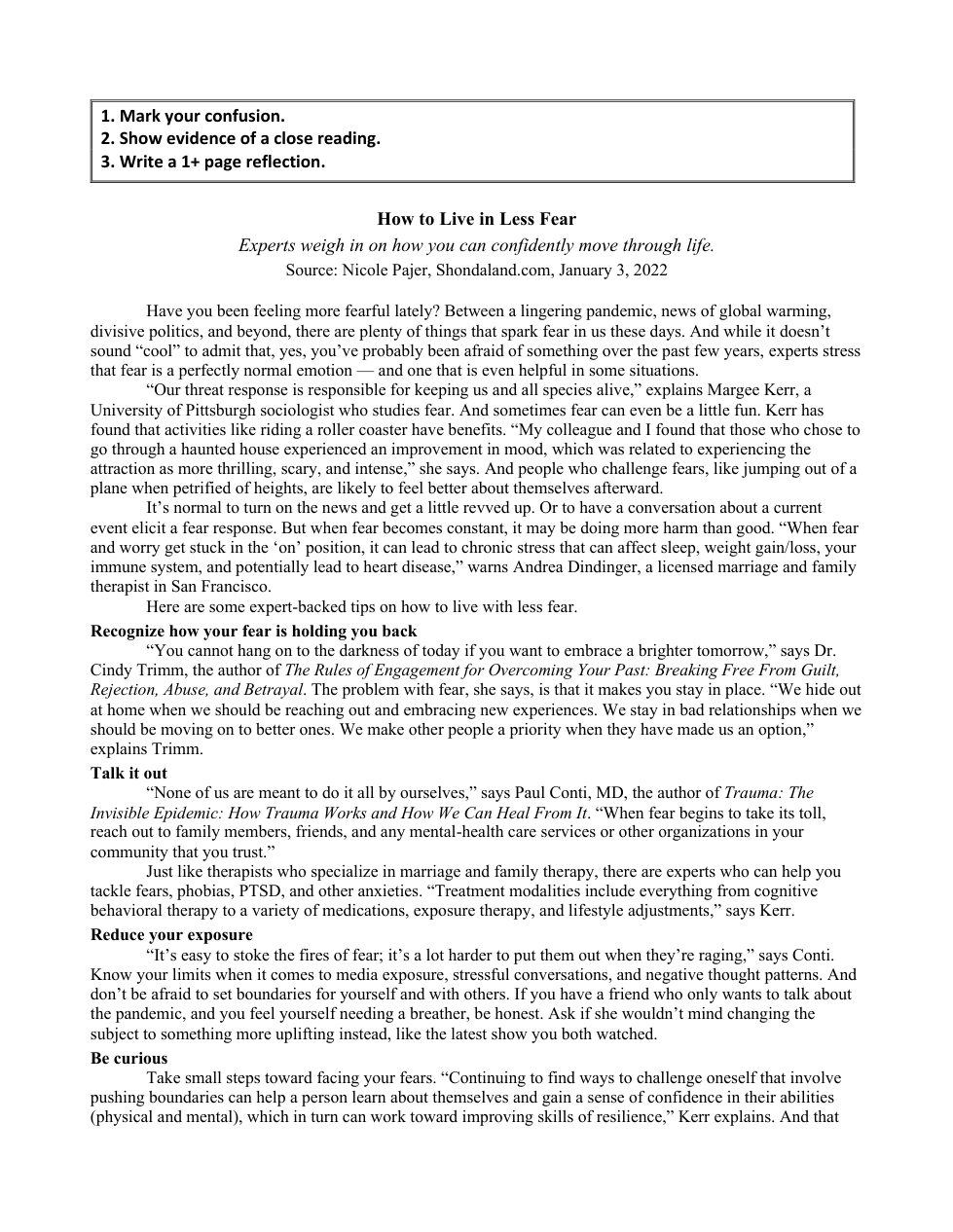
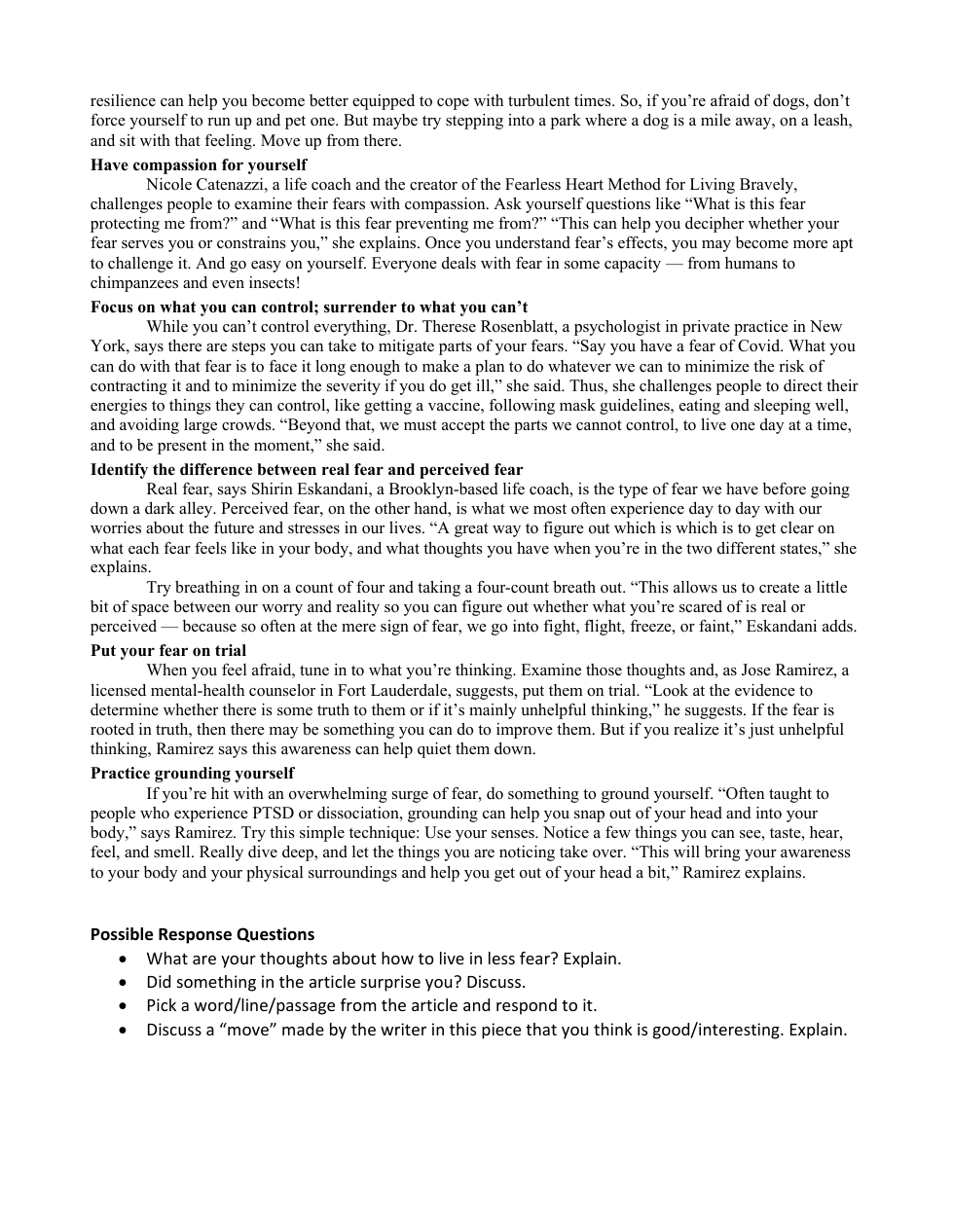
Read the article, and then answer the questions that follow.
1
2
3
4
5
zoom_in
10
10
10
10
10
6
7
8
9
10
zoom_in
10
10
10
10
10
Question 1
1.
According to the article, why is fear considered a normal and helpful emotion?
It is a result of irrational thinking and should be ignored.
It keeps us alive and helps us make better decisions.
It is a sign of weakness and should be avoided.
It has no impact on our well-being.
Question 2
2.
What did Margee Kerr's research on haunted houses and roller coasters reveal?
Fearful individuals should avoid these activities at all costs.
Such activities have no impact on a person's emotions or well-being.
Engaging in these activities can lead to chronic stress and health issues.
a) People who engage in thrilling and scary activities experience an improvement in mood.
Question 3
3.
How can chronic fear negatively affect our health?
It can improve our immune system and overall resilience.
It can lead to chronic stress, sleep problems, weight fluctuations, and heart disease.
It has no impact on our physical health, only our mental well-being.
It can lead to a sense of confidence and self-improvement.
Question 4
4.
How can reducing media exposure and setting boundaries help in managing fear?
It can eliminate fear completely and make us immune to negative influences.
It can prevent us from staying informed and aware of potential threats.
It can help us maintain a healthy balance and prevent fear from overwhelming us.
It has no impact on fear management and is irrelevant.
Question 5
5.
What is one way to overcome fear, according to the article?
Challenging oneself and taking small steps to face fears.
Ignoring fear and pretending it doesn't exist.
Seeking professional help and therapy.
Avoiding any situation that triggers fear.
Question 6
6.
How can compassion help in dealing with fear?
It can make us more fearful and anxious.
It can eliminate fear completely.
It can help us understand the purpose and effects of our fears.
It is irrelevant and has no impact on fear management.
Question 7
7.
According to Dr. Therese Rosenblatt, what can we do to mitigate our fears related to COVID-19?
Accept that we have no control over the situation and live in fear.
Focus on things we can control, such as following safety guidelines and taking care of our health.
Avoid any social interactions and isolate ourselves completely.
Panic and worry excessively about the future.
Question 8
8.
What is the difference between real fear and perceived fear?
Real fear is temporary, while perceived fear is long-lasting.
Real fear is always helpful, while perceived fear is always harmful.
Real fear is experienced physically, while perceived fear is only in our minds.
Real fear is based on actual threats, while perceived fear is based on irrational thoughts and worries.
Question 9
9.
What is the purpose of putting our fears on trial, as suggested by Jose Ramirez?
To prove that our fears are justified and should be taken seriously.
To ignore our fears and pretend they don't exist.
To examine the evidence and determine if our fears are based on reality or unhelpful thinking.
To intensify our fears and make them more prominent.
Question 10
10.
How can grounding oneself help in managing fear?
It can intensify our fears and make them more overwhelming.
It can bring our awareness to the present moment and our physical surroundings.
It can distract us from our fears and make them disappear.
It can help us understand the root causes of our fears.