Log in
Sign up for FREE
arrow_back
Library

"Baile Folklórico" and "The Heart of a Dancer"

star
star
star
star
star
Last updated about 1 year ago
15 questions
1
1
1
1
1
1
1
1
1
1
1
1
1
1
Question 14
14.

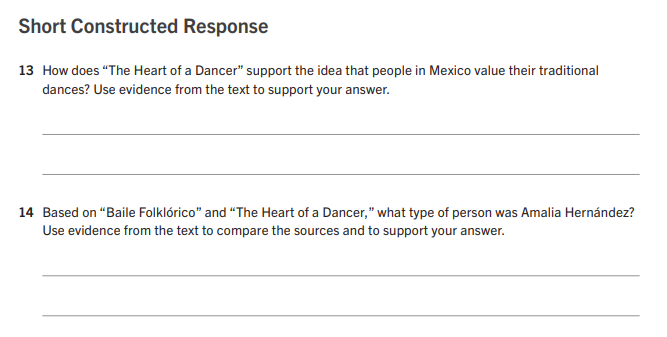
How does "The Heart of a Dancer" support the idea that people in Mexico value their traditional dances? Use evidence from the text to support your answer.

1
Question 1
1.

Question 2
2.

Question 3
3.

Question 4
4.

Question 5
5.

Question 6
6.

Question 7
7.

Question 8
8.

Question 9
9.

Question 10
10.

Question 11
11.

Question 12
12.
Complete the sentence by selecting the correct answer from the drop-down menus.
The author of "Baile Folklórico" structures the text in order to_________________________________________________ while the author of "The Heart of a Dancer" structures the text in order to____________________________________________
Other Answer Choices:
show how an art form has evolved.
explain the origins of a Mexican dance style
emphasize the excitement of performing.
compare two styles of dance
reveal the concerns of performers.
present a solution to a cultural problem
Question 13
13.

Question 15
15.

Based on "Baile Folklórico" and "The Heart of a Dancer," what type of person was Amalia Hernandez? Use evidence from the text to compare the sources and to support your answer.

Which inference about baile folklorico is supported by information in paragraphs 2 and 3?
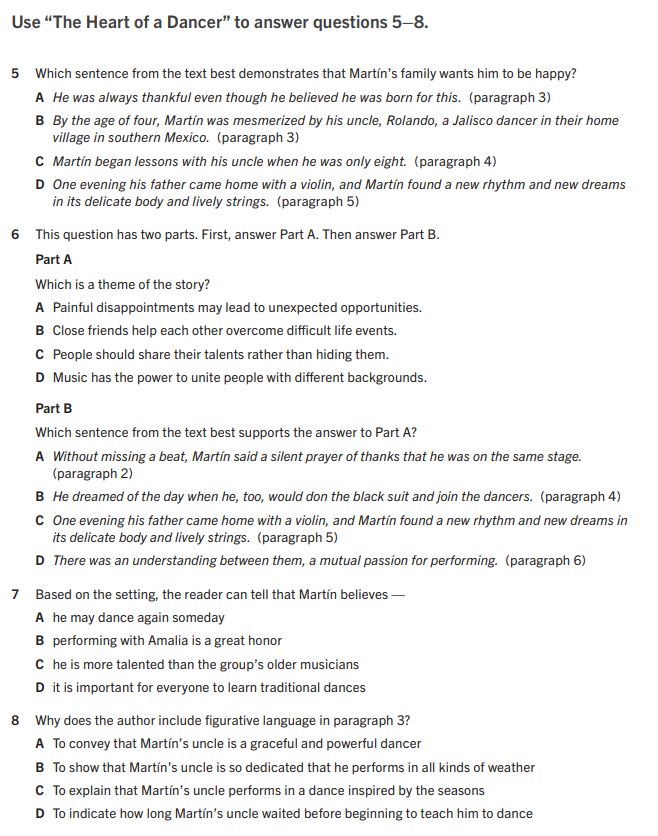
A) At one point, only Spanish dancers were allowed to perform baile folklórico.
B.) Performing baile folklórico was seen as a way to resist Spain's control.
C.) Baile folklórico was in danger of disappearing from Mexico.
D.) Recent changes to baile folklórico have made it more popular.
Which sentence from the text provides the best evidence for the controlling idea in the text?
A.) Centuries passed, but all of Mexico's efforts to gain its independence from Spain were unsuccessful. (paragraph 3)
B.) Since that time, many of the traditional dances have been forgotten. (paragraph 3)
C.) After attending the National School of Dance in Mexico City, she began teaching modern dance and European ballet at the Fine Arts National Institute. (paragraph 4)
D.) Baile folklórico is as beautiful as it is significant to the cultural heritage of Latin America. (paragraph 7)
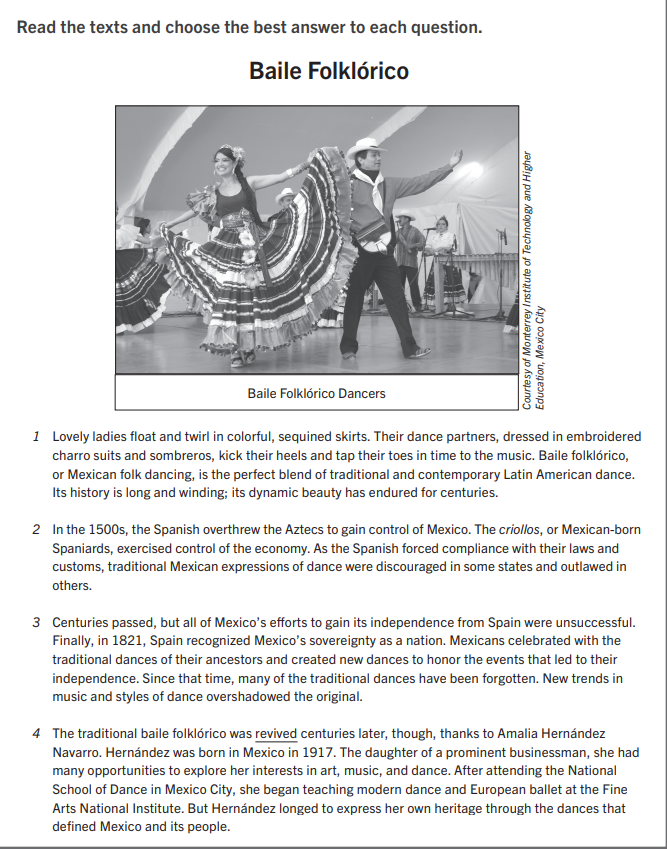
Which idea about baile folklórico is emphasized by the photograph?
A.) Its music is fast and lively.
B.) It contains many modern elements.
C.) Its dancers wear traditional clothing.
D.) It is more popular in Mexico than in other countries.
The Latin root viv, meaning "life, live," helps the reader understand that the word revived means-
A.) regained interst
B.) watched again
C.) considered again
D.) researched by others
Which sentence from the text best demonstrates that Martin's family wants him to be happy?
A.) He was always thankful even though he believed he was born for this. (paragraph 3)
B.) By the age of four, Martin was mesmerized by his uncle, Rolando, a Jalisco dancer in their home village in southern Mexico. (paragraph 3)
C.) Martin began lessons with his uncle when was only eight. (paragraph 4)
D.) One evening his father came home with a violin, and Martin found a new rhythm and new dreams in its delicate body and lively strings. (paragraph 5)
Part A
Which is a theme of the story?
A.) Painful disappointments may lead to unexpected opportunities.
B.) Close friends help each other overcome difficult life events.
C.) People should share their talents rather than hiding them.
D.) Music has the power to unite people with different backgrounds.
Part B
Which sentence from the text best supports the answer to Part A?
A.) Without missing a beat, Martin said a silent prayer of thanks that he was on the same stage. (paragraph 2)
B.) He dreamed of the day when he, too, would don the black suit and join the dancers. (paragraph 4)
C.) One evening his father came home with a violin, and Martin found a new rhythm and new dreams in its delicate body and lively strings. (paragraph 5)
D.) There was an understanding between them, a mutual passion for performing. (paragraph 6)
Based on the setting, the reader can tell that Martin believes-
A.) he may dance again someday
B.) performing with Amalia is a great honor
C.) he is more talented than the group's older musicians
D.) it is important for everyone to learn traditional dances
Why does the author include figurative language in paragraph 3?
A.) To convey that Martin's uncle is a graceful and powerful dancer
B.) To show that Martin's uncle is so dedicated that he performs in all kinds of weather
C.) To explain that Martin's uncle performs in a dance inspired by the seasons
D.) To indicate how long Martin's uncle waited before beginning to teach him to dance
One way the texts differ is that only "The Heart of a Dancer"-
A.) highlights the role of live music in baile folklórico
B.) captures the public's enthusiasm for baile folklórico
C.) acknowledges a person who helped preserve baile folklórico
D.) provides details about the traditional costumes of baile folklórico
Which evidence in "The Heart of a Dancer" best supports the idea that the Amalia in Martin's dance troupe is Amalia Hernandez from Baile Folklórico?
A.) Amalia wears a red, white, and black dress as she performs.
B.) Martin thinks Amalia as the heart of his dance company.
C.) Amalia shares the stage with many other dancers.
D.) Martin believes that Amalia loves to perform.
With which idea would both authors most likely agree?
A.) Baile folklórico can only truly be appreciated by someone who performs it.
B.) Balie folklórico may never completely recover from its historic treatment.
C.) Baile folklórico holds a special significance for people in Latin American countries.
D.) Baile folklórico dancers must start learning its technique when they are children.