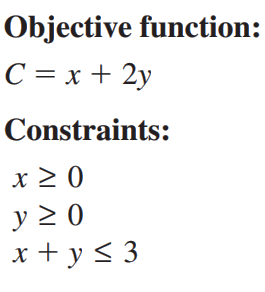
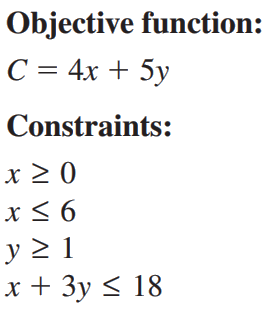
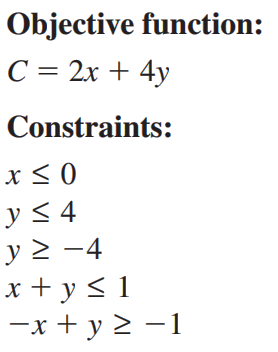
Work with a partner. Linear programming is a modeling technique that is useful for quantitative decisions in engineering, business, and the sciences. To solve a linear programming problem, you must find the maximum and minimum values of a linear equation within a set of constraints expressed as inequalities. This is called the feasible region, or the solution set of a system of linear inequalities. The extreme values, or maximum and minimum values, of any objective function f (x, y) must occur at the vertices of the feasible region
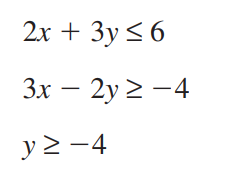
Use technology to graph the system of inequalities.
Complete the table by evaluating the function f (x, y) = x + 3y at the vertices of the feasible region.
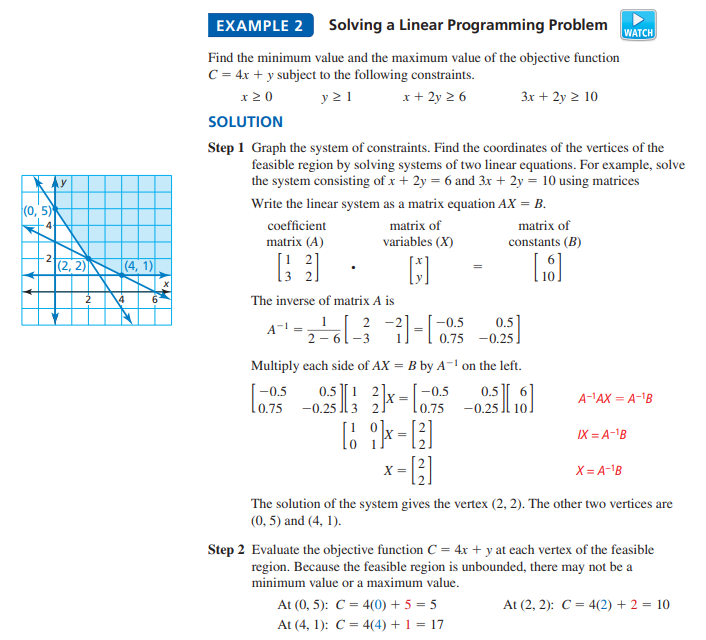
By evaluating the objective function for several other points in the feasible region, you can see that the value of the objective function increases without bound as the coordinates increase. So, the objective function has no maximum value on the feasible region. The minimum value is 5. It occurs when x = 0 and y = 5.
Real-Life Application
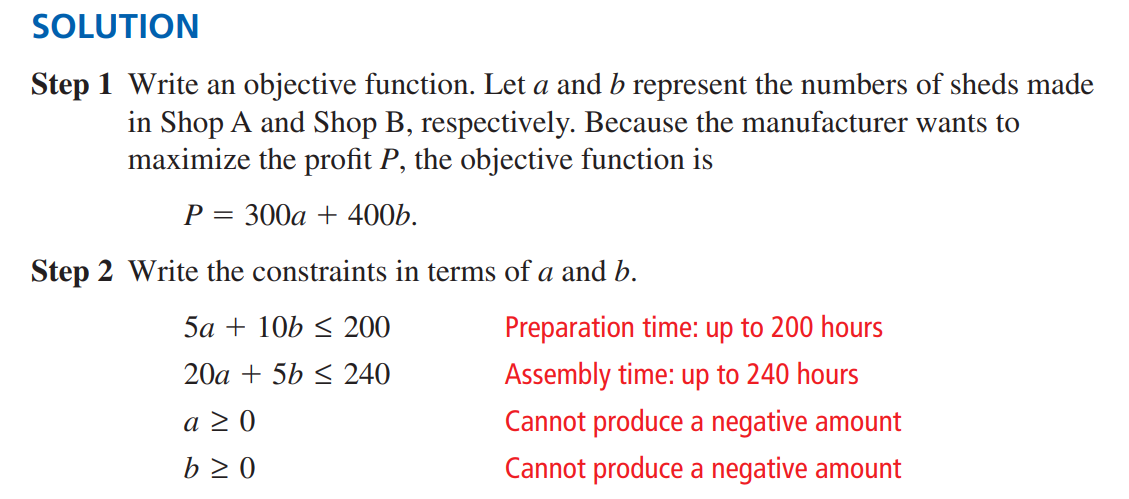
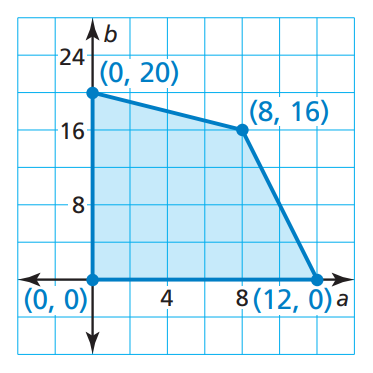
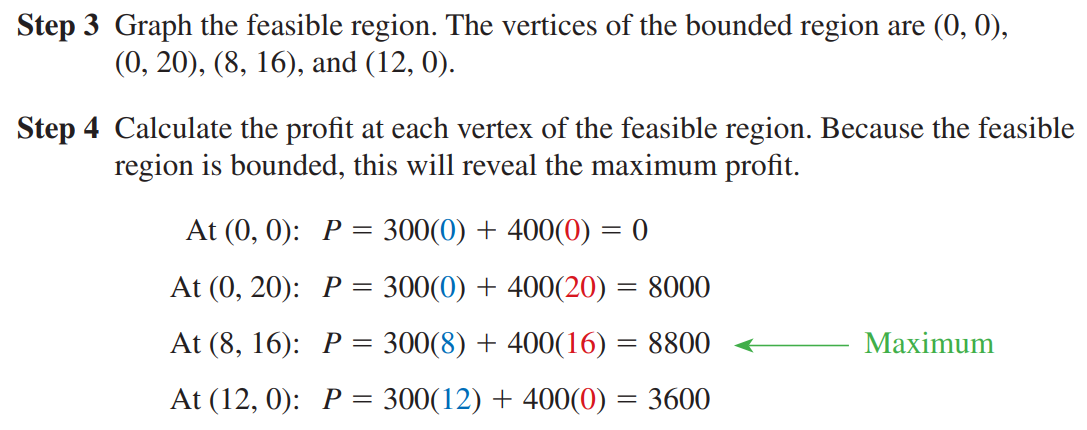
Two woodshops make the same kind of garden shed. The table gives the preparation and assembly times (in hours) required to make one shed in each shop. For the two shops combined, the manufacturer can afford to use up to 200 hours for preparation and up to 240 hours for assembly per week. Shop A earns a profit of $300 per shed and Shop B earns a profit of $400 per shed. How many sheds per week should the manufacturer make in each shop to maximize profit?