What is the term for a feature that allows an organism to survive better in its environment?
1 point
1
Question 2
2.
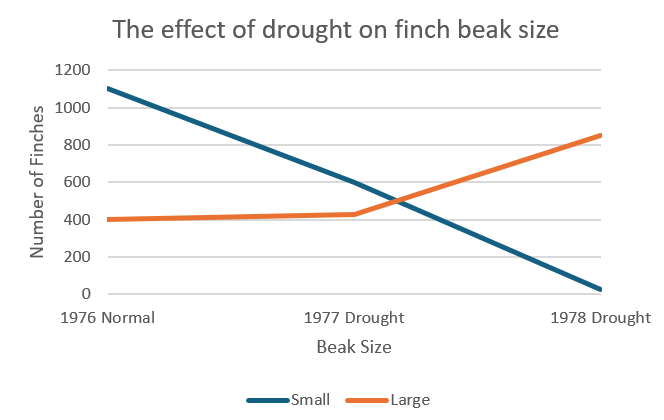
Which of the following statements might best explain the increase in average beak size in the finch population during the drought?
1 point
1
Question 3
3.
Which of the following best characterizes natural selection?
1 point
1
Question 4
4.
Which of the following is NOT a part of Darwin’s theory of evolution by natural selection?
1 point
1
Question 5
5.
A group of imaginary creatures known as “fur babies” come in three forms: super-wooly fur baby, short-haired fur baby, and naked baby. Due to mankind’s inability to control its carbon emissions, a greenhouse effect is created and the global climate rises. Before the global warming, the wooly fur baby existed in the largest frequency with the short-haired fur baby in a close second. The naked baby existed in the lowest numbers. One hundred years later, scientists noticed that not only did the wooly and short-haired fur babies decline to near extinction, but the naked babies’ frequency also increased. Based on this information which is the most likely reason for this trend?
7.2 Evidences for Evolution
1 point
1
Question 6
6.
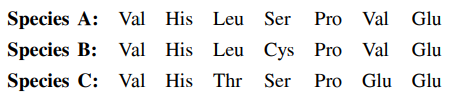
The amino acid sequences of three species shown below were determined in an investigation of evolutionary relationships. Based on these data, which two species are most closely related?
1 point
1
Question 7
7.
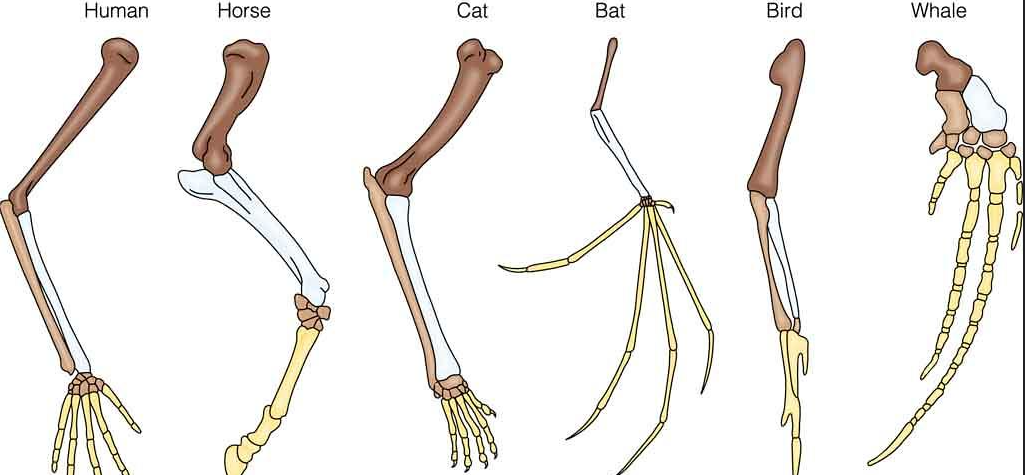
This diagram provides a good example of
1 point
1
Question 8
8.
Which of the following would not qualify as evidence for evolution?
1 point
1
Question 9
9.
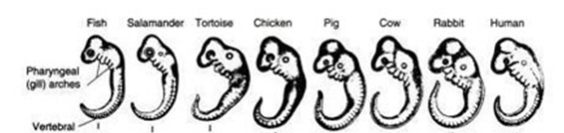
Based on the picture below, what can a scientist conclude?
1 point
1
Question 10
10.
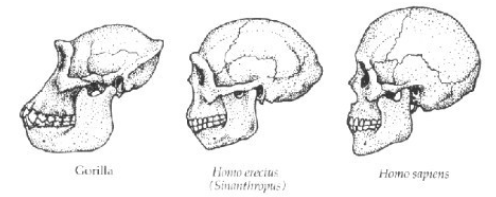
Scientists have found evidence that about 2.4 million years ago a gene regulating jaw muscles mutated and may have led to the more modern human jaw we see today. The diagram below shows the skulls of 3 hominid species. Which statement below most closely explains the link between jaw size and hominid evolution?