Log in
Sign up for FREE
arrow_back
Library

Unit 7 Evolution & Classification Test

star
star
star
star
star
Last updated over 1 year ago
20 questions
LT 7.1 Natural Selection
1
7.3a
1
7.3a
1
7.3a
1
7.3a
1
7.3a
LT 7.2 Evidences of Evolution
1
7.4c
1
7.4c
1
7.4c
1
7.4c
1
7.4c
LT 7.3 Cladograms and Phylogenetics
1
8.2c
1
8.2c
1
8.2c
1
8.2c
1
8.2c
LT 7.4 Domains and Kingdoms
1
8.3b
1
8.3b
1
8.3b
1
8.3b
1
8.3b
Question 1
1.

Question 2
2.

Question 3
3.

Question 4
4.

Question 5
5.

Question 6
6.

Question 7
7.

Question 8
8.

Question 9
9.

Question 10
10.

Question 11
11.

Question 12
12.

Question 13
13.

Question 14
14.

Question 15
15.

Question 16
16.

Question 17
17.

Question 18
18.

Question 19
19.

Question 20
20.

The information below was printed on a calendar of important events in the field of biology.

1859
Darwin Publishes
On the Origin of Species by Natural Selection

This information is most closely associated with
an attempt to explain the structural similarities observed among diverse living organisms
the effect of carrying capacity on the size of populations
an explanation for the change in types of minerals in an area through ecological succession
the reasons for the loss of biodiversity in all habitats on Earth
The theory of biological evolution includes the concept that
the smallest organisms are always eliminated by the larger organisms within the ecosystem
fossils are the remains of present-day species and were all formed at the same time
species of organisms found on Earth today have adaptations not always found in earlier species
individuals may acquire physical characteristics after birth and pass these acquired characteristics on to their offspring
The extremes of dry and wet weather of the Galapagos Islands cause the food supply to constantly change. During dry years, the food is mainly large, hard seeds, and finches with large beaks are found in greater numbers.
Which statement best explains this observation?
Finches grow larger when they have more water.
Large beak size is an adaptation in dry conditions
Dry environments cause mutations in finches
Small finches become smaller during dry seasons.
Which statement describes an effect of natural selection on a species?
It favors the survival of certain members of the species and results in a change in the proportion of individuals with highly adaptive traits.
It provides feedback mechanisms for members of a species and results in a change in the proportion of individuals with homeostatic controls.
It leads to reproduction with other species, increasing the number of different adaptations
It increases competition between populations that occupy different niches, increasing the chance of extinction of the less-adapted species
In a certain species of insect, some individuals have flattened white disks on their bodies that protrude and interlock, resembling an orchid flower. This adaptation provides the insect with a better opportunity to capture its prey. If environmental conditions remain unchanged, it is most likely that, in future generations, the proportion of the population with this adaptation will
increase, then decrease
decrease, then increase
increase, only
decrease, only
In the early stages of development, the embryos of fish, amphibians, reptiles, birds and mammals resemble one another. This observation suggests that these animals may have
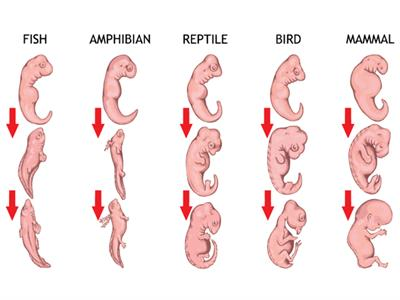
a common ancestor
a similar number of chromosomes
the same blood components
similar habitat requirements
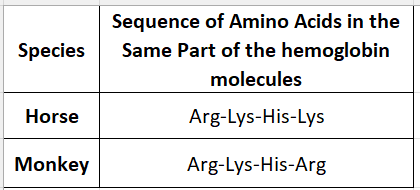
Blood proteins in horses are chemically similar to blood proteins in monkeys. This similarity suggests that horses and monkeys

evolved at the same time
can interbreed
live in the same habitat
may have a common ancestor
Evidence that best supports the theory of biological evolution was obtained from the
investigation of environmental niches
comparison of the number of cells in organisms
study of fossil records
analysis of food chains and food webs
When examining the skeleton of whales, scientists identified a bone that resembles the pelvic bone found in land dwelling mammals.  Whales, however, do not have legs and thus do not use this pelvic bone.  This is an example of:
analogous structure because whales contain a structure adapted to a similar environment compared to other distantly related organisms.
transitional structure because whales contain a structure that originated from a land-dwelling ancestor but now serve a different purpose in a marine dwelling organism
vestigial structure because whales contain a structure that no longer serves a purpose compared to other evolutionarily related organisms
homologous structure because whales contain a structure that shares a similar purpose to other evolutionarily related organisms
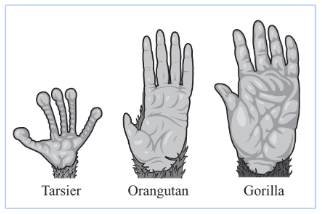
The hands of three primates are shown below.

In addition to having similar external appearances, the primates’ hands have similar bone structures. Which of the following conclusions is best supported by the similarity of these primates’ hands?
Tarsiers, orangutans, and gorillas eat the same types of foods.
Tarsiers, orangutans, and gorillas are descended from a common ancestor.
Tarsiers, orangutans, and gorillas were the first mammals to evolve from reptiles.
Tarsiers, orangutans, and gorillas are classified as different subspecies of the same species.
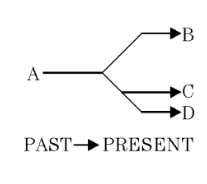
In the diagram shown, B, C, and D represent organisms that exist in the present time and show a striking similarity to each other in their bone structure. In the diagram, letter A most likely represents

homologous structures
a common ancestor
an acquired characteristic
geographic distribution
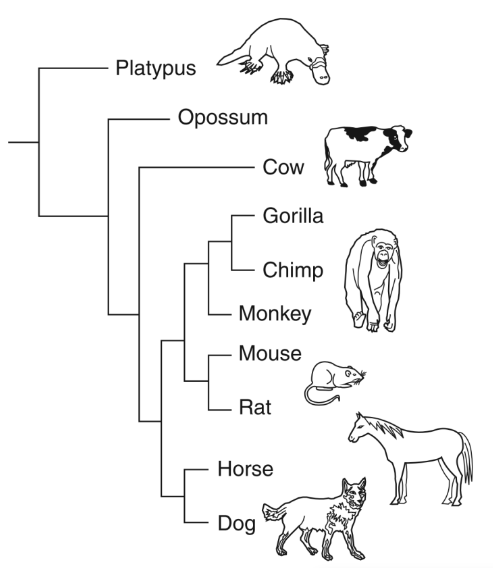
Base your answer(s) to the following question(s) on the diagram below and on your knowledge of biology. The diagram shows the evolutionary relationships of
some organisms.

Which two organisms would most likely synthesize the most similar enzymes?
monkey and mouse
horse and dog
chimp and rat
cow and horse
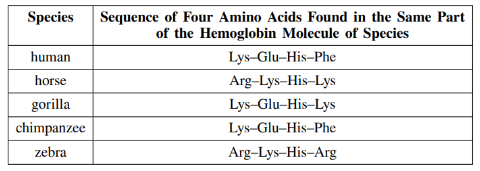
Base your answer to the following question on the information below and on your knowledge of biology

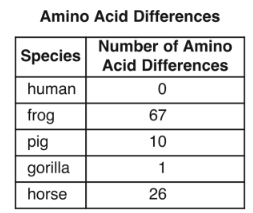
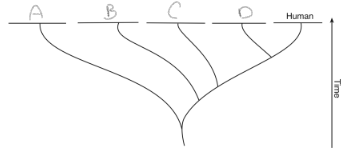
Which evolutionary tree best represents the information in the chart?
The data table below shows the number of amino acid differences in the hemoglobin molecules of several species compared with amino acids in the hemoglobin of humans.


Based on the information in the data table, write the names of the organisms from the table in their correct positions on the evolutionary tree below

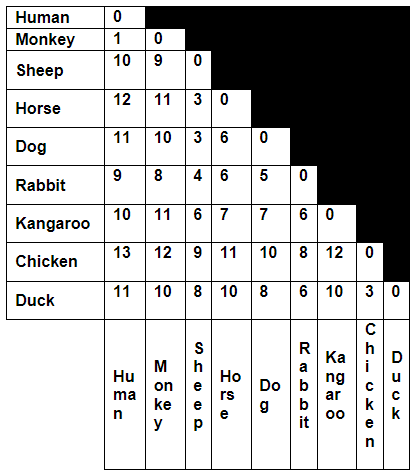
Scientists analyzed the genetic sequences of the protein cytochrome c of several animal species.  The numbers in the table identify how many amino acids in the protein cytochrome c of a given species differ from those of the other studied species.


On the basis of their cytochrome c differences, which of the following pairs of animals are LEAST closely related to each other?
Sheep and chicken
Monkey and chicken
Kangaroo and rabbit
Dog and horse
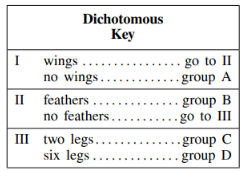
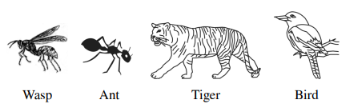
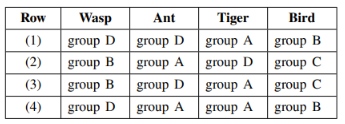
The dichotomous key below provides a way to classify some animals into groups according to their physical characteristics.


The key can be used to classify each of the four animals represented below.


Which row in the chart shows the correct classi fication group for each animal?

Row 2
Row 4
Row 3
Row 1
All organisms in the kingdoms Protista, Plantae, Fungi, and Animalia are
Photosynthetic organisms
Multicellular organisms
Eukaryotes
Prokaryotes
The organism Quercus phellos is a member of the genus
Phellos
Quercus
Protista
Plantae
Mushrooms are a type of fungus. What characteristic of fungi makes them different from plants?
Fungal cells are eukaryotic
Fungi are multicellular
Fungi have cell walls
Fungi are heterotrophic
A scientist is studying two microscopic organisms. Both organisms are single celled and have no defined, membrane bound nucleus. Organism A only inhabits the harsh climate of sulfurous hot springs and organism B are commonly encountered in everyday human life. Which kingdoms would these organisms best be classified in?
Animalia and Protista
Archaebacteria and Eubacteria
Fungi and Eubacteria
Plantae and Archaebacteria