Which light bulbs will remain lit if the wire is cut at Position X?
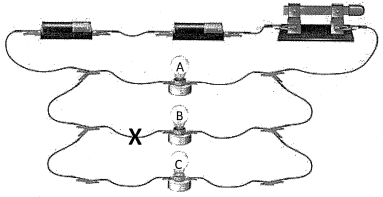
Select TWO correct answers.
Which light bulbs will remain lit if the wire is cut at Position X?
Select TWO correct answers.
Match the titles on the left to the correct definition on the right.
| Draggable item | arrow_right_alt | Corresponding Item |
|---|---|---|
Force | arrow_right_alt | The path that electricity flows |
Circuit | arrow_right_alt | Allows an electrical current to flow through a continuous path |
Open circuit | arrow_right_alt | A push or a pull |
Closed circuit | arrow_right_alt | Does not allow an electrical current to flow through a continuous path |
A student rolled a toy car down a ramp with different surfaces - wood, carpet, and tile. The student measured the distance that the car traveled. Which question is the student most likely investigating?
Which light bulbs will remain lit if the wire is cut at Position X?
Select TWO correct answers.
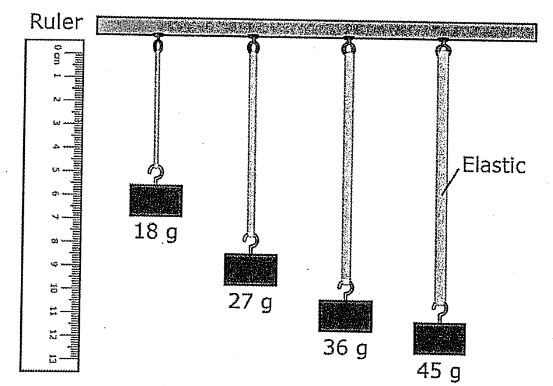
A student designs an experiment to test the effect of the width of a piece of elastic on the elastic's ability to stretch. The student selects four pieces of elastic with different widths but the same length. The student then attaches blocks with different masses to the pieces of elastic. The results of the student's experiment are shown below.
What should the student do to improve this experiment?
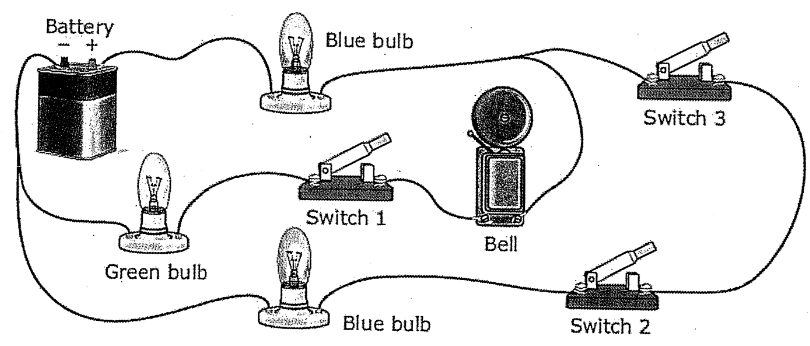
This circuit has three lightbulbs and a bell.
Which procedure will result in only the blue lightbulbs operating?
Match the titles on the left to the correct definition on the right.
| Draggable item | arrow_right_alt | Corresponding Item |
|---|---|---|
Fossil fuels | arrow_right_alt | A resource that can be replaced in a long time (millions of years) |
Nonrenewable resources | arrow_right_alt | A resource that can be replaced in a short time |
Sedimentary rock | arrow_right_alt | A nonrenewable resource formed from the remains of ancient plants and animals using heat, time, and pressure |
Renewable resources | arrow_right_alt | Formed when layers of sediment are compacted and cemented together |
Which of the following is NOT a nonrenewable resource?
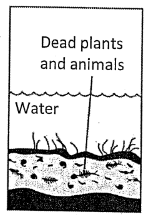
The image shows dead plants and animals under a body of water.
What type of fossil fuels could potentially form from this environment AND what other processes would need to occur to form the fossil fuel(s)?
The type of fossil fuels created under water are . The processes needed to produce these fossil fuels include the of sediment that leads to the of different types of sediments. then occurs which produces heat and pressure. Over millions of years, then occurs which cements all the layers together, producing fossil fuels.
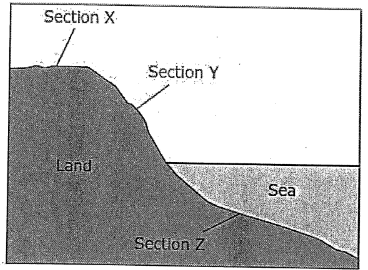
A diagram of different sections of land is shown.
Which action is most likely happening in Section Y in the diagram?
The diagram below shows the sequence of the processes that turn solid rock into sandstone.
Which two processes best complete this diagram?