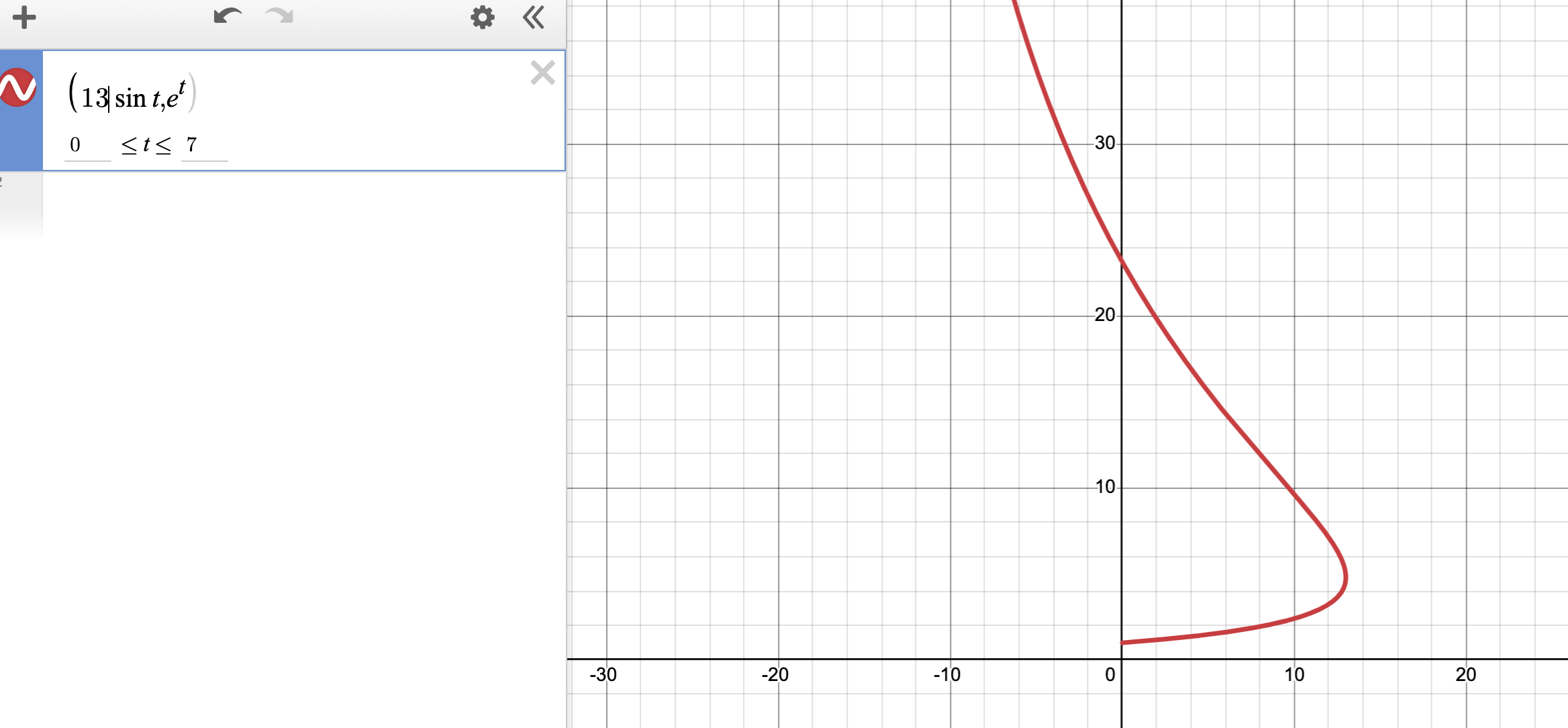
looking at this equation, notice that is parametric. it pass the vertical line test, but it pass the "one output for each input" test.
any questions?
When you graph 3x+4y=2 you get a line. When you graph 3x+4y+2z=5 you get a plane. If you want a line in 3d space, you are going to need parametric equations. go to https://www.desmos.com/3d
and input (2t,3t,5t)
what kind of line do you get?
what does t frequently stand for in questions of parametric equations?
parametric equations are a little like describing vectors - the functions input is t, and the function's output is a coordinate point where x, y and z are each described by a different function.
The vertical line test is a good test to see if a relation is a function if
looking at this equation, notice that is parametric. it pass the vertical line test, but it pass the "one output for each input" test.
how do we graph one of these without using desmos or a graphing calculator? we go back to our early days of Algebra 1 and create a table.
Take the parametric equation
You'll notice that what you graphed there could easily have been written in y=f(x) instead of
sometimes it is easier than others to convert parametric equations into rectangular equations, but typically the method is simple - solve one equation for t, then input that equation into the other equation. for instance:
if your parametric equations are x=4t and y=2t^2 you can solve the first equation more easily for t than the second (square roots mess with your domain, you want to avoid them if you can).
solve for t as a function of x, and then substitute that into the t in the second function. What did you get?
One of the aspects of parametric equations is that it is 2d or 3d movement over time. on desmos (you can use 2d or 3d, it may be easier to see in 2d) create the following parametric equation
create a slider c, then set h=3csinc and k=4cosc, then plot the point (h,k) This will
It should look like this, but I can't get you to work the slider in the embedded view. Create this in desmos and if you move the slider around, you can see that the point move along the graph.
Explain why this parametric equation is still a function even though it does not pass the vertical line test.
So what is this good for? Lets look at a simple situation in physics: if you drop a 1kg mass ball from a 10 meter height and neglect air resistance, you know that the acceleration due to gravity is 9.8m/s^2 and the equation that describes the path of the ball is
using this equation, could you determine when the ball hits the ground (y=0)? round to the nearest tenth
Just like with vectors, you can deal with two different directions independently of each other. If you flick a penny off a table with a force that is parallel to the floor and drop another penny the moment the first penny leaves the edge of the table, the pennies should fall with at the exact same speed and acceleration. the time in the air is the same, but the flicked penny starts with horizontal velocity. The horizontal equation for the first dropped penny is
x=0
but the horizontal equation for the flicked penny, assuming the original velocity is 2m/s is going to be
notice that there is no gravity or force of any kind in the x direction, so there is no acceleration (or deceleration, but deceleration is just acceleration in a direction opposite the velocity). take the time it took to hit the ground (last problem) to figure out how far away from the table edge the penny got.
On desmos graph the following parametric equations:
then create a slider c , and create three points to follow the three lines, the way you did above. You should notice as you move the slider c, the three points will follow the three paths in similar ways. they will all hit the x axis at the same time.
what you just did was graph the parabolic motion associated with falling objects, both in 1d and 2d. Your graph doesn't just capture the path of the ball, but using parabolic equations allows you to capture the time element of that parabolic motion.
What did you notice when you make this graph?
there are typically many different ways you can turn a rectangular function into a parametric equation. for instance, if you are given that y=3x^2 but x = t+1, you should be able to plug the x into the original equation to find y as a function of t.
y=3(t+1)^2 = 3t^2+6t+3
What would you get if you were given that x=t-2?
how are you feeling?
what are parametric equations?
how do you translate parametric equations to rectangular?
how do you translate rectangular to parametric?
why do you need one of the parameters before fully translating rectangular to parametric?
how are parametric functions that don't pass the vertical line test still a function?
how to use desmos to demonstrated the movement of the function over time
what this is good for
parabolic motion of falling objects as a parametric function
I've got this
I'm fuzzy
so confused