U5D7 Review Matrices Apr17
star
star
star
star
star
Posljednje ažuriranje about 1 year ago
25

1
1
1
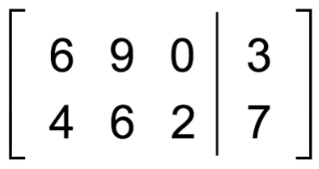
What are the dimensions of the matrix?
What are the dimensions of the matrix?
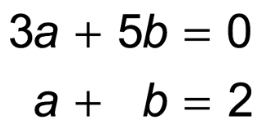
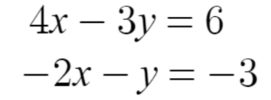
Which matrix represents the system?
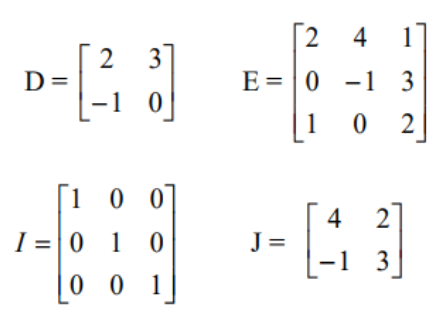
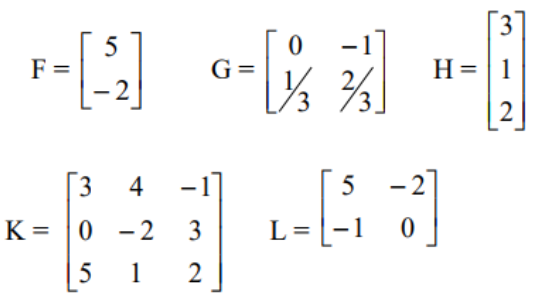
Use the following matrices to answer questions 4 - 6.
a =
b =
c =
d =
For #7 - 11.
Use an inverse matrix to solve the linear system.
a =
b =
c =
d =
a =
b =
a =
b =
a =
b =
c =
d =
The solution to the system is (
(A-1)(B) = X
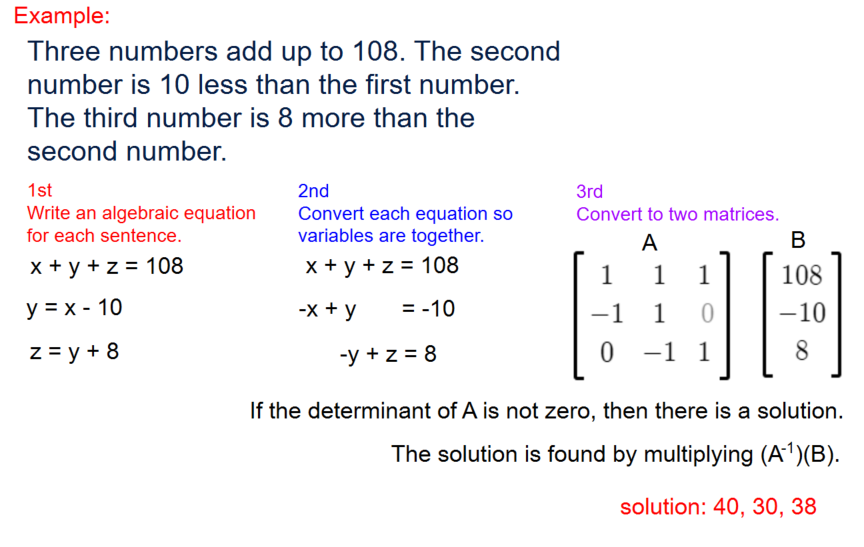
Three numbers add up to 217. The second number is 3 more than the first number. The third number is 5 less than the second number.
Construct a system of linear equations to describe the situation. Then calculate the determinant to determine whether there will be a unique solution or not.
The determinant is
Is there a unique solution?
If there is a unique solution, then find it.
The first number is
The second number is
The third number is
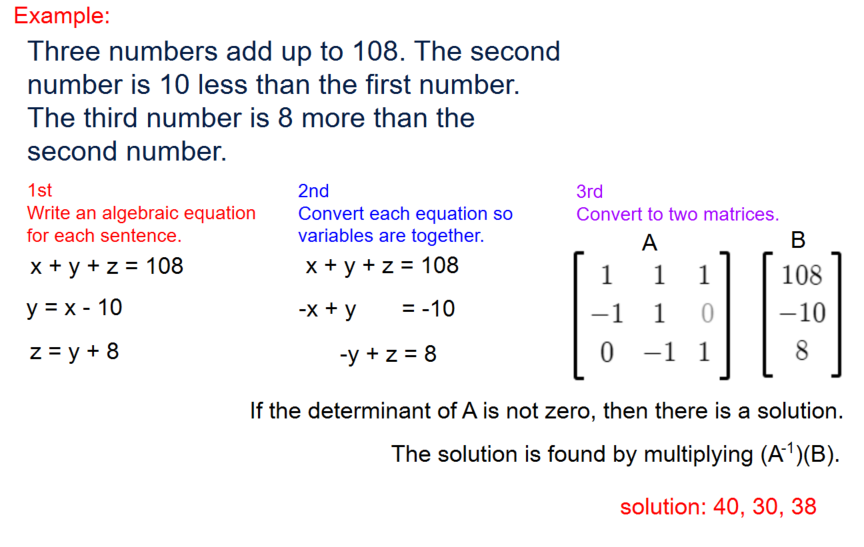
Three numbers add up to 345. The second number is 13 more than the first number. The third number is 11 less than the second number.
Construct a system of linear equations to describe the situation. Then calculate the determinant to determine whether there will be a unique solution or not.
The determinant is
Is there a unique solution?
If there is a unique solution, then find it.
The first number is
The second number is
The third number is
Model Real World Problems
A rental car company charges a flat daily fee plus a charge for each mile driven. A car rented for 5 days and driven for 300 miles costs $178, while a car rented for 4 days and driven for 500 miles costs $197. Find the daily fee and the charge for each mile driven.
Choose the augmented matrix that models the situation.
Use matrixes to find the daily fee and the charge for each mile driven.
The daily fee is $
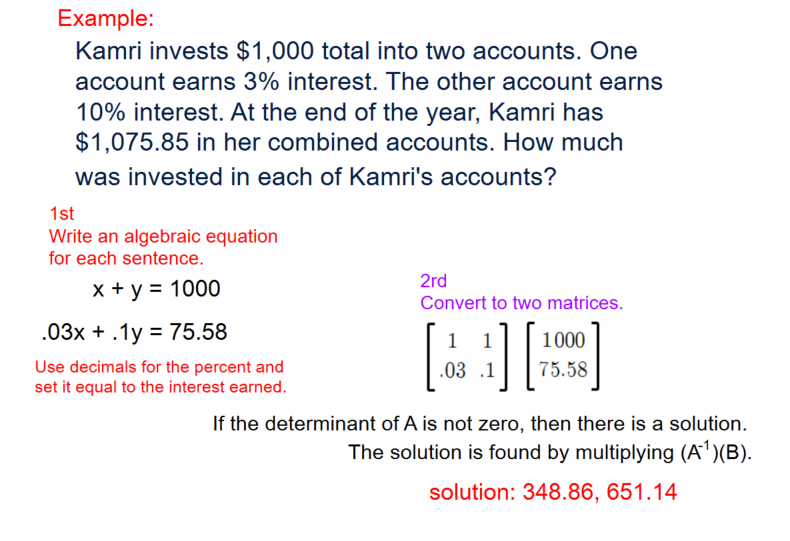
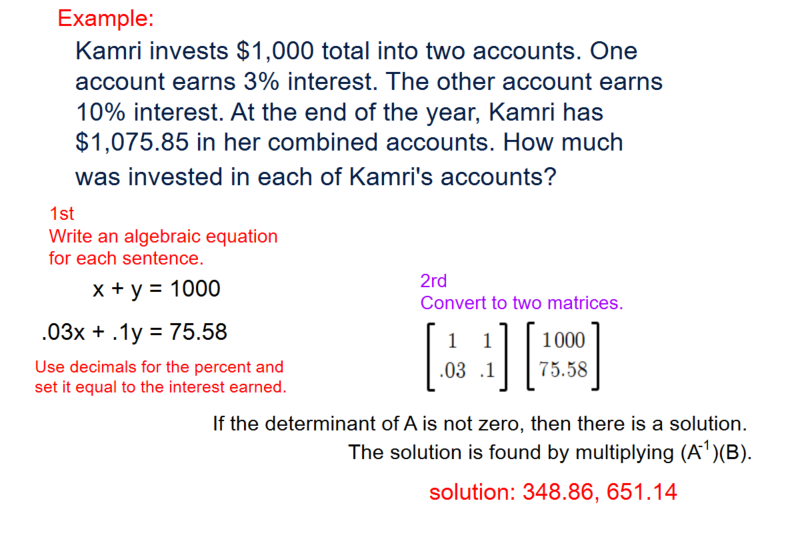
You invest $50,000 total into two accounts. One account earns 7.5% interest. The other account earns 5% interest. At the end of the year, you have $53,012.50 in your combined accounts. How much was invested in each of your accounts?
The amount invested in the 7.5% interest account was $
The amount invested in the 5% interest account was $
You invest $10,000 total into two accounts. One account earns 9% interest. The other account earns 6% interest. At the end of the year, you have $10,729.63 in your combined accounts. How much was invested in each of your accounts?
The amount invested in the 9% interest account was $
The amount invested in the 6% interest account was $
The total cost of five oranges and seven avocados is $25.04 . The cost of each orange is $1 more than the cost of each avocado.
Construct a system of linear equations to describe the situation. Then calculate the determinant to determine whether there will be a unique solution or not.
The determinant is
Is there a unique solution?
If there is a unique solution, then find it.
The cost of an orange is $
The cost of each avocado is $
For which of the following is the solution defined (defined = you are allowed to do the operation and get a solution)? Select all that apply.
Select all the matrices with a determinant.
Select all the matrices that can be multiplied by D. example (D)(X) = so D goes first.