Practice 16E
star
star
star
star
star
Last updated about 2 years ago
12 Nsɛmmisa
1
1
1
1
2

2
1
1
1
1
1
1
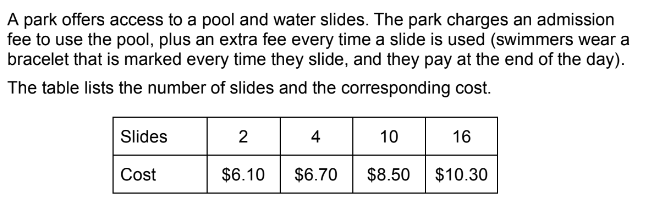
What is the cost per side (slope)?
What is the cost of going to the pool without going on any slides (y-intercept)?
Using your previous two answers, write an equation in slope-intercept form (y = mx +b) that represents the relationship between the cost and the number of slides.
Let c = the cost be the dependent variable (y) and s = the number of slides be the independent variable (x).
A customer wants to know how much money to bring with her to the pool, if she wants to go down the slides 24 times?
Graph a line using data from the table. Extend the line the full length of the grid. Use your graph to predict the cost of going on 12 slides.
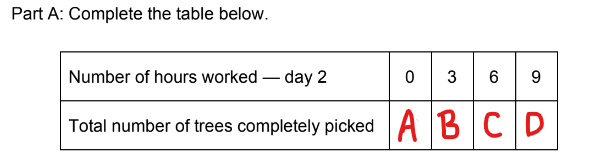
| Draggable item | arrow_right_alt | Corresponding Item |
|---|---|---|
15 | arrow_right_alt | A |
25 | arrow_right_alt | B |
10 | arrow_right_alt | C |
20 | arrow_right_alt | D |
Note: Round to the nearest hundredth.
Write an equation in slope-intercept form (y = mx +b) that represents the relationship between the number of trees and the hours worked.
Let t = the number of trees be the dependent variable (y) and h = the hours worked be the independent variable (x).
Using your equation from #8, if there are a total of 100 trees to pick in the orchard, how many hours will it take to pick them all? Round to the nearest hour.
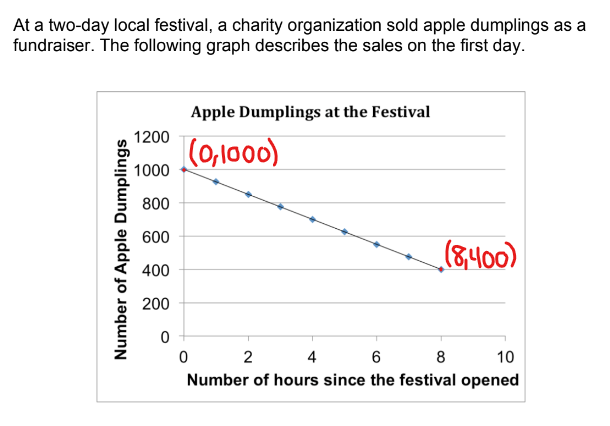
How many apples dumplings are sold per hour (slope) at the festival?
Note: The slope of the line is negative.
Write an equation in slope-intercept form (y = mx +b) that represents the relationship between the number of apple dumplings sold and the hours of the festival.
Let d = the number of dumplings be the dependent variable (y) and h = the hours open be the independent variable (x).
Use your equation from question 11 to determine how many apple dumplings are left after 8 hours. Check your answer with the graph.