In this virtual experience, you will build your knowledge so that you can convince someone about the scientific basis for the current scientific theory about the origin of the universe.
These Support Slides have been created to guide you through this information - you'll need to flip back and forth between those slides and this Formative.
What are some ways that studying space can help people here on earth? You can share your own reasons or ones from the video on slide 2.
What curiosities or questions do you have about space? We won't talk much about planets in this unit, but feel free to put some of those questions here if you're curious about them!
The Doppler Effect: The apparent change in the frequency of a wave due to the relative motion between the source of the wave and the receiver.
Click on "Show Your Work" below to draw what happens to the sound waves of a train that is moving.
Because of the Doppler Effect, if an object that's making noise is moving towards you, you'll hear that sound with a frequency that is:
Hint: Watch this short video to hear it for yourself.
Because of the Doppler Effect, if an object that's making noise is moving away from you, you'll hear that sound with a frequency that is:
The apparent frequency of light can also be affected by the Doppler Effect, but instead of changing the pitch of the sound, it would change the color or type of light.
The "electromagnetic spectrum" encompasses all the versions of light - we often only think about the visible light range, but it's actually only a small portion of the overall spectrum:
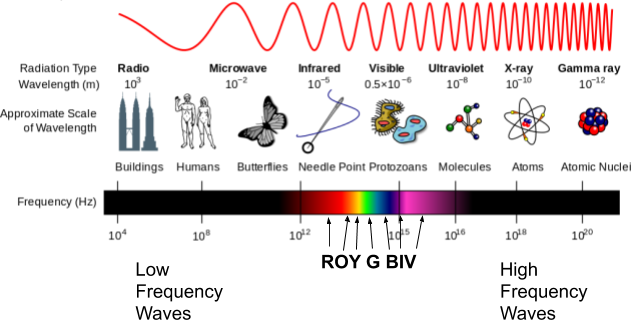
If a star making light was moving toward us, how would the frequency and color change?
If a star making light was moving away from us, how would the frequency and color change?
Go back the slideshow to finish the videos that you started before and then answer this crucial question:
Evidence Piece: Why is the sky dark at night and what does that mean about what the universe is doing? Use the phrase "Doppler Effect" in your answer
Question 2: What is that mysterious signal coming from space? Watch the intro video linked in the slideshow to answer the next 2 questions:
What were Robert Wilson and Arnold Penzias initially trying to do?
What had Wilson and Penzias actually discovered?
Check all the true statements:
The intro video describes the discovery of the Cosmic Microwave Background Radiation, but it doesn't use that phrase. Use the second CMB video to write out a definition for what the Cosmic Microwave Background is:
Evidence Piece: How does the “Cosmic Microwave Background Radiation” provide evidence that the “Big Bang” theory is accurate?
Hint: Check out the slides on this topic for more info and video links.
_____ are observations about the world around us
"Science" is:
The idea that germs cause disease became a theory when:
Observing an apple falling is an example of a:
In order to explain why the apple falls, we need:
The only way to be right all the time is to:
Move on from the video after answering this question: What are some of the benefits of viewing the world from a scientific lens? (select more than 1)