Log in
Sign up for FREE
arrow_back
Library

Urinary System

star
star
star
star
star
Last updated almost 2 years ago
16 questions
1
1
1
1
1
1
1
1
1
1
1
1
1
1
1
Question 1
1.

Question 2
2.

Question 3
3.

Question 4
4.

Question 5
5.

Question 6
6.

Question 7
7.

Question 8
8.

Question 9
9.

Question 10
10.

Question 11
11.

Question 12
12.

Question 13
13.

Question 14
14.

Question 15
15.

1
Which correctly states the level of organization in the body?
organ, organism, tissue, cell
cell, organ, organ system ,tissue
cell, tissue, organ, organ system
tissue, cell, organ system, organ
Click on all the functions of the urinary system.
control the volume of blood by removing excess water
pumps blood through the body
gas exchange- exchange oxygen and carbon dioxide
maintains the balance of salt
movement
support and protection
sends electrical signals throughout the body
Which organ is NOT part of the urinary system?
kidneys
ureter
bladder
rectum
What are kidneys composed of?
nephrons
adipose tissue
neurons
melanocytes
What is the function of the bladder?
moves urine outside the body
filters blood and makes urine
holds urine
transports urine from the kidneys
What is the function of the kidneys?
moves urine outside the body
filters blood and makes urine
holds urine
transports urine from the kidneys
What is the function of the urethra?
moves urine outside the body
filters blood and makes urine
holds urine
transports urine from the kidneys
What structure is labeled A?
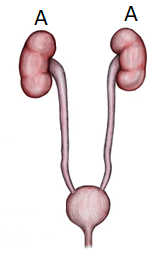
Bladder
Ureter
Kidney
Urethra
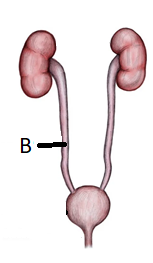
What structure is labeled B?
Bladder
Ureter
Kidney
Urethra
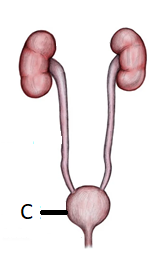
What structure is labeled C?

Bladder
Ureter
Kidney
Urethra
If there is a lot of water in the blood, the kidneys
release insulin
remove excess water and make urine
release glucagon
reabsorb water making less urine
If there is a high concentration of salt in the blood the kidneys will reabsorb water by what process
mitosis
exocytosis
endocytosis
passive transport
Most people are born with two kidneys. However, it is possible to live with only one kidney. Doctors recommend that people with one kidney have their urine tested at least once a year.
Which of the following are doctors most likely trying to determine when testing the urine of a person with only one kidney?
that enough nutrients are dissolving in the blood
that enough oxygen is being delivered throughout the body
that enough red blood cells are being replaced in the blood
that enough nitrogenous waste is being removed from the body
Which of the following is the best example of homeostasis?
heart rate increases when a person exercises
the chest cavity expands when the diaphragm contracts
the biceps muscle relaxes when the triceps muscle contracts
digestive enzymes are secreted when food enters the stomach
A student walks to school in the morning when the outside temperature is 60°F. When the same student walks home after school, the outside temperature has dropped to 35°F. In this situation, how is thermal homeostasis maintained?
The student's heart rate drops as a negative feedback mechanism to deliver less oxygen to the lungs.
The student begins to sweat as a positive feedback mechanism to reduce the core body temperature.
The student begins to shiver as a negative feedback mechanism to increase the core body temperature.
The student's breathing rate slows as a positive feedback mechanism to deliver more oxygen to the lungs.
Question 16
16.

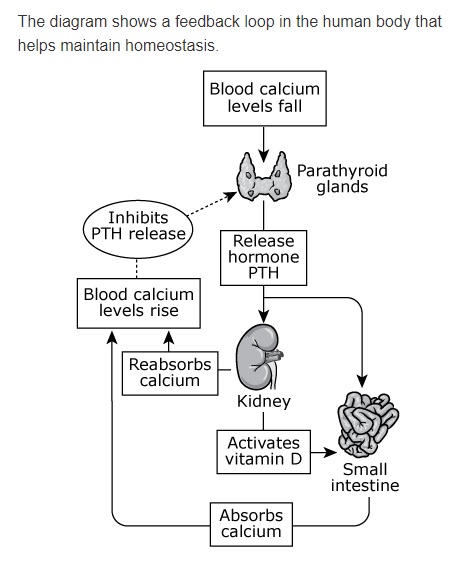
Which of the following is the most likely function of this feedback loop?
A. conversion of calcium to PTH
B. storage of calcium in the kidney
C. regulation of calcium levels in the blood
D. breakdown of calcium in the small intestine