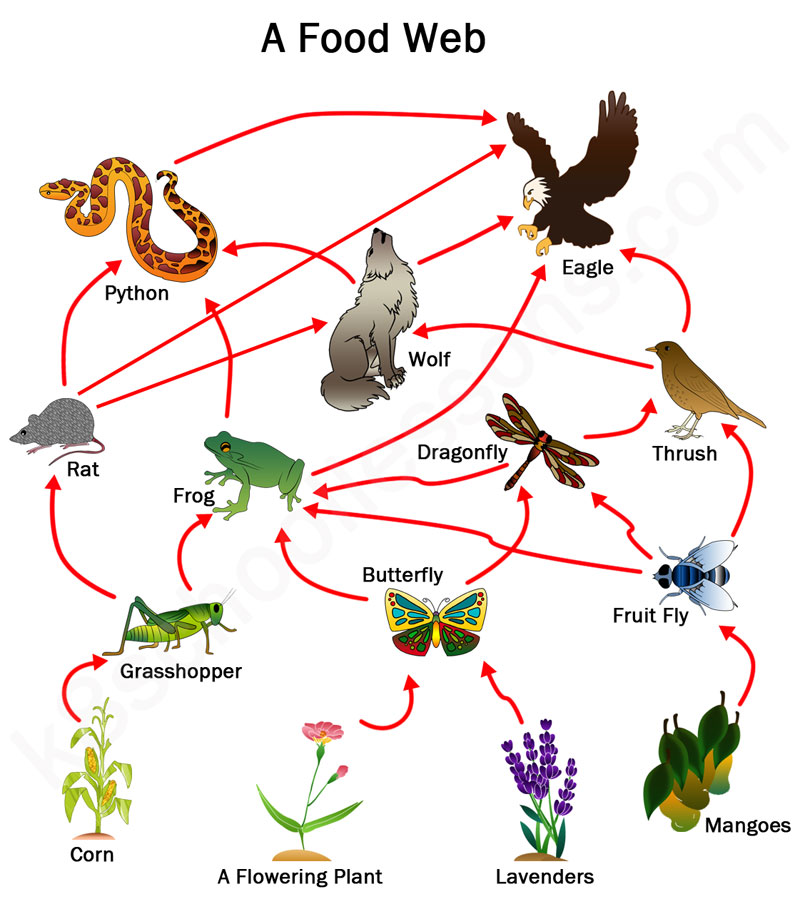
Use the following food web to answer the remaining questions:
Categorize the following based on whether it is a population, community, or neither
All of the white tailed deer in Rhode Island
All of the insects in a specific rainforest
All of the rocks in a lake
All of the insects, fish, and the mud in a and around a lake
All of the fish in a lake
All of the rainbow trout in a river
Population
Community
Neither
Which of the following are examples of intraspecific interactions?
Which of the following are examples of interspecific interactions?
Sort the following interspecific interactions into what kind of interaction they are.
Mutualism
Interspecific competition
Predation
Parasites/pathogens
Herbivory
+/+
+/-
-/-
Which of the following is true about interspecific competition (select all that apply)?
Two species of fish (bass and bluegill) are competing live in the same lake and are competing for the same food sources. They both eat the same insects, crustaceans, and plants. This means that they have overlapping niches. Over time the bass start outcompeting the bluegill and increase in population size. In response the bluegill starts eating insects and plants that the bass doesn't eat.
Explain why it would be beneficial for both species to start eating different foods using the following terms: niche, interspecific competition, competitive exclusion. For reference - my answer (once you submit) is about 5 sentences.
Which of the following are favorable adaptations for predators?
A species of insect has very bright colors that indicates that they are poisonous to eat. This is known as _____.
There is an insect that has similar coloration to the poisonous insect from the previous question. This is known as _____.
Which organism is benefiting from a parasite/pathogen interaction?
Which of the following are examples of mutualism? Select all that apply.
Why would eating the leaves of a plant be an example of herbivory while eating fruit would be an example of mutualism? My answer (once you submit) is about 3 sentences.
Use the following food web to answer the remaining questions:
Which of the following are examples of producers?
Which of the following are examples of primary consumers?
Which of the following are examples of secondary consumers?
Which of the following are examples of tertiary consumers?
Which of the following are examples of quaternary consumers?
Order the following into a food chain (starting with the producer).
Lavender
Wolf
Butterfly
Dragonfly
Eagle
Thrush
Where does all of the energy for this food web come from originally?
Decomposers are not present in this food web. What are examples of decomposers and what is their role? My answer (once you submit) is about 3 sentences.