Preskoči na glavni sadržaj
Prijava
Sign up for FREE
arrow_back
Biblioteka

AP Bio FRQ: Agricultural biologist and wheat crops

star
star
star
star
star
Posljednje ažuriranje about 2 years ago
24 questions
Napomena autora:

This has all interventions/supports included except it does not go deeply enough into how to solve a rate problem (yet). It addresses the immediately-related content and thinking for parts a, b, and c of the released question #2 from 2012's exam.

Quick Explanation: Null vs Alternative Hypotheses
2
Pitanje 1
1.
2.5
FRQ - Agricultural biologist and wheat crops
FRQ Support and Related Concepts (Supports a)
FRQ Support and Related Concepts (Supports b)
(c) and INCOMPLETE review of stages of cellular respiration
Rubric - Please Only Use When You Are Ready

When testing mathematically through chi-square, null and alternative hypotheses are used to frame the statistical test.

You will have the option to learn chi-square (optional edpuzzle) if you are confident in math and would like to 'earn points' in that section, but it recently has not been showing up in detail on the exam. If you are not confident in math, your best bet is to spend your time reviewing the biology so you can earn the points there.

A null hypothesis is a prediction that can be rejected if the data shows changes from 'zero effect' of the independent variable on the dependent variable. For instance, if I tried a new brand of fertilizer on grass, my null hypothesis could be "Application of Super-Gro does not affect the growth of grass." If I saw that super-gro treated grass grew less (and did a chi square test to show that it was statistically significant), that null hypothesis would be rejected. If there was no statistically significant difference in Super-gro treated grass vs non-treated grass, then the null hypothesis would be supported.

An alternative hypothesis is a prediction that is more directional. It's what we think of as a traditional hypothesis. "Application of super-gro increases the growth of grass". Of course, that alternative hypothesis leaves space for two outcomes: either super-gro has no effect, or it causes a decrease in grass growth. So you could have a second alternative hypothesis; "Application of super-gro decreases the growth of grass."

Notation uses subscripts:

H0 = Application of Super-Gro does not affect the growth of grass.

HA1 = Application of Super-Gro increases the growth of grass.

HA2=Application of Super-Gro increases the growth of grass.

Using both the null and alternative hypothesis during statistical testing lets you clearly determine what happened during the experiment, and whether the experiment's data supports or rejects each hypothesis.

The likely thing that you will be asked to do, rather than calculate all of chi-square, is to write or identify a null or alternative hypothesis, or determine whether those hypotheses are supported or rejected based on the data.

You could also be asked to interpret a chi-square number, which doesn't require doing all the math.

Pitanje 2
2.

Sort the examples.

  • Super-Bryte laundry detergent is just as effective as Bargain Bin detergent

  • Bargain Bin detergent is less effective than Super-Bryte laundry detergent

  • independent variable related to the dependent variable

  • Super-Bryte laundry detergent is less effective than Bargain Bin detergent

  • Null

  • Alternative

An agricultural biologist was evaluating two newly developed varieties of wheat as potential crops. In an experiment, seedlings were germinated on moist paper towels at 20ºC for 48 hours. Oxygen consumption of the two-day-old seedlings was measured at different temperatures. The data are shown in the graph below.
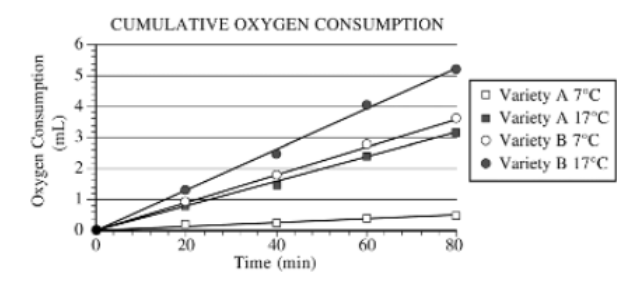
(a) Calculate the rates of oxygen consumption in mL/min for each variety of wheat at 7°C and at 17°C. Show your work (including your setup and calculation).

(b) Explain the relationship between metabolism and oxygen consumption. Discuss the effect of temperature on metabolism for each variety of seedlings.

(c) In a second experiment, variety A seedlings at both temperatures were treated with a chemical that prevents NADH from being oxidized to NAD+. Predict the most likely effect of the chemical on metabolism and oxygen consumption of the treated seedlings. Explain your prediction.

1
Pitanje 3
3.

Complete the free-response, with labels. You may write on paper and upload to emulate the exam experience more closely (there will be no uploading, just a paper booklet on the exam).
An agricultural biologist was evaluating two newly developed varieties of wheat as potential crops. In an experiment, seedlings were germinated on moist paper towels at 20ºC for 48 hours. Oxygen consumption of the two-day-old seedlings was measured at different temperatures. The data are shown in the graph below.

(a) Calculate the rates of oxygen consumption in mL/min for each variety of wheat at 7°C and at 17°C. Show your work (including your setup and calculation).

6
Pitanje 4
4.
1
1
Pitanje 6
6.

As a side note, these are cheap points. For each correct calculation and showing of work, another point is earned. I'm not grading shown work here but you are welcome to show me your procedure to see if you would have earned the point for showing the work in rate formula.)

1

An agricultural biologist was evaluating two newly developed varieties of wheat as potential crops. In an experiment, seedlings were germinated on moist paper towels at 20ºC for 48 hours. Oxygen consumption of the two-day-old seedlings was measured at different temperatures. The data are shown in the graph below.

(b) Explain the relationship between metabolism and oxygen consumption. Discuss the effect of temperature on metabolism for each variety of seedlings.

1
1
Pitanje 9
9.
1
Pitanje 10
10.

"Discuss" is a weird and rarely used task verb these days. Make sure you wrote something about

Variety A/Variety B, or temperature and the oxygen consumption. (One point).

That you COMPARED the varieties; what do you notice about variety A vs variety B? (1-2 points)

And/or you talked about how temperature works in an enzymatic reaction: see the next set of questions to understand how.

Here, copy-paste your previous discussion and compare it to these expectations.

1
2
2
2

An agricultural biologist was evaluating two newly developed varieties of wheat as potential crops. In an experiment, seedlings were germinated on moist paper towels at 20ºC for 48 hours. Oxygen consumption of the two-day-old seedlings was measured at different temperatures. The data are shown in the graph below.

  • c) In a second experiment, variety A seedlings at both temperatures were treated with a chemical that prevents NADH from being oxidized to NAD+. Predict the most likely effect of the chemical on metabolism and oxygen consumption of the treated seedlings. Explain your prediction.

1
1
2.5
4
1
2
6
Pitanje 21
21.
1
1
2.5
Pitanje 5
5.

The procedure for finding a rate (check all useful true concepts for finding rate)

Pitanje 7
7.

Any notes to teacher or self about this kind of question?

Pitanje 8
8.

Check all true statements.

Pitanje 11
11.

When temperature increases, the rate of random molecular collisions

Pitanje 12
12.

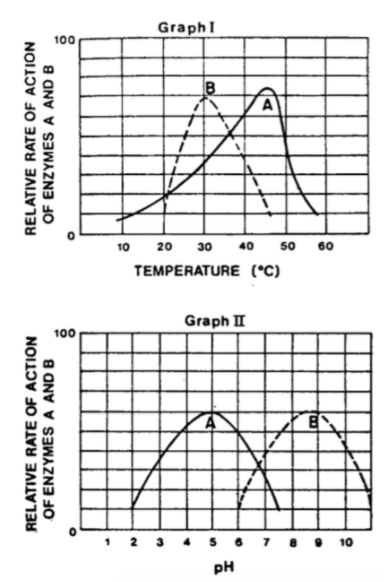
At which temperature has enzyme B reached the most efficient reaction rate?

Pitanje 13
13.

Across which temperature range is enzyme B most likely denatured?

Pitanje 14
14.

Across which temperature range is the environment most likely not optimal to promote molecular collision between the substrate of the enzyme and its active site?

Pitanje 15
15.

Check all true statements.

Pitanje 16
16.

Which graphic organizer best compares the energy inputs and outputs of cellular respiration and photosynthesis?

Pitanje 17
17.

Compare and contrast these processes of living things

  • needs oxygen to take food energy to usable energy

  • plants and algae and some bacteria, but not animals or fungi

  • all eukaryotes - plants, animals, fungi, protists, (prokaryotes also, but a simpler version)

  • break down

  • the alternative pathway for using glucose in absence of oxygen

  • light energy to food energy, produces oxygen

  • Cellular Respiration

  • Photosynthesis

  • Decomposition

  • Fermentation

Pitanje 18
18.

Organize the byproducts and additonal details of photosynthesis and cellular respiration.

  • generates energy

  • produces oxygen

  • consumes oxygen

  • produces O2 as byproduct

  • stores energy

  • chloroplast

  • mitochondria

  • produces CO2 as byproduct

  • Cellular Respiration

  • Photosynthesis

Pitanje 19
19.

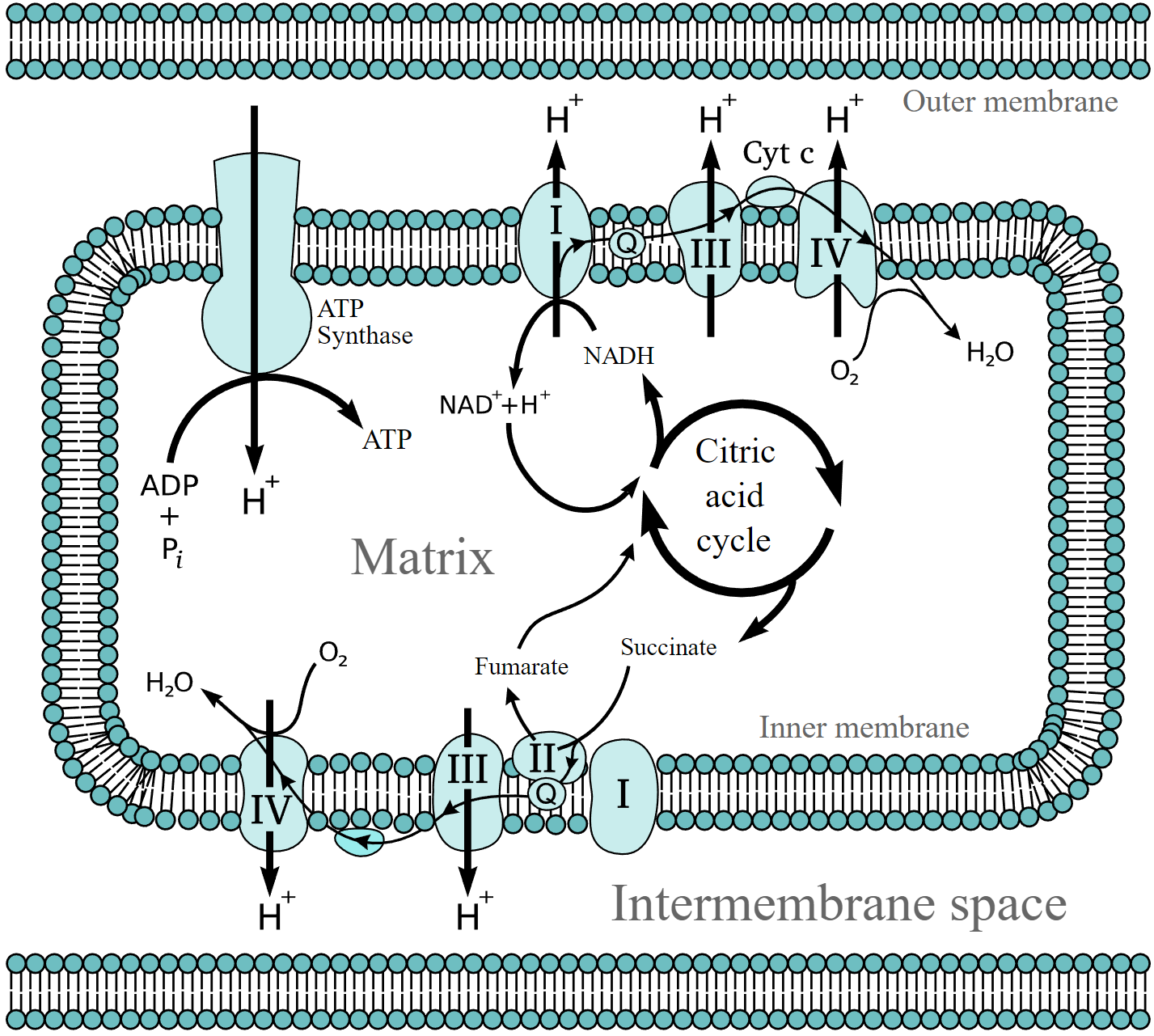
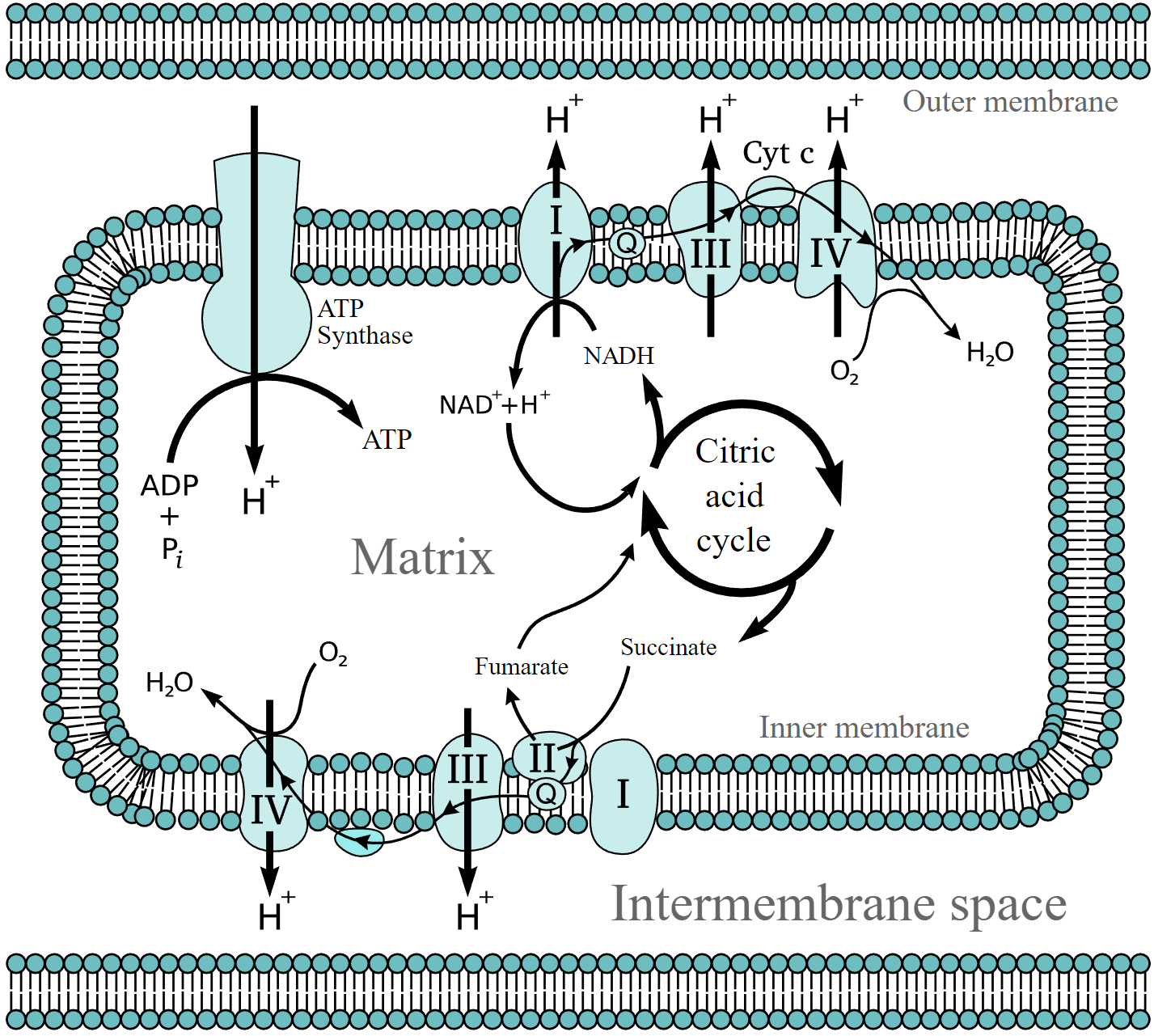
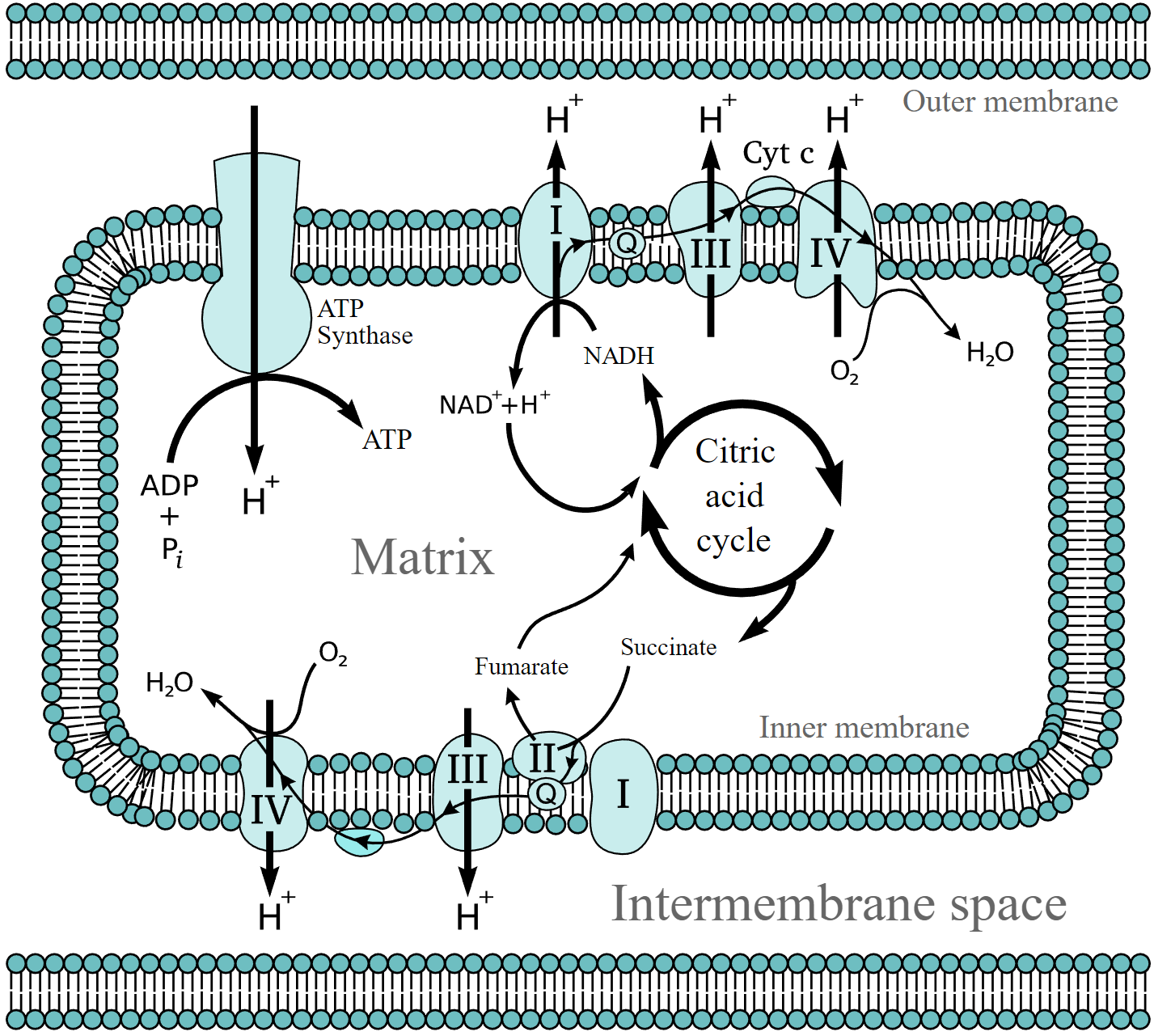
This diagram emphasizes the events of the

Pitanje 20
20.

Resequence the stages into a coherent explanation of what is happening in this diagram.

  1. The Krebs cycle produced electron carriers

  2. ATP synthase facilitates diffusion of hydrogen ions into the matrix; the energy from this chemiosmotic force produces ATP

  3. The energy from electron carriers is donated to the proteins of the electron transport chain

  4. Proteins of the electron transport chain pump hydrogen into the intermembrane space

Pitanje 22
22.

Examine the diagram above and the work you've done with it. Do you need to update your answer? The questions after this one will help you check it, so try writing a clean and clear one first.

c) In a second experiment, variety A seedlings at both temperatures were treated with a chemical that prevents NADH from being oxidized to NAD+. Predict the most likely effect of the chemical on metabolism and oxygen consumption of the treated seedlings. Explain your prediction.

Pitanje 23
23.
Pitanje 24
24.