For each number listed from the diagram below, identify the name of that particular endocrine gland.
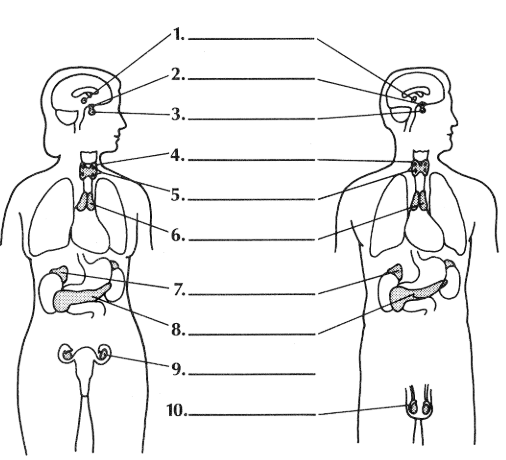
#3 -
#4 -
#6 -
#8 -
#9 -
This tutorial has three sections:
Endocrine System Notes
Immune System Notes
Practice Questions
Please make sure you take helpful, detailed notes during each of the two notes sections. Finally, during the Practice Questions section, you'll answer a series of questions covering content from the notes sections. These practice questions will allow you to check your answers as many times as you need to, before submitting the assignment! Make sure you fully understand each question and answer, though - you'll see similar questions and topics on the CFU and Unit Test!
On your first note page, draw a large table taking up the entire page. It should have four columns and eleven rows (that includes the row that you'll write the column names in).
The four columns should be labeled, in this order:
Gland
Location
Function(s)
Hormone(s)
Fill in the 10 gland names below, in that first column labeled "Gland":
Pineal
Hypothalamus
Pituitary
Thyroid
Parathyroid
Thymus
Adrenal
Pancreas
Ovaries
Testes
Once you've created your table, click the answer below to indicate that you've done so, and are ready to watch the upcoming video and fill in this table!
P.S. There will also be important information about the endocrine system and hormones that you'll need to write down on another page outside of this table! The video starts with this extra information, and then halfway through it will begin a rundown of all the major glands.
Cells that are able to respond to a particular hormone are called . In order to be this kind of cell, the cell must have a for that particular hormone.
For each number listed from the diagram below, identify the name of that particular endocrine gland.
#3 -
#4 -
#6 -
#8 -
#9 -
Why is the pituitary gland sometimes referred to as the "master gland"?
[MARK ALL THAT APPLY!]
Below are a series of statements. Determine whether each statement is TRUE or FALSE. Mark all TRUE statements!
For each symptom listed below, identify the gland that would be most likely to lead to that symptom, if something was wrong/abnormal with that gland.
| Draggable item | arrow_right_alt | Corresponding Item |
|---|---|---|
lack of expected general growth and development | arrow_right_alt | pancreas |
very low rate of metabolism (breaking down food to absorb nutrients is slower than normal) | arrow_right_alt | pineal |
lack of development of typical male reproductive characteristics | arrow_right_alt | pituitary |
chronically high blood sugar levels | arrow_right_alt | thyroid |
difficulty falling asleep at night, but consistently sleepy and tired during the day | arrow_right_alt | testes |
The very first protective force of the immune system .
are one of the earliest immune cells to arrive and respond to a new infection.
Some cells, like , will consume a pathogen, break down its parts into small pieces, and then present those pieces to other immune cells to help find specific cells that will be able to recognize and bind to the pathogen.
Proteins called are able to bind very specifically to certain structures on the outside of a cell and/or pathogen.
[MARK ALL THAT APPLY!]
Which of the following statements are TRUE?
The human immune system is....
Biology is the subject with the teacher.