Use the image below to help answer the questions that follow.
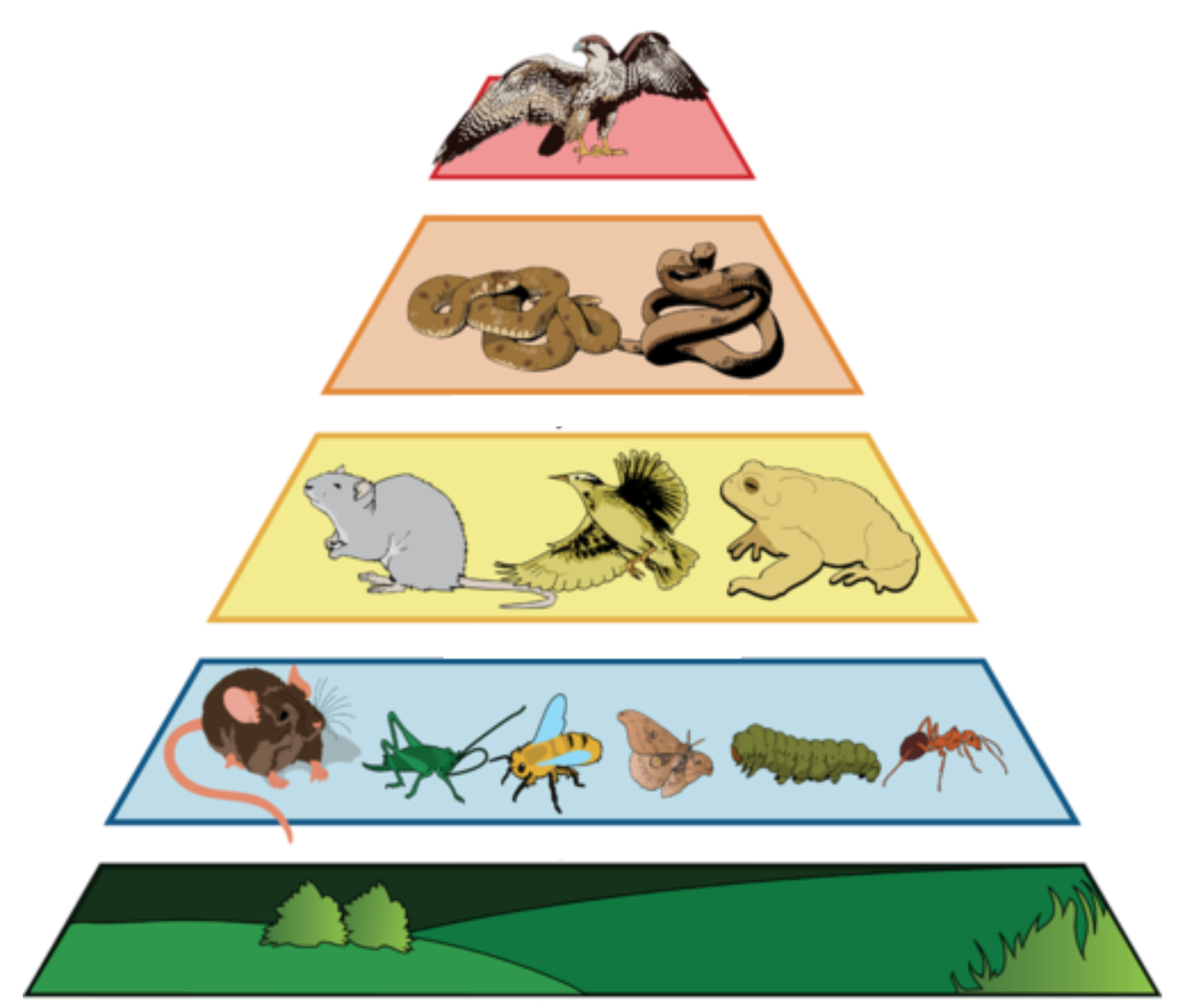
Use the image below to help answer the questions that follow.
What are the organisms at the bottom of the pyramid called?
What are the organisms the next level up called?
What are the organisms the next level up called?
What are the organisms the next level up called?
What are the organisms the next level up called?
Where does all of the energy come from originally for this trophic structure?
Which of the following would have the greatest biomass?
Following the 10% rule, if the producer level has a biomass/energy content of 7,000,000 kcal/kg. What would the biomass/energy content of the primary consumers be? No need to write the unit, just write the approximate number.
Following the 10% rule, if the producer level has a biomass/energy content of 7,000,000 kcal/kg. What would the biomass/energy content of the secondary consumers be? No need to write the unit, just write the approximate number.
Following the 10% rule, if the producer level has a biomass/energy content of 7,000,000 kcal/kg. What would the biomass/energy content of the tertiary consumers be? No need to write the unit, just write the approximate number.
Following the 10% rule, if the producer level has a biomass/energy content of 7,000,000 kcal/kg. What would the biomass/energy content of the quaternary consumers be? No need to write the unit, just write the approximate number.
What is the majority of energy lost as when moving up the trophic structure?
For the next few questions read this short passage first:
The red lionfish (Pterois volitans) has become a significant threat to marine ecosystems in various parts of the world, including the Caribbean Sea and the western Atlantic Ocean. Originally native to the Indo-Pacific region, lionfish were introduced to these new habitats through aquarium releases or accidental releases from aquaculture facilities. With no natural predators in their new environments, lionfish populations have exploded, outcompeting native fish species for food and habitat. This competition has led to a decline in biodiversity as native fish populations struggle to survive against the invasive lionfish, resulting in a less diverse and balanced ecosystem.
Because the lionfish is a non-native species that, when introduced into the new environment, doesn't have limiting factors and causes harm to the native species and ecosystem, what term do we use to describe the lionfish?

Explain why biodiversity in an ecosystem drops when the lionfish is introduced using the data in the table above. When you submit you can compare your answer to mine - I wrote about 3 sentences.
For the next few questions read this short passage first:
The sea otter plays a crucial role in maintaining the health of kelp forests. By controlling sea urchin populations through predation, sea otters prevent these herbivores from overgrazing on kelp beds. However, historical overhunting of sea otters led to a significant decline in their numbers, allowing sea urchin populations to explode. Consequently, the absence of sea otters resulted in the unchecked proliferation of sea urchins, leading to the destruction of kelp forests and the loss of habitat for various marine species which causes a significant decrease in biodiversity.
Because the sea otter plays such a significant role in this ecosystem and, when removed, the ecosystem is harmed and biodiversity drops the sea otter is known as a ___________ species.
Why would the removal of the sea otters reduce the biodiversity of the ecosystem? My answer is about 3 sentences.
For the next few questions read this short passage first:
Historically polychlorinated biphenyls (PCBs) have been used in various industrial applications such as electrical equipment and hydraulic fluids. PCBs are highly stable organic compounds that persist in the environment for a long time. When released into water bodies, PCBs are absorbed by plankton and other small aquatic organisms. As larger predators consume these contaminated organisms, they accumulate higher concentrations of PCBs in their bodies. This process continues as predators higher up the food chain consume contaminated prey, leading to an increase in concentration of the PCBs. Consequently, top predators like birds of prey and marine mammals end up with dangerously high levels of PCBs in their tissues, which can impair their immune systems, reproductive abilities, and overall health. This underscores the importance of proper waste management and regulations to prevent further contamination of ecosystems and protect biodiversity.
The process of an increase in concentration of the PCBs as you move up the food chain/trophic levels is known as _____.
How does the 10% rule relate to the increase in concentration of PCBs in higher level predators? My answer is about 2 sentences.