The Holocaust

Last updated over 1 year ago
19 questions
Look through the slides from last week's guest speaker, and respond to the following questions.
1

Why are people willing or vulnerable to extremist messages and conspiracy theories? How does this relate to what happened in Germany? Italy? Russia?

1

How are extremism and conspiracy theories used to destroy democracy? How did we see this happen in Germany?

1

How can we recognize and interrupt anti-democratic extremism? How does this relate in our current world today?

atrocity

an extremely wicked or cruel act, typically one involving physical violence or injury.

Genocide

is a fairly new word. It was created by Raphael Lemkin who believed that the atrocities of the Holocaust needed a new name to describe them so he combined the prefix geno- meaning “race or tribe” with the suffix -cide which denotes killing.
After the Holocaust, an organization called the United Nations defined the term in the following way:
[G]enocide means any of the following acts committed with intent to destroy, in whole or in part, a national, ethnical, racial or religious group, as such:
  • (a) Killing members of the group;
  • (b) Causing serious bodily or mental harm to members of the group;
  • (c) Deliberately inflicting on the group conditions of life calculated to bring about its physical destruction in whole or in part;
  • (d) Imposing measures intended to prevent births within the group;
  • (e) Forcibly transferring children of the group to another group.
Source: http://www.ushmm.org/wlc/en/article.php?ModuleId=10007043

anti-semitism

hostility to or prejudice against Jews
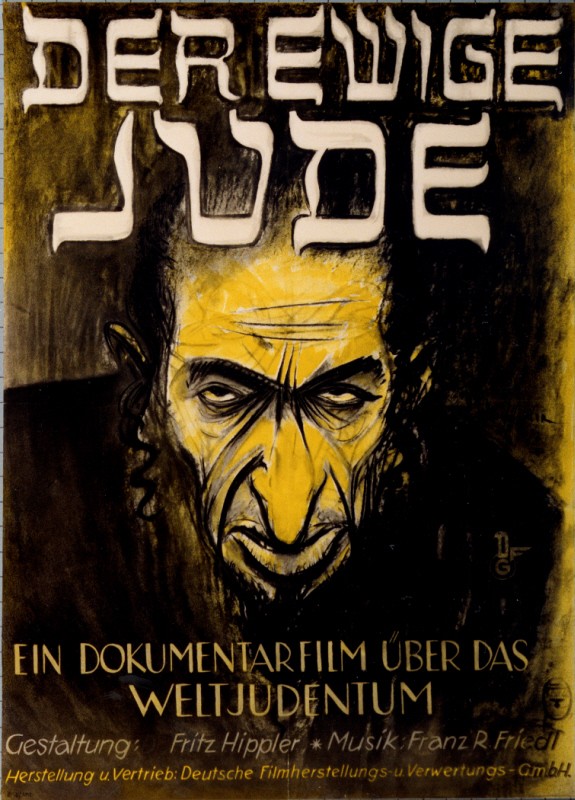

Poster for The Eternal Jew (1940), an anti-semitic German Nazi propaganda film
Image is courtesy of Wikimedia Commons and qualifies for fair use under the copyright law of the United States
1

Identify an event have you studied in history that could be called an atrocity? Why does this event qualify as an atrocity? (Not the Holcaust)

1

Why was the word genocide created?

1

Based on what you have already learned about Nazi Germany, give an example of an anti-semitic action taken by the regime.

What was the Holocaust?

After reading the text below and the rest of the article from the United States Holocaust Memorial Museum’s “Introduction to the Holocaust”, answer the questions below.

The Holocaust was the systematic, bureaucratic, state-sponsored persecution and murder of six million Jewish people by the Nazi regime and its collaborators. Holocaust is a word of Greek origin meaning "sacrifice by fire." The Nazis, who came to power in Germany in January 1933, believed that Germans were "racially superior" and that the Jews, deemed "inferior," were an alien threat to the so-called German racial community.
1

How many Jewish people were killed during the Holocaust?

1

What other groups were targeted during the Holocaust? Why did the German target the Jewish people and these groups?

1

What methods did the Nazis use to separate Jewish people and other targeted groups from the rest of the population?

1

What methods did the Nazis use to carry out the extermination of Jewish people and other targeted groups?

1

What ended the Holocaust?

Directions: Read the poem below, then answer the questions that follow.
First they came for the Socialists, and I did not speak out—
Because I was not a Socialist.
Then they came for the Trade Unionists, and I did not speak out—
Because I was not a Trade Unionist.
Then they came for the Jews, and I did not speak out—
Because I was not a Jew.
Then they came for me—and there was no one left to speak for me.

Poem by Martin Niemöller (1892–1984), a prominent Protestant pastor who emerged as an outspoken public foe of Adolf Hitler and spent the last seven years of Nazi rule in concentration camps.
Source: http://www.ushmm.org/wlc/en/article.php?ModuleId=10007392
1

Which historical event is referenced in the poem above? Why do you think that?

1

Who do you think they are in the poem above? Why do you think that?

1

According the author this poem, who is responsible for the historical event that is referenced?

The Nuremberg Trials
Watch this excerpt from PBS Legacy of War: The Nuremberg Trials and answer the questions below.

The Nuremberg Trials were a series of trials most notable for the prosecution of prominent members of the political, military and economic leadership of Nazi Germany. The trials were held in the city of Nuremberg, Germany, from 1945 to 1946, at the Nuremberg Palace of Justice. The first and best known of these trials was the Trial of the Major War Criminals Before the International Military Tribunal (IMT), which tried 24 of the most important captured leaders of Nazi Germany. It was held from November 20, 1945 to October 1, 1946. The Nuremberg Trials were an attempt to bring to justice those leaders of Nazi Germany who were not only responsible for World War II, but also the Holocaust which was perpetrated against millions of people of Central and Eastern Europe.
Some 200 German war crimes defendants were tried at Nuremberg, and 1,600 others were tried under the traditional channels of military justice. Political authority for Germany had been transferred to the Allied Control Council, which having sovereign power over Germany, could choose to punish violations of international law and the laws of war. Because the court was limited to violations of the laws of war, it did not have jurisdiction over crimes that took place before the outbreak of war on September 1, 1939.
Representatives from four Allied countries, Great Britain, the United States of America, France, and Russia served as prosecutors and judges.
The indictments were for:
  1. Participation in a common plan or conspiracy for the accomplishment of crime against peace
  2. Planning, initiating and waging wars of aggression and other crimes against peace
  3. War crimes
  4. Crimes against humanity
Death sentences were carried out on Oct 16th 1946, and the prisoners sentenced to incarceration were transferred to Spandau Prison in 1947.
The Nuremberg trials initiated a movement for the establishment of a permanent international criminal court, eventually leading over fifty years later to the adoption of the Statute of the International Criminal Court.
  • The Conclusions of the Nuremberg trials served to help draft:
  • The Genocide Convention, 1948.
  • The Universal Declaration of Human Rights, 1948.
  • The Convention on the Abolition of the Statute of Limitations on War Crimes and Crimes against Humanity, 1968.
  • The Geneva Convention on the Laws and Customs of War, 1949; its supplementary protocols, 1977.
Source: “Nuremberg Trials.” New World Encyclopedia. http://www.newworldencyclopedia.org/entry/Nuremberg_Trials
1

What was the purpose of the Nuremberg Trials?

1

What were the defendants on trial for?

1

What evidence was brought forth during the trial to support the indictments?

1

What were the effects of the Nuremberg Trials?

The following video is from the United States Holocaust Memorial Museum.


Why It’s Important to Confront Holocaust Denial

The Nazi persecution of the Jews began with hateful words, escalated to discrimination and dehumanization, and culminated in genocide. The consequences for Jews were horrific, but suffering and death was not limited to them. Millions of others were victimized, displaced, forced into slave labor, and murdered. The Holocaust shows that when one group is targeted, all people are vulnerable.
The denial or distortion of history is an assault on truth and understanding. Comprehension and memory of the past are crucial to how we understand ourselves, our society, and our goals for the future. Intentionally denying or distorting the historical record threatens communal understanding of how to safeguard democracy and individual rights.
2

One of the growing topics that we see discussed more and more today is "Holocaust Denial". After watching the video, what do you believe is the harm when we as a society begin to deny atrocities in history?