Log in
Sign up for FREE
arrow_back
Library

A-level-Edexcel Chemistry - 1.1 Atomic Structure - Easy

star
star
star
star
star
Last updated about 2 years ago
12 questions
1
1
1
1
1
1
1
1
1
1
Question 1
1.

What is the definition of the atomic number of an element?

Question 2
2.

Explain the difference between atomic number and mass number.

Question 3
3.

Bromine exists as two stable isotopes. The two isotopes are represented by the symbols 35 79 Br and 35 81 Br. Give one similarity and one difference between these two isotopes by referring to the number of particles in the nuclei of the two isotopes.

Question 4
4.

The relative abundance of the two isotopes in a sample cannot be found in a chemical test. Give the reason why, despite the difference in atomic structure, the isotopes have the same chemical reactions. State how the relative abundance of the two isotopes can be found.

Question 5
5.

Question 6
6.

Question 7
7.

1
Question 8
8.

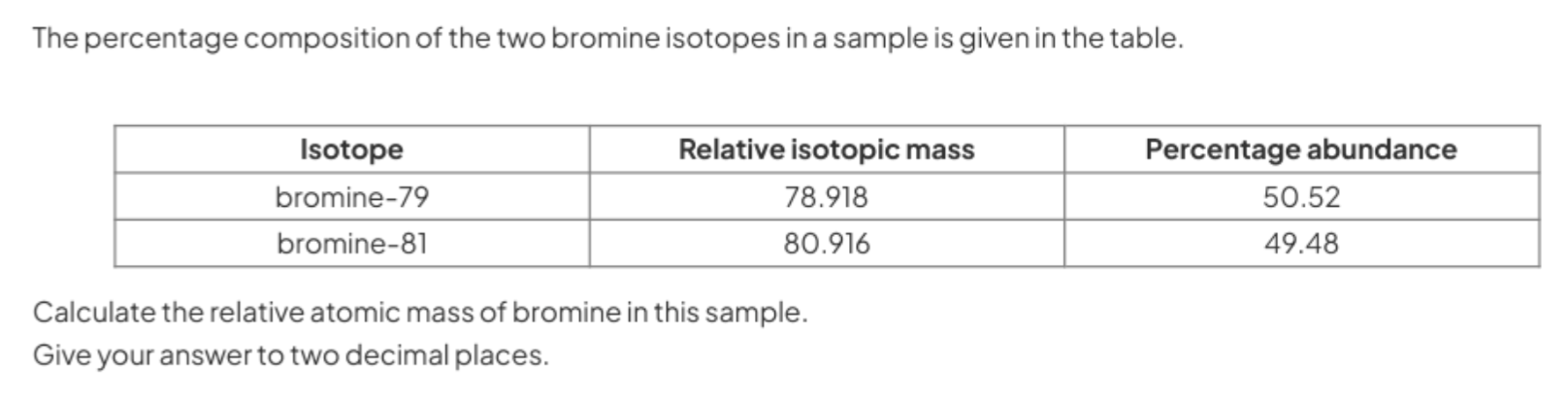
The percentage composition of the two bromine isotopes in a sample is given in the table. Isotope Relative isotopic mass Percentage abundance bromine-79 78.918 50.52 bromine-81 80.916 49.48

Calculate the relative atomic mass of bromine in this sample.

Give your answer to two decimal places.
Question 9
9.

1
Question 11
11.

Question 12
12.

Complete the electronic configuration of a bromine atom. What is the number of electrons in the fourth quantum shell of bromine?
2
7
17
18
Which of the following pairs of ions is isoelectronic?
N3- and Cl-
O2- and S2-
Na+ and K+
Na+ and Mg2+
Which is a correct definition of relative isotopic mass?
A the weighted mean mass of an atom of an element relative to one twelfth of the mass of an atom of the isotope carbon-12
B the mass of one atom of an isotope relative to one twelfth of the mass of an atom of the isotope carbon-12
C the weighted mean mass of an atom of an element relative to 12g of the isotope carbon-12
D the mass of one atom of an isotope relative to the mass of 12g of the isotope carbon-12
The numbers of subatomic particles in an 18O atom are:
8 protons, 10 neutrons, and 8 electrons
9 protons, 9 neutrons, and 9 electrons
10 protons, 8 neutrons, and 10 electrons
18 protons, 18 neutrons, and 18 electrons
Question 10
10.

The total number of electrons in all the occupied p orbitals in a chloride ion, Cl, is
5
6
12
18
Which of these isoelectronic ions has the largest ionic radius?
N3-
02-
Na+
Al3+
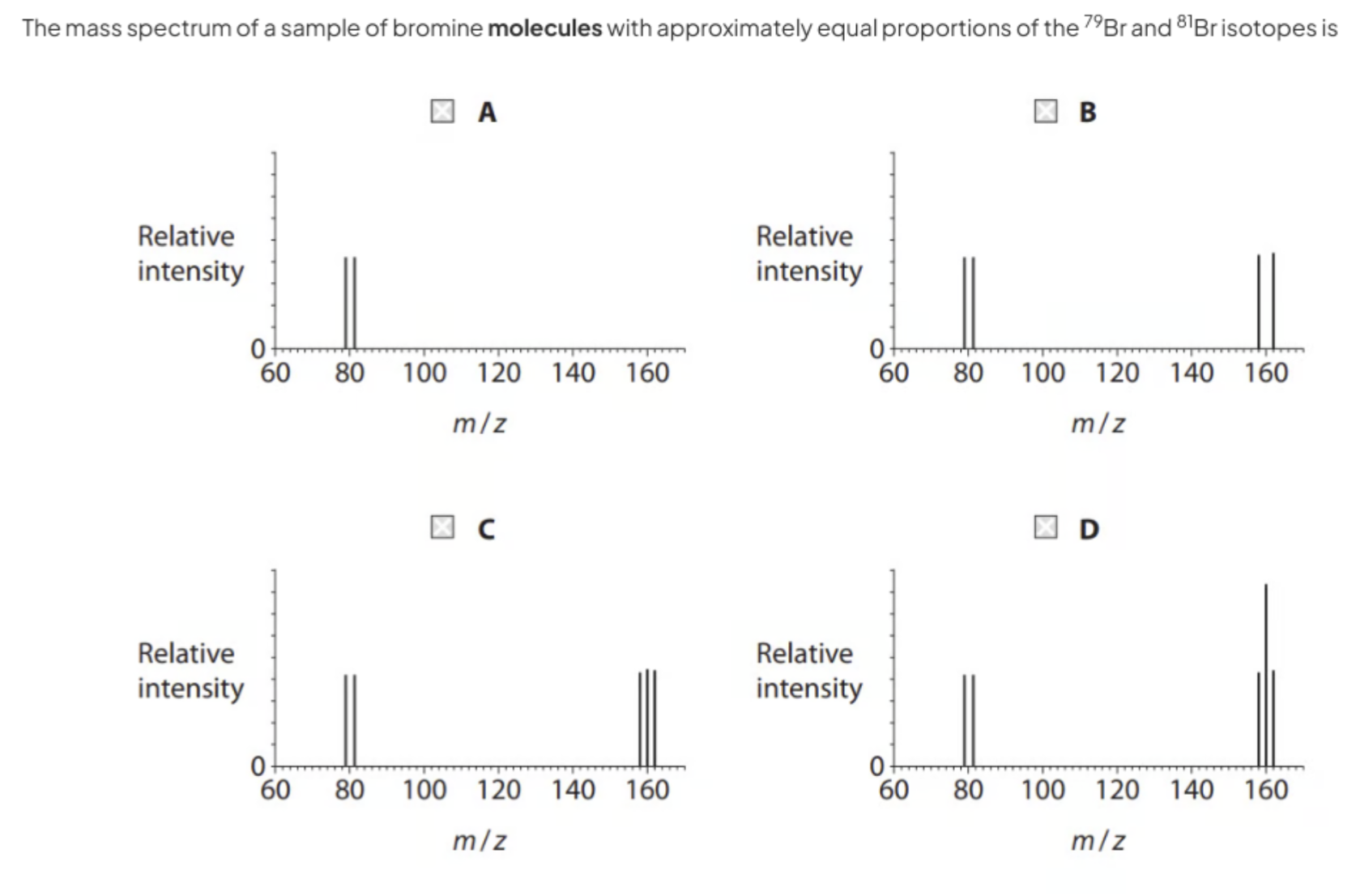
Refer to the image: The mass spectrum of a sample of bromine molecules with approximately equal proportions of the Br-79 and Br-81 isotopes is :
A
B
C
D