Ɛhia
1
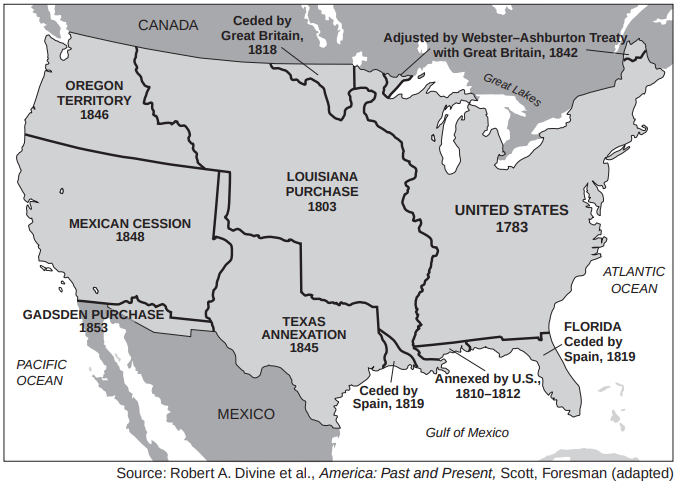
A historian could best use this map to study
A historian could best use this map to study
Ɛhia
1
. . . My object is to consider that undefined, unbounded and immense power which is comprised [included] in the following clause—“And to make all laws which shall be necessary and proper for carrying into execution the foregoing powers, and all other powers vested by this constitution in the government of the United States; or in any department or offices thereof.” Under such a clause as this, can anything be said to be reserved and kept back from Congress? . . .
Source: Antifederalist Papers No. 46, November 2, 1788 (adapted)
The purpose of this statement was to
. . . No Person except a natural born Citizen, or a Citizen of the United States, at the time of the Adoption of this Constitution, shall be eligible to the Office of President; neither shall any Person be eligible to that Office who shall not have attained to the Age of thirty five Years, and been fourteen Years a Resident within the United States. In Case of the Removal of the President from Office, or of his Death, Resignation, or Inability to discharge the Powers and Duties of the said Office, the Same shall devolve on [pass on to] the Vice President, and the Congress may by Law provide for the Case of Removal, Death, Resignation or Inability, both of the President and Vice President, declaring what Officer shall then act as President, and such Officer shall act accordingly, until the Disability be removed, or a President shall be elected. . . .
Source: Article II, Section 1, United States Constitution
. . . The great rule of conduct for us, in regard to foreign Nations is in extending our commercial relations to have with them as little political connection as possible. So far as we have already formed engagements let them be fulfilled with perfect good faith. Here let us stop. Europe has a set of primary interests, which to us have none, or a very remote relation. Hence she must be engaged in frequent controversies, the causes of which are essentially foreign to our concerns. Hence therefore it must be unwise in us to implicate ourselves, by artificial ties, in the ordinary vicissitudes [shifts] of her politics, or the ordinary combinations and collisions of her friendships, or enmities [hostilities]. Our detached and distant situation invites and enables us to pursue a different course. If we remain one People, under an efficient government, the period is not far off, when we may defy material injury from external annoyance; when we may take such an attitude as will cause the neutrality we may at any time resolve upon to be scrupulously [completely] respected; when belligerent nations, under the impossibility of making acquisitions upon us, will not lightly hazard the giving us provocation; when we may choose peace or War as our interest guided by justice shall counsel. . . .
Source: President George Washington, Farewell Address, 1796 (adapted)
In this address, President George Washington states that the United States can stay out of foreign entanglements because of its
A historian could best use this map to study
. . . The history of mankind is a history of repeated injuries and usurpations [wrongdoings] on the part of man toward woman, having in direct object the establishment of an absolute tyranny over her. To prove this, let facts be submitted to a candid world. He has never permitted her to exercise her inalienable right to the elective franchise. He has compelled her to submit to laws, in the formation of which she had no voice. He has withheld from her rights which are given to the most ignorant and degraded men—both natives and foreigners. Having deprived her of this first right of a citizen, the elective franchise, thereby leaving her without representation in the halls of legislation, he has oppressed her on all sides. He has made her, if married, in the eye of the law, civilly dead. He has taken from her all right in property, even to the wages she earns. . . .
Source: Declaration of Sentiments, Seneca Falls, 1848
Based on this excerpt from the Seneca Falls’ Declaration of Sentiments, women should
Browns Station, Kansas Territory, 14th Decem 1855 Dear Sir, I have just returned from the Kansas War (about which you have no doubt learned by the newspapers;) & find your Letter of the 19th Nov[ember]. As I intend to send you shortly a paper published here giving you a more full account of the invasion that I can consistently afford the time to give; I will only say at this time that the Territory is now entirely in the power of the Free State men; & notwithstanding this result has been secured by means of some bravery, & tact; with a good deal of trickery on the one side; & of cowardice, folly, & drunkenness on the other yet so it is; & I believe the Missourians will give up all further hope of making Kansas a Slave State. Tomorrow the people of Kansas will decide whether to adopt or to reject the Free Constitution submitted to them; & I have no doubt of its adoption. Indeed I consider it no longer a question whether this is to be a Free or a Slave State. . . .
Source: John Brown, Letter to Orson Day, December 14, 1855 (adapted)
What was a major cause of the invasion John Brown refers to in this letter?
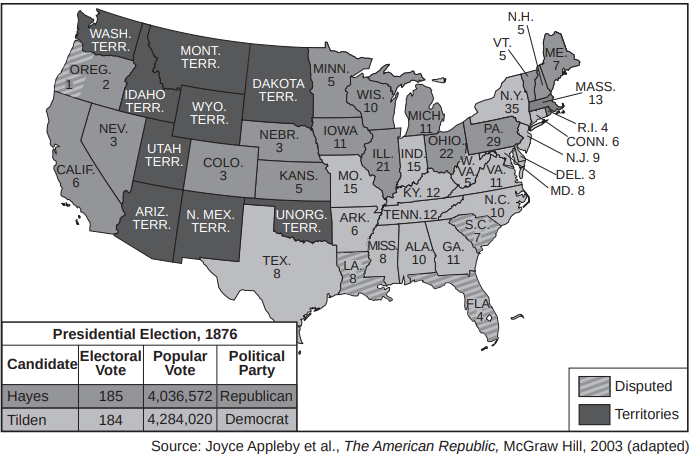
Which conclusion about presidential elections is supported by the information on this map?
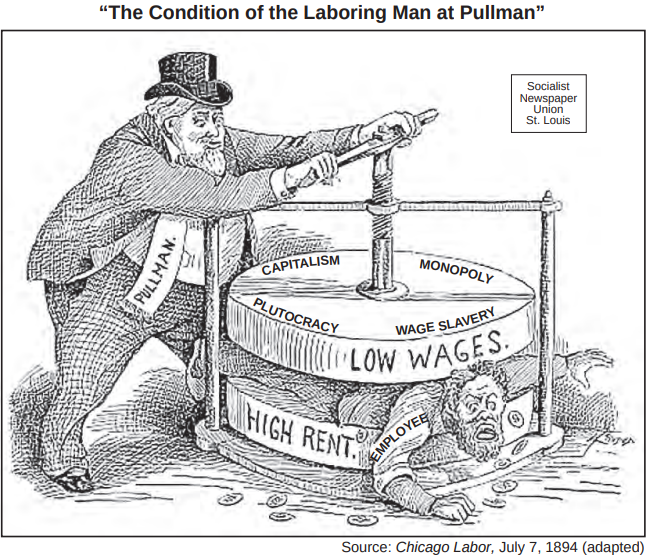
A historian could best use this cartoon to study
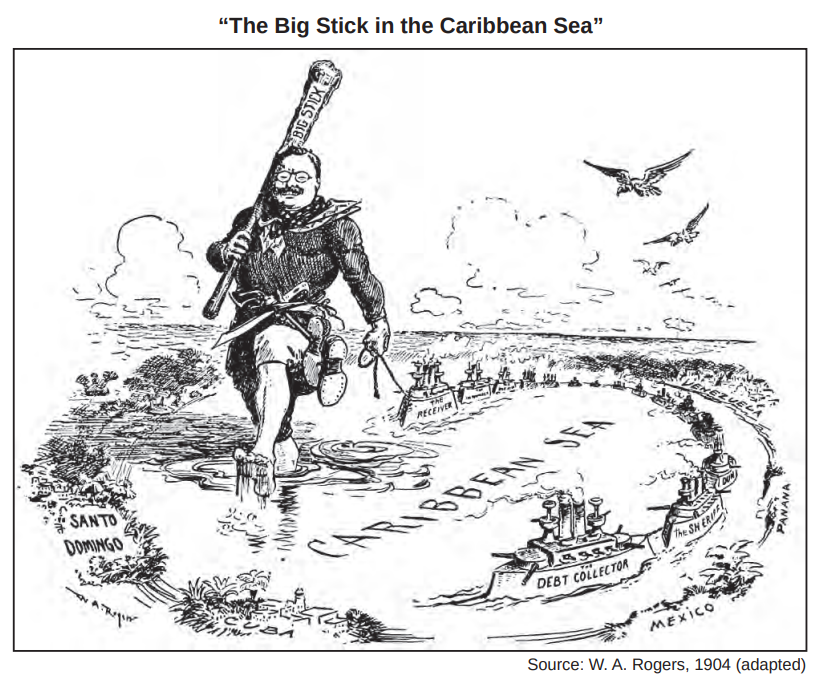
This cartoon reflects the foreign policy belief that the United States should
. . . In May a friend in the southwestern county of Kansas voluntarily sent me a list of the people who had already left their immediate neighborhood or were packed up and ready to go. The list included 109 persons in 26 families, substantial people, most of whom had been in that locality over ten years, and some as long as forty years. In these families there had been two deaths from dust pneumonia. Others in the neighborhood were ill at that time. Fewer actual residents have left our neighborhood, but on a sixty mile trip yesterday to procure [obtain] tract repairs we saw many pitiful reminders of broken hopes and apparently wasted effort. Little abandoned homes where people had drilled deep wells for the precious water, had set trees and vines, built reservoirs, and fenced in gardens—with everything now walled in half buried by banks of drifted soil, told a painful story of loss and disappointment.
Source: Letter from Caroline A. Henderson, printed in The Atlantic (adapted)
The events described in this letter took place in
. . . In the present world situation of course there is absolutely no doubt in the mind of a very overwhelming number of Americans that the best immediate defense of the United States is the success of Great Britain in defending itself, and that, therefore, quite aside from our historic and current interest in the survival of democracy as a whole in the world, it is equally important from a selfish point of view of American defense that we should do everything to help the British Empire to defend itself. . . .
Source: President Franklin D. Roosevelt, Press Conference, December 17, 1940 (adapted)
What foreign policy goal does President Franklin D. Roosevelt’s statement illustrate?
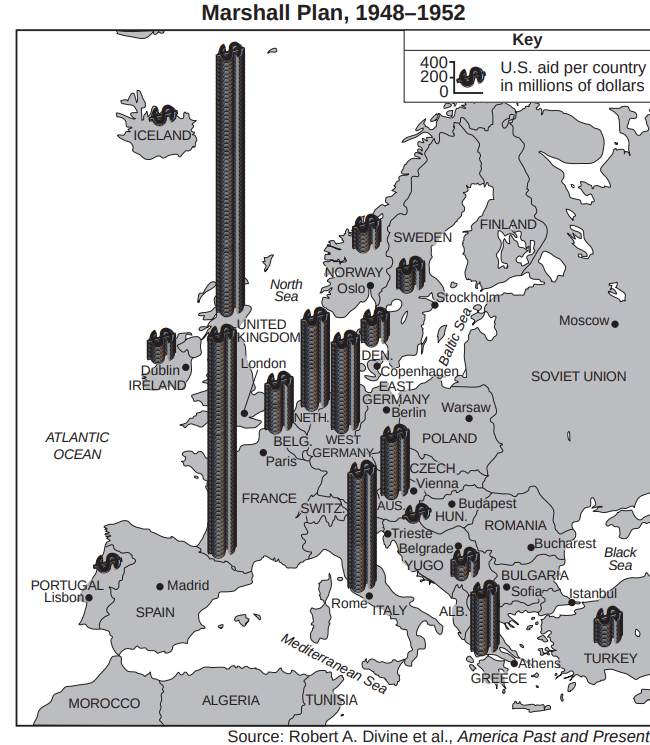
What countries received the most aid from the Marshall Plan?
Federal law said that there should be no segregation in interstate travel. The Supreme Court had decided that. But still state laws in the southern states and local ordinances ordered segregation of the races on those buses. Why didn’t the federal government enforce its law? We decided it was because of politics. If we were right in assuming that the federal government did not enforce federal law because of its fear of reprisals from the South, then what we had to do was to make it more dangerous politically for the federal government not to enforce federal law. And how would we do that? We decided the way to do it was to have an interracial group ride through the South. This was not civil disobedience, really, because we would be doing merely what the Supreme Court said we had a right to do. The whites in the group would sit in the back of the bus, the blacks would sit in the front of the bus, and would refuse to move when ordered. At every rest stop, the whites would go into the waiting room for blacks, and the blacks into the waiting room for whites, and would seek to use all the facilities, refusing to leave. We felt that we could then count upon the racists of the South to create a crisis, so that the federal government would be compelled to enforce federal law. That was the rationale for the Freedom Ride. . . .
Source: James Farmer, Director of the Congress of Racial Equality, in Voices of Freedom: An Oral History of the Civil Rights Movement from the 1950s through the 1980s, Random House, 1990
According to this passage, why was the Supreme Court decision about this federal law not enforced?
Be it enacted by the Senate and House of Representatives of the United States of America in Congress assembled, That this Act shall be known as the “Voting Rights Act of 1965.” SEC. 2. No voting qualification or prerequisite to voting, or standard, practice, or procedure shall be imposed or applied by any State or political subdivision to deny or abridge the right of any citizen of the United States to vote on account of race or color. . . .
Source: United States Congress, August 6, 1965
What was the primary reason that Congress passed this 1965 law?
. . . From 1991 to 1995 the United States had been reluctant to act in Bosnia. But after Srebrenica [massacre in Bosnia and Herzegovina], President Bill Clinton knew that although the American people would not like it, the United States could no longer avoid involvement there. Thus began the diplomatic and military policy that led to the Dayton accords, to peace in Bosnia and, four years later, to the liberation of the Albanian people in Kosovo from Slobodan Milosevic’s oppression. . . .
Source: Richard Holbrooke, “Was Bosnia Worth It?”, Washington Post, July 19, 2005
What was a main reason for the public’s opposition to President Bill Clinton’s intervention in Bosnia?
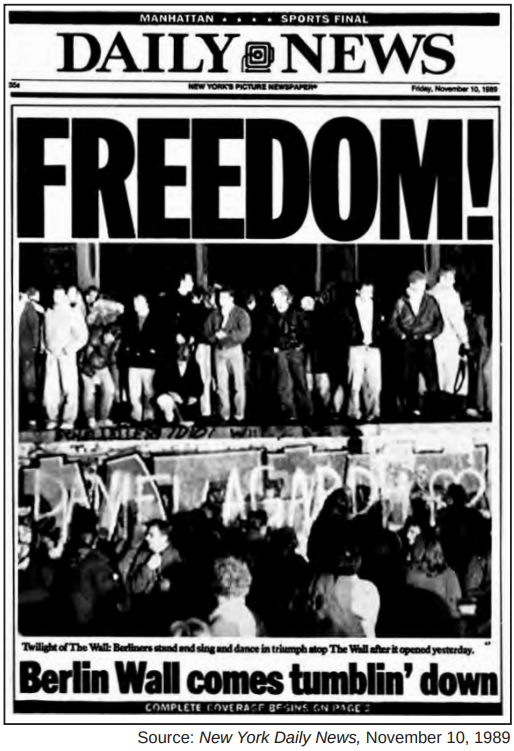
The event shown on the front page of this newspaper is most closely associated with the
Which provision in the Constitution is the author of this passage questioning?
The Constitution gives the power to determine presidential succession beyond the vice president to
The 22nd amendment, added in 1951, changed presidential eligibility by
Based on this passage, President Washington would urge the United States to avoid
Which statement can best be supported by the information found on this map?
Which government action addressed a grievance included in this declaration?
The situation described in this letter led to which outcome?
What was one result of the election of 1876?
Which action by the federal government was designed to help correct the problems described in this letter?
Which United States action resulted from the ideas expressed in this passage?
One major goal of the Marshall Plan was to
Based on this passage, what was the goal of the Freedom Riders?
Based on this passage, what was a major reason for President Clinton’s decision?