Context 11 - Hopping Toward Optimization
star
star
star
star
star
Last updated over 1 year ago
14 questions
Note from the author:
MMR Resources

1
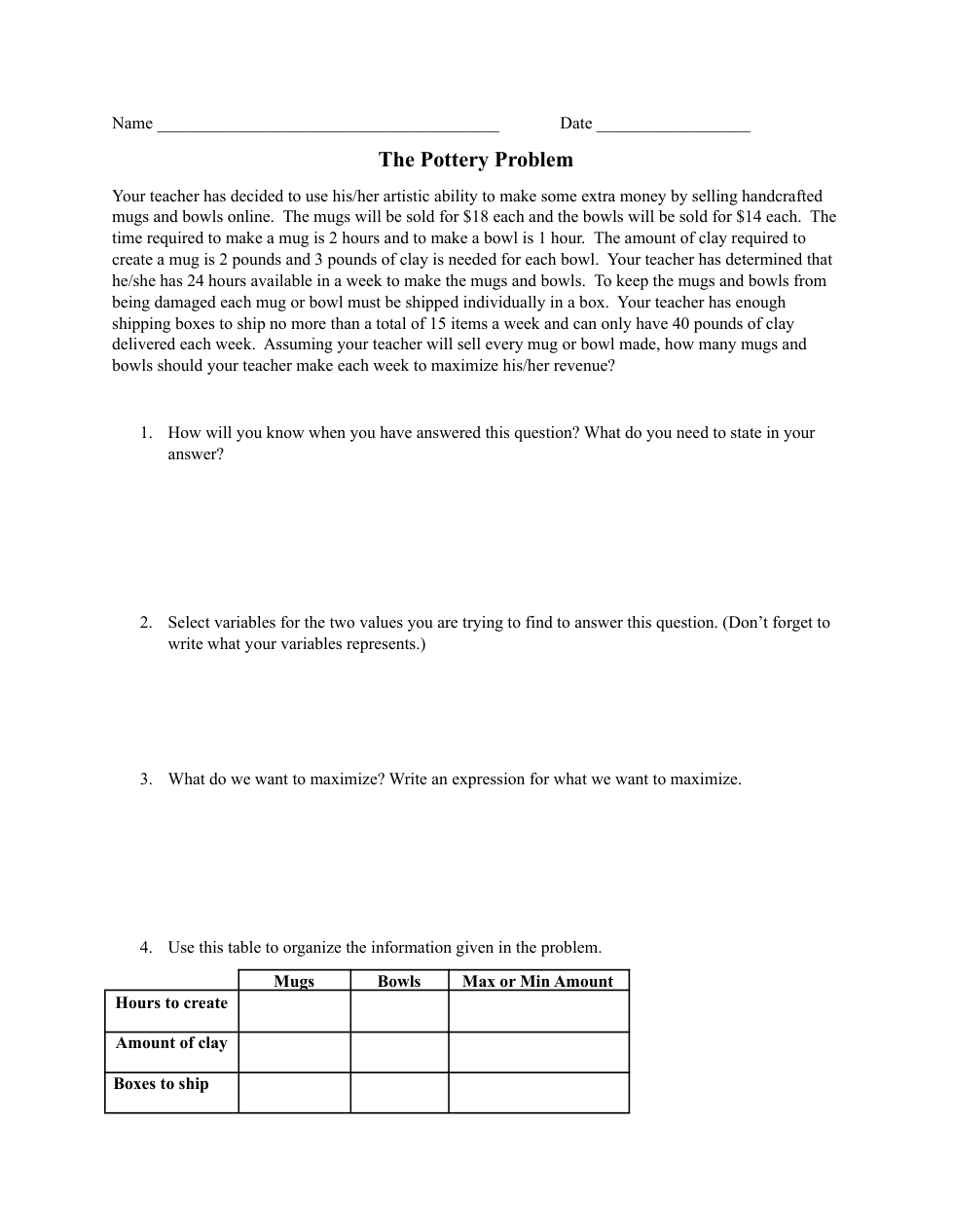
Read the scenario above.How will you know when you have answered this question? What do you need to state in your answer?
Read the scenario above.
How will you know when you have answered this question? What do you need to state in your answer?
1
Select variables for the two values you are trying to find to answer this question. (Don’t forget to write what your variables represents.)
1
What do we want to maximize? Write an expression for what we want to maximize.
1
Click "Show your work" to fill out the table.Hint: Use the "T" option on the left side menu to type your answers and use the "Scribble" option at the top of the menu to draw your responses.
Click "Show your work" to fill out the table.
Hint: Use the "T" option on the left side menu to type your answers and use the "Scribble" option at the top of the menu to draw your responses.

1
The max or min amounts lead to constraints on how many mugs and bowls can be made. We write these constraints as inequalities. Write an inequality using the fact that only 15 boxes are available for shipping.
The max or min amounts lead to constraints on how many mugs and bowls can be made. We write these constraints as inequalities.
Write an inequality using the fact that only 15 boxes are available for shipping.
1
Write an inequality indicating there are 24 hours available for creating mugs and bowls
1
Write an inequality using the fact that 40 pounds of clay is available.
1
What is the lowest possible number of mugs that can be made?(Is there a type of number that does not make sense?) Write an inequality for this fact.
1
Write an inequality for the lowest possible number of bowls that can be made.
1
Using Desmos, Graph the system of inequalities from above. Click "Show my work" and copy and paste your resulting graph.

1
Your feasible region for this problem has 5 sides and therefore 5 vertices. (Some people call the vertices corner points.) Find the coordinates for the 5 vertices.
1
Now look back to question 3. The objective for this problem was to maximize revenue and you wrote an expression for what we wanted to maximize. Set this expression equal to R and we will call this our objective function. (Note: R was selected because revenue starts with R)Write your objective function: R =
Now look back to question 3. The objective for this problem was to maximize revenue and you wrote an expression for what we wanted to maximize. Set this expression equal to R and we will call this our objective function. (Note: R was selected because revenue starts with R)
Write your objective function: R =
1
Use the vertices of the feasible region and your objective function to determine how many mugs and bowls should be made to maximize revenue.What vertices gives use a maximum profit?
Use the vertices of the feasible region and your objective function to determine how many mugs and bowls should be made to maximize revenue.
What vertices gives use a maximum profit?
1
Perhaps you used your graphing utility to find the coordinates of some of the vertices. How could you find the coordinates without using a graphing utility? Explain how to find at least one set of vertices without graphing.