Faith Schutt How are the rock pocket mouse populations changing? Page 26 - 32

Last updated over 1 year ago
38 questions
Slide 1:

Slide 2:

Slide 3:
Slide 4:

Required
1

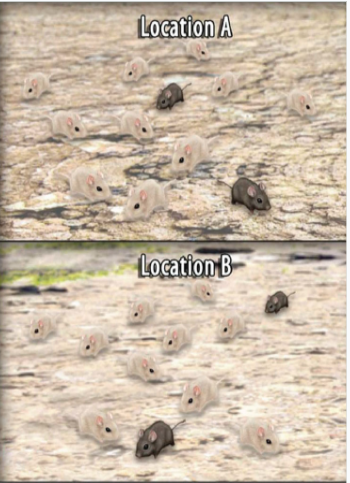
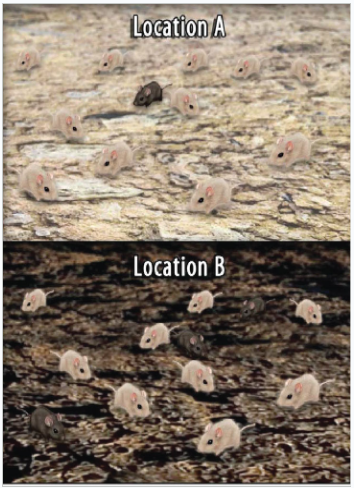
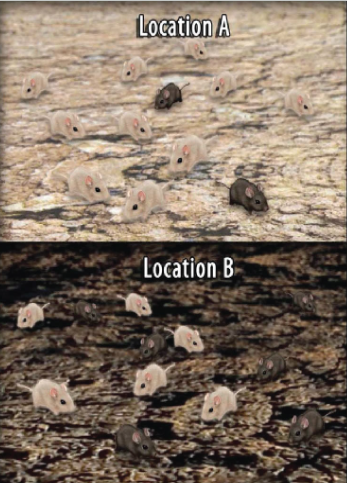
Use these images to fill in the table. Copy this table onto page 26, question 1 and fill it in

Required
1

Write what you believe happened on your paper, question 1. Write done for the answer when it is completed

Required
1

Answer question 2 in your packet, write done when the question is completed

Required
1

Selective pressure is the extent to which organisms possessing a particular characteristic are either eliminated or favoured by environmental demands. Answer questions 3 and 4. Write done.

Required
1

What caused the patches of black rock in New Mexico's Valley of Fire?

Required
1

Why did the dark lava rock pose a challenge to creatures dependent on camouflage?

Required
1

According to Michael Nachman, what are the dark mice in the desert likened to?

Required
1

What is the advantage for mice with dark fur on the dark lava rocks?

Required
1

How did the genetic mutation for dark coloration in the pocket mice most likely occur?

Required
1

What is the function of the gene Mc1r in the pocket mice?

Required
1

How does natural selection impact the spread of dark fur in the mouse population?

Required
1

What is the timeframe needed for the majority of the mouse population to evolve dark fur?

Required
1

Why do Nachman's findings support the concept of natural selection?

Required
1

What does the evolution of rock pocket mice demonstrate about the process of evolution?

Required
1

Why do animals use color? Select ALL that apply.

Required
1

What is it called when the environment influences what traits are most successful?

Required
1

What does the term “primary selective pressure” mean in this case?

Required
1

On the DNA EVIDENCE SHEET (page 27), you will see the gene involved in the origin of melanism in some rock pocket mouse populations, melanocortin receptor 1, or
MC1R for short. The complete gene is 954bp in length. Scientists have collected this data from a population of primarily dark-colored mice living in an area of
basalt in Arizona called the Pinacate lava flow, as well as from a nearby light-colored population and some other areas.
Summarize what you just read.

Required
1

DNA is double-stranded and consists of a “sense strand” and an “antisense strand.” The sense strand (top row below) is what you see on the data sheet, but
you transcribe mRNA from the antisense strand. Take the first 20 triplets (groups of 3) and add them to the DNA boxes (top row below), crossing them off as you go to avoid
errors. Do this for both the light mouse. Write done, when this is complete.

Required
1

Take the first 20 triplets (groups of 3) and add them to the DNA boxes (top row below), crossing them off as you go to avoid
errors. Do this for both the dark mouse. Write done, when this is complete.

Required
1

Add the complementary bases for the antisense strand of DNA (second row). Do this for the light mouse. Write done when completed. Remember:

Required
1

Add the complementary bases for the antisense strand of DNA (second row). Do this for the dark mouse. Write done when completed. Remember:

Required
1

Then transcribe these triplets to mRNA (third row). Do this for the light mouse. Write done when completed. Remember:

Required
1

Then transcribe these triplets to mRNA (third row). Do this for the light mouse. Write done when completed. Remember:

Required
1

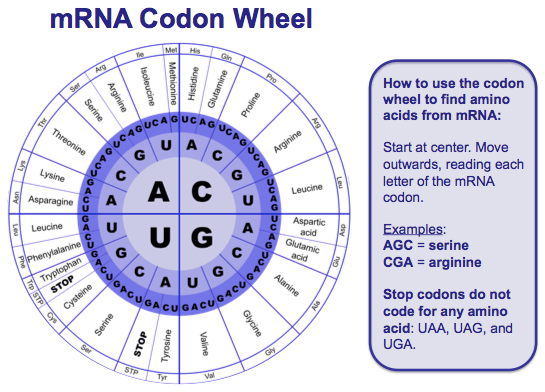
Next, translate to amino acids using the Genetic Code Chart on page 28, do this for the light mouse.

Write done, when complete

Required
1

Next, translate to amino acids using the Genetic Code Chart on page 28, do this for the dark mouse.

Write done, when complete

Required
1

Circle or highlight all differences between the Light Mouse data and the Dark Mouse data. Write done when complete

Required
1

Answer both questions at the bottom of the page. Write done when complete

Required
1

What process drives this trait to be more frequent?

Required
1

What is the selective pressure on the mouse population?

Required
1

Where does a random mutation occur in an organism?

Required
1

How is DNA used to make a protein?

Required
1

Flip to page 30 and answer question 1, write done when complete

Required
1

Answer question 2, the question is referring to the diagram on the top right, each ball represents ONE amino acid, count and circle the amino acid that was different and answer question 2. write done when complete

Required
1

Answer question 3, write done when complete

Required
1

Flip to page 31, use the genetic code chart on page 28 to complete the table. Write done when complete.

Write done, when complete

Required
1

Looking across each row of the table, highlight any differences you see. write done when complete

Required
1

Answer EVERY question on page 31 and 32. If you are confused ask a peer for help, if no peers can help ask Mrs. Beaver next door in room 113. Write done when all questions are complete