Ɛhia
1
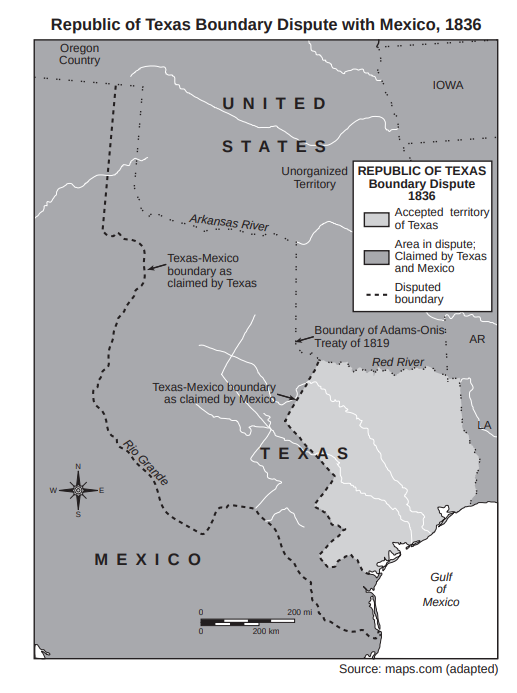
This map could best be used to study the concept of
This map could best be used to study the concept of
Ɛhia
1
Brothers, we must be as one as the English are, or we shall all be destroyed. You know our fathers had plenty of deer and skins and our plains were full of game and turkeys, and our coves and rivers were full of fish. But, brothers, since these Englishmen have seized our country, they have cut down the grass with scythes, and the trees with axes. Their cows and horses eat up the grass, and their hogs spoil our bed of clams; and finally we shall all starve to death; therefore, stand not in your own light, I ask you, but resolve to act like men. All the sachems [tribal chiefs] both to the east and the west have joined with us, and we are resolved to fall upon them at a day appointed, and therefore I come secretly to you, cause you can persuade your Indians [Native Americans] to do what you will.
Source: Narragansett Chief Miantonomo
The situation described in this passage was caused by
. . . “That whenever any Form of Government becomes destructive of these ends, it is the Right of the People to alter or to abolish it,” . . .
Which Enlightenment principle does this quotation refer to?
Our ships all in motion,
Once whiten’d the ocean
They sail’d and return’d with a Cargo;
Now doom’d to decay
They are fallen a prey,
To Jefferson, worms, and EMBARGO.
Source: Henry Mellen, 1808, Massachusetts Historical Society Broadsides
The viewpoint expressed in this song reflects
This map could best be used to study the concept of
Forty-Seventh Congress. Session I. 1882. Chapter 126. An act to execute certain treaty stipulations relating to Chinese.
. . . Preamble. Whereas, in the opinion of the Government of the United States the coming of Chinese laborers to this country endangers the good order of certain localities within the territory thereof: Therefore, Be it enacted by the Senate and House of Representatives of the United States of America in Congress assembled, That from and after the expiration of ninety days next after the passage of this act, and until the expiration of ten years next after the passage of this act, the coming of Chinese laborers to the United States be, and the same is hereby, suspended; and during such suspension it shall not be lawful for any Chinese laborer to come, or having so come after the expiration of said ninety days to remain within the United States. . . .
Source: National Archives and Records Administration
According to this excerpt, what is the main purpose of this act of Congress?
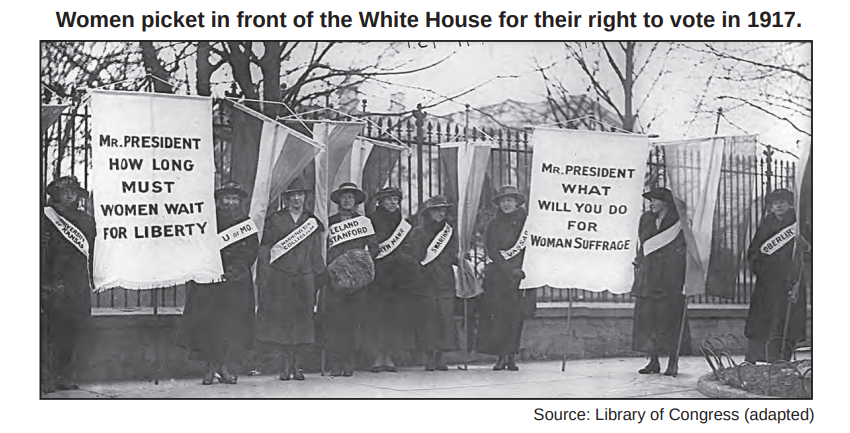
The main goal of the women’s rights movement in the early 20th century was to achieve
I, Too
I, too, sing America.
I am the darker brother.
They send me to eat in the kitchen
When company comes,
But I laugh,
And eat well,
And grow strong.
Tomorrow,
I’ll be at the table
When company comes.
Nobody’ll dare
Say to me,
“Eat in the kitchen,”
Then.
Besides,
They’ll see how beautiful I am
And be ashamed—
I, too, am America.
Source: Langston Hughes, 1924, in Rampersad and Roessel, eds., The Collected Poems of Langston Hughes, Alfred A. Knopf
What concept is best illustrated in this 1924 poem written by Langston Hughes?
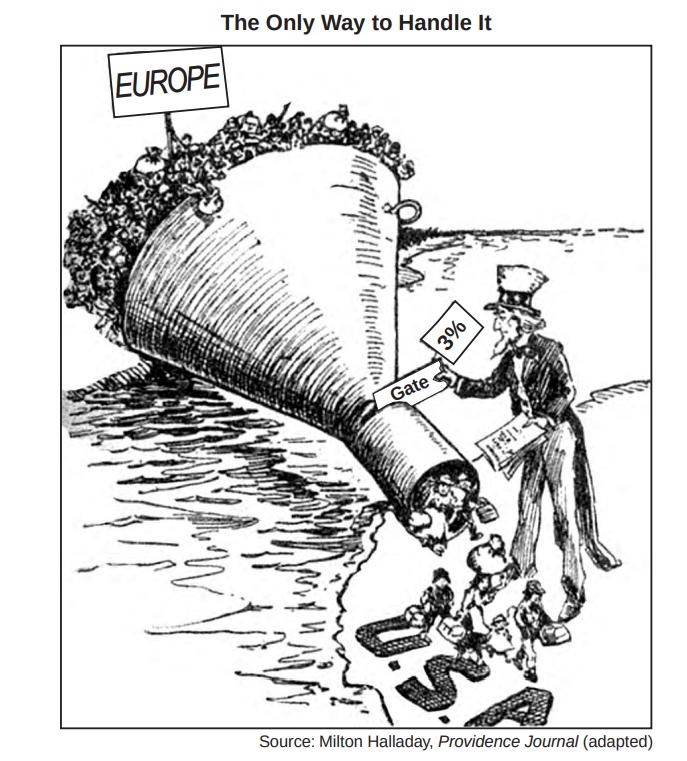
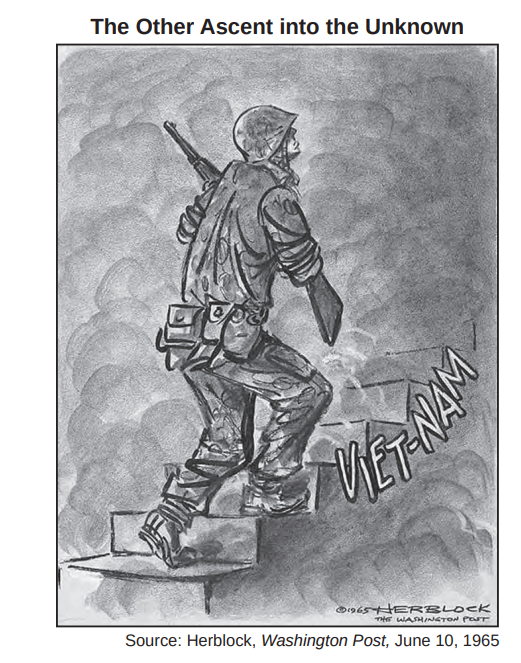
Which policy is most directly related to the point of view expressed in this cartoon?
March 24, 1935
Dear Family,
Did some of you think that you had a dust storm? I’ll tell you what it was. It was us shaking our bedding, carpets, etc.
For over a week we have been having troublesome times. The dust is something fierce. Sometimes it lets up enough so we can see around; even the sun may shine for a little time, then we have a frenzied time of cleaning, anticipating the comfort of a clean feeling once more.
We keep the doors and windows all shut tight, with wet papers on the sills. The tiny particles of dirt sift right through the walls. Two different times it has been an inch thick on my kitchen floor. . . .
When we open the door, swirling whirlwinds of soil beat against us unmercifully, and we are glad to go back inside and sit choking in the dirt. We couldn’t see the streetlight just in front of the house. . . .
As for gardens, we had ours plowed, but now we do not know whether we have more or less soil. It’s useless to plant anything.
Grace
Source: Deb Mulvey, ed., “We Had Everything but Money” (adapted)
What was one impact of the situation described in this letter?
. . . I see one-third of a nation ill-housed, ill-clad, ill-nourished.
But it is not in despair that I paint you that picture. I paint it for you in hope—because the nation, seeing and understanding the injustice in it, proposes to paint it out. We are determined to make every American citizen the subject of [t]his country’s interest and concern; and we will never regard any faithful law-abiding group within our borders as superfluous [unnecessary]. The test of our progress is not whether we add more to the abundance of those who have much; it is whether we provide enough for those who have too little. . . .
Source: President Franklin D. Roosevelt, Second Inaugural Address, January 20, 1937 (adapted)
Which later presidential program is most similar to the idea expressed in this passage?
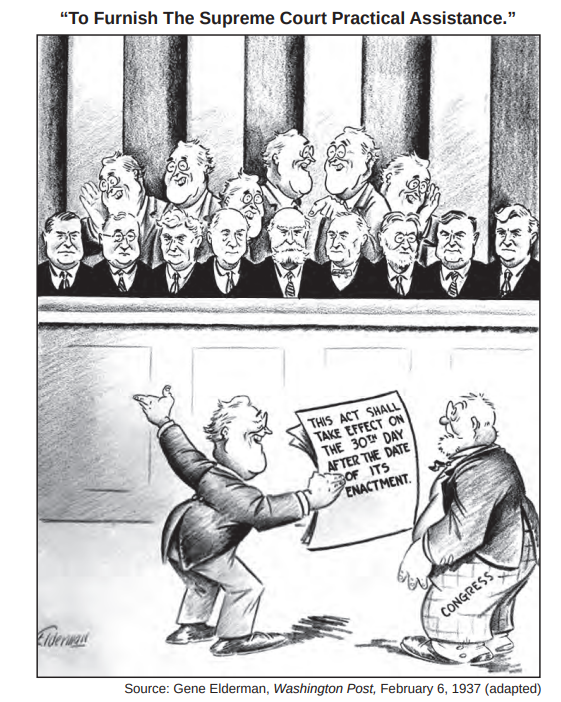
What was the major reason President Franklin D. Roosevelt proposed the action illustrated in this cartoon?
. . . The truth of the matter is that Europe’s requirements for the next 3 or 4 years of foreign food and other essential products—principally from America—are so much greater than her present ability to pay that she must have substantial additional help, or face economic, social, and political deterioration of a very grave character. . . .
Aside from the demoralizing effect on the world at large and the possibilities of disturbances arising as a result of the desperation of the people concerned, the consequences to the economy of the United States should be apparent to all. It is logical that the United States should do whatever it is able to do to assist in the return of normal economic health in the world, without which there can be no political stability and no assured peace. Our policy is directed not against any country or doctrine but against hunger, poverty, desperation, and chaos. Its purpose should be the revival of working economy in the world so as to permit the emergence of political and social conditions in which free institutions can exist. . . .
Source: Secretary of State George Marshall, June 5, 1947
By implementing this policy in Europe, the United States hoped to stabilize
[Reporter Mike] WALLACE: All right, sir. A Federal District Court has already ruled that Little Rock [Arkansas] Central High School should be integrated. And the reasons for preventing integration now are anemic [weak]. In view of your promise to the President [Dwight D. Eisenhower], will you respect this decision and give your okay to integration beginning tomorrow morning?
[Governor Orval] FAUBUS: I’ve previously given my okay to integration. The Guard was not called out to prevent integration, but to keep the peace and order of the community. And, of course, I disagree with your preliminary statement that we are in defiance of a Federal Court order, based upon the premise that the peace and good order of the community is paramount to all other issues. . . .
Source: Mike Wallace interview with Arkansas Governor Orval Faubus, September 15, 1957
The issue discussed in this interview resulted from an effort to enforce the Supreme Court decision in
What was a major result of the situation portrayed in the cartoon?
Eight months ago I signed into law the Wholesome Meat Act of 1967. That landmark bill capped a crusade that had begun 60 years ago—[in the presidency of Theodore Roosevelt] to assure American housewives that the meat they served their families was pure, not harmful or dirty or diseased.
Today I am proud to sign a bill that will extend the same coverage to all poultry products. It is the fulfillment of a promise I made to every housewife—in my first consumer message just after I became President.
In the early days of this century, Americans took for granted that there were risks in buying food. They even joked about it in print. One newspaper printed a little poem:
“Mary had a little lamb,
And when she saw it sicken,
She shipped it off to packing town,
And now it’s labeled chicken.”
In 1968, we cannot tolerate the image, or the fact, of unwholesome food:
—Not when Americans last year consumed more than 12 billion pounds of poultry.
—Not when a full 13 percent of that supply—or 1.6 billion pounds—was subject to little or no inspection because it didn’t cross State lines. . . .
The Wholesome Poultry Products Act of 1968 will insure that dirty plants will have to clean up or close down. . . .
Source: President Lyndon B. Johnson, Statement Upon Signing the Wholesome Poultry Products Act, August 19, 1968
President Lyndon B. Johnson’s statements are most closely associated with the work of which Progressive Era muckraker?
What course of action does Chief Miantonomo support?
What impact did this quotation have on the American Revolution?
Why was New England concerned about President Thomas Jefferson’s embargo?
The conflict shown on this map was settled by the
This act of Congress supports the goals of
Which statement best represents a reason why this protest was considered controversial?
This poem is an example of the cultural movement known as
The policy represented by this cartoon was a response to
Which New Deal action attempted to address the causes of this situation?
Which constitutional principle was threatened by President Roosevelt’s action?
Which foreign policy does George Marshall’s proposal most directly support?
Which action did President Eisenhower take to address the issue raised in this interview?
What conclusion can be drawn from President Johnson’s statement?