Friday 5/17: 4-Int Cast PT 10-15 Waves
star
star
star
star
star
Last updated about 1 month ago
6 Nsɛmmisa
Part 1
Part 2
In this performance task, you will answer six questions.
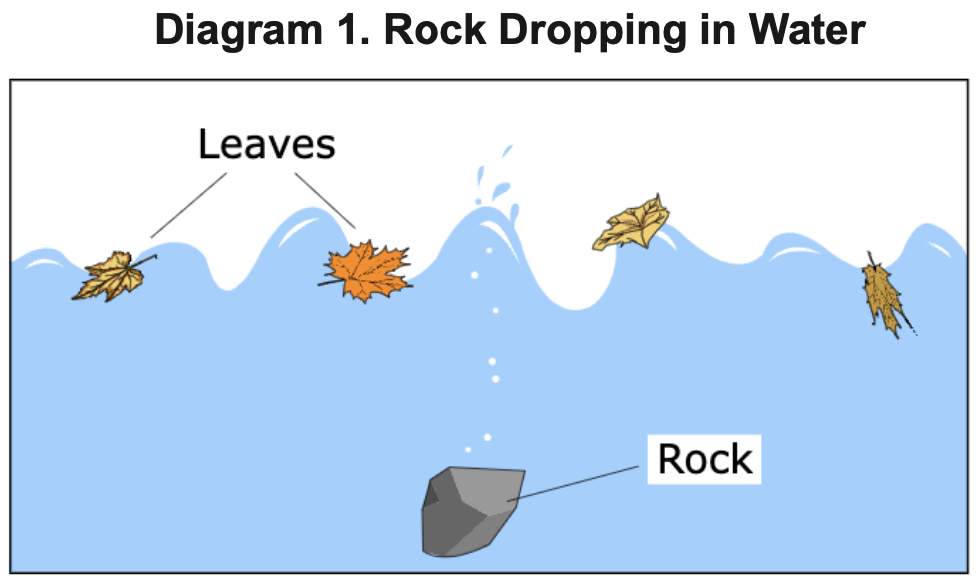
A student drops rocks, one at a time, into a pond from different heights. The student drops two rocks while standing next to the pond and the same two rocks from a bridge over the pond. Both rocks have about the same shape.
The student observes that when each rock hits the water
small waves spread out from where the rock hits,
leaves on the surface move up and down, and
waves get shorter as they spread out.
Diagram 1 shows one of the splashes.
Another student uses a speedometer to record the speed of each rock in meters per second (m/s) as it hits the water. The student knows that when the rock has more speed and mass, it has more energy, and it makes a louder splash. Table 1 shows the students’ recorded data. Mass is measured in kilograms (kg), and height is measured in meters (m).
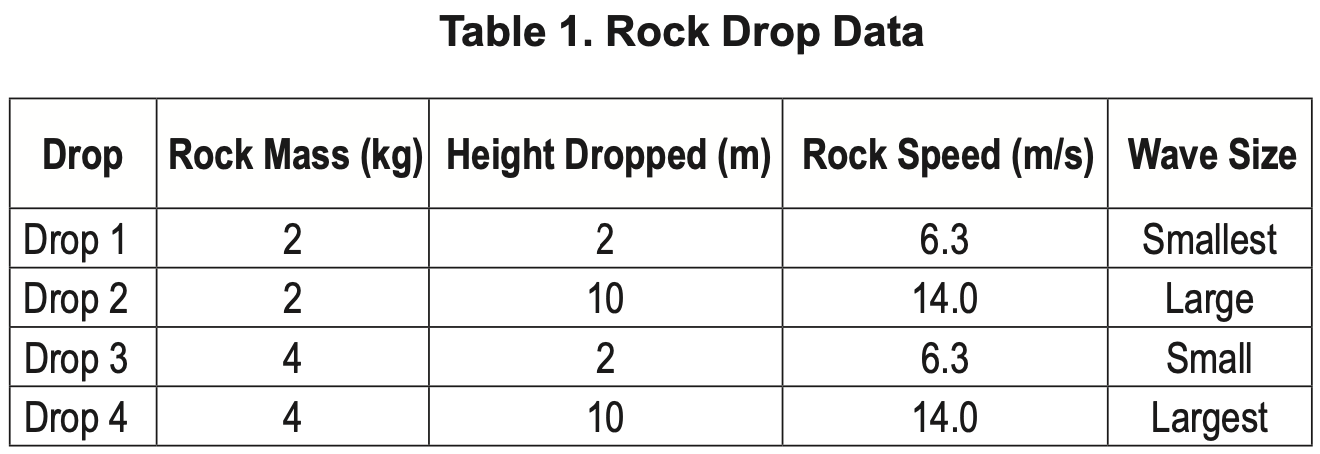
Which question could the students most likely answer based on data in Table 1?
How does the height of the drop affect the ___________
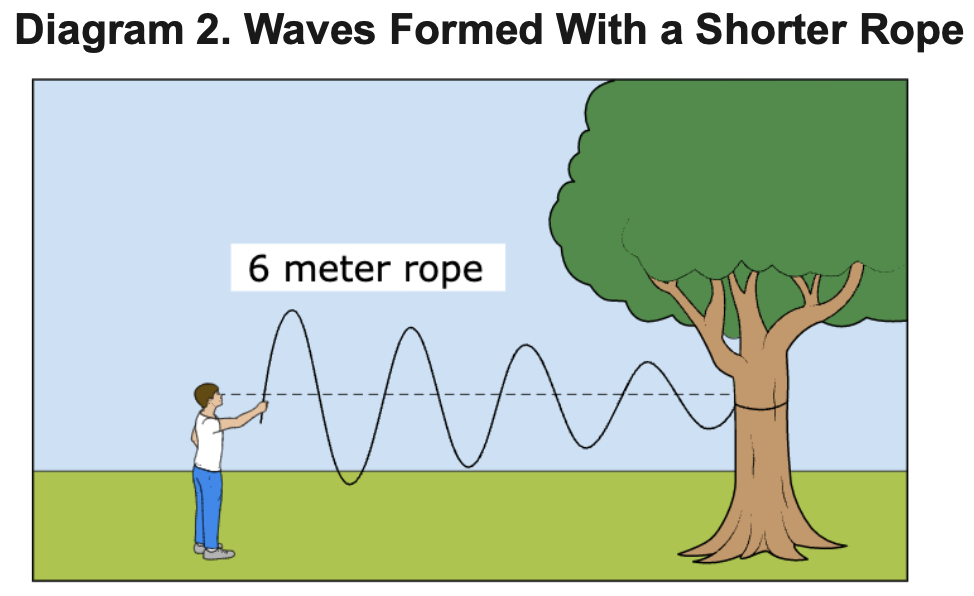
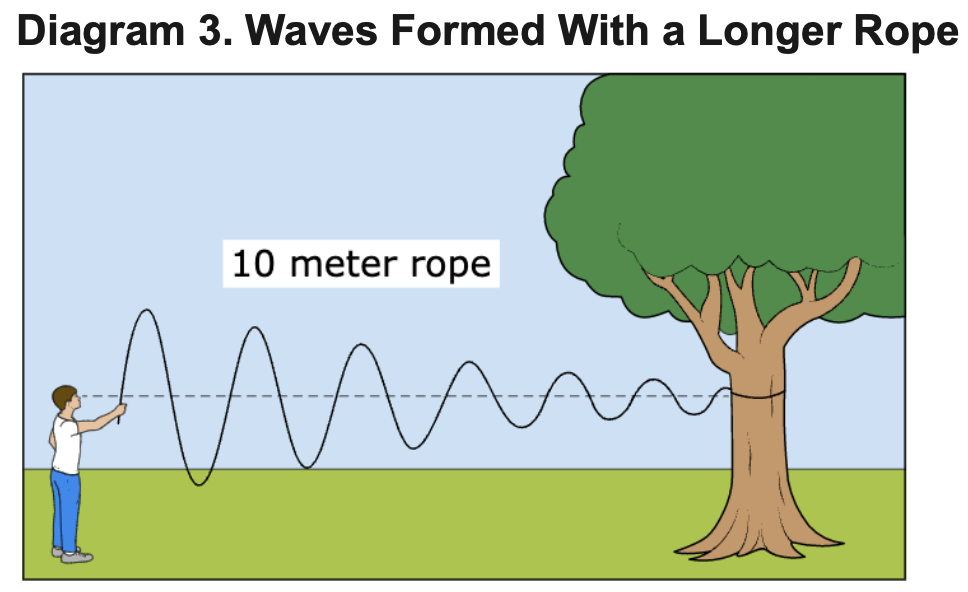
After making waves in a pond with rocks, the students model waves with different ropes tied to a tree trunk. One student moves a shorter rope (6 m) up and down to create waves, as shown in Diagram 2. Next, the student makes waves with a longer rope (10 m) tied to the same tree, as shown in Diagram 3. The student moves both ropes up and down the same amount. The student notices that with both ropes, the waves get smaller as they move away from the student’s hand.
Select words from the lists to complete the sentences.
Based on the diagrams, the height of the waves starts as the waves move from where the rock hit the water. After the rock hits the water, ripples form, and the ripples get over time.
The student marks the middle of the 10 m rope with blue tape. The student moves the 10 m rope up and down the same amount as the smaller 6 m rope.
Based on this setup, provide an answer for both statements:
Compare the number of waves in the 10 m rope to the number of waves in the 6 m rope.
Explain how the tape moves as the student moves the 10 m rope.
Enter your answer in the box provided.
Based on data in Table 1, select one check box in each row to identify how the energy of the waves depends on the speed of the rock.
Slower rock speed | Faster rock speed | |
|---|---|---|
Lower-energy waves | ||
Higher-energy waves |
The students noticed that there is a relationship between the energy of the waves and how loud the splash sounds.
Which drop most likely made the quietest splash?
Select words from the lists to complete the sentences.
Based on Table 1, the students conclude that the the speed of the rock, the bigger the transfer of energy to the water. This results in a bigger .