Log in
Sign up for FREE
arrow_back
Library

Quarter 4 Unit 7.1 Remediation Test (5/16/2024)

star
star
star
star
star
Last updated over 1 year ago
5 questions
LT 7.1: Natural Selection
1
7.3a
1
7.3a
1
7.3a
1
7.3a
1
7.3a
Question 1
1.

Question 2
2.

Question 3
3.

Question 4
4.

Question 5
5.

Which of the following is NOT a part of Darwin’s theory of evolution by natural selection?
Changes in an individual’s genetic material are usually harmful
Some organisms possess features that enable them to survive better than those lacking the features
More offspring are produced than can generally survive
Individuals in a population vary in many ways
Blue jays are birds that live in the forest. They can have beaks of different thicknesses.
Blue jays use their beaks to get to the seeds they eat. Blue jays with thinner beaks can easily reach and eat the seeds inside pinecones. Blue jays with thicker beaks can easily open and eat seeds with hard shells.
The image below shows three possible blue jay populations.
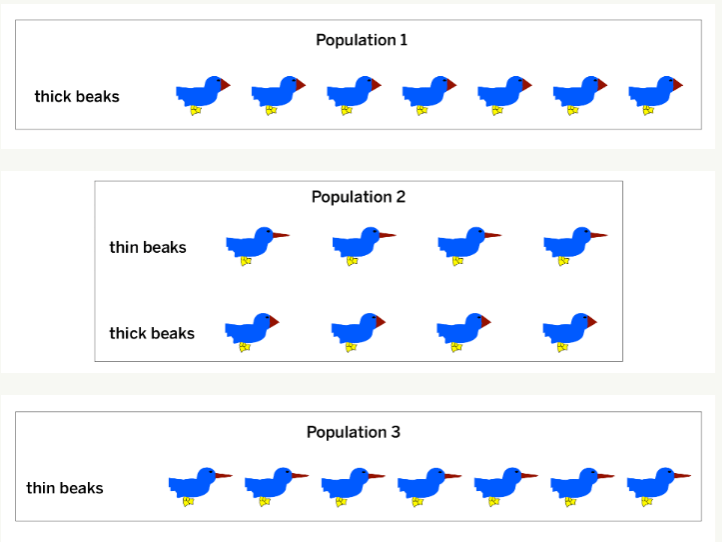
If the environment changes to have only seeds in pinecones, which of the following blue jay populations will most likely survive?
Only population 2
Populations 2 and 3
All the populations
Populations 1 and 2
In the imaginary world of Eos a species of bird called the Chocobo comes in three colors: yellow, white, and black, in which black is the most genetically dominant trait and white is recessive.  A cataclysmic event occurred when a rogue meteor strikes the planet and sends up a vast amount of dust into the atmosphere, blocking out the sun.  Consequently, the sun’s rays were not able to penetrate through the thick cloud well and thus was not warming up the surface. The climate cooled to the point that it snowed year round across the globe. After three years the population of the yellow and black Chocobo declined drastically while the white Chocobo thrived.  Which of the following statements best explains the trend?
Due to their new environment, the yellow and black Chocobos emigrated out of the area and settled in regions that lacked snow where they would be able to camouflage from predators.
Due to genetic drift, the climate change randomly killed off the yellow and black Chocobos leaving behind only white Chocobos to mate and populate the region with the white feather allele.
Due to the need to camouflage from predators, female Chocobos only selected to mate with white feathered Chocobos and thus produced more white feathered offspring while the yellow and black Chocobos were not able to pass on their genetic variations.
Due to genetic diversity already existing in the population, white Chocobos were able to camouflage into their surrounding and thus escaped predators while the other Chocobos were preyed upon.
A patient with HIV is treated with a new drug, 3TC.  Within a few weeks of treatment, the HIV viruses consist entirely of 3TC-resistant viruses.  How can this result best be explained?
The drug caused the HIV genes to change.
Some drug-resistant viruses were present at the start of treatment and reproduced while the non-resistant viruses were destroyed.
The patient must have become re-infected with a resistant form of the virus.
The viruses changed their surface proteins to resist the vaccine variation.
Which of the following is an example of an adaptation?
20 ants leave and start a new colony
camouflage
growing longer fur because it is cold in winter
a bee carrying pollen from one flower to another