Intro/ Review to Rounding & Estimations
star
star
star
star
star
Last updated 7 months ago
23 questions
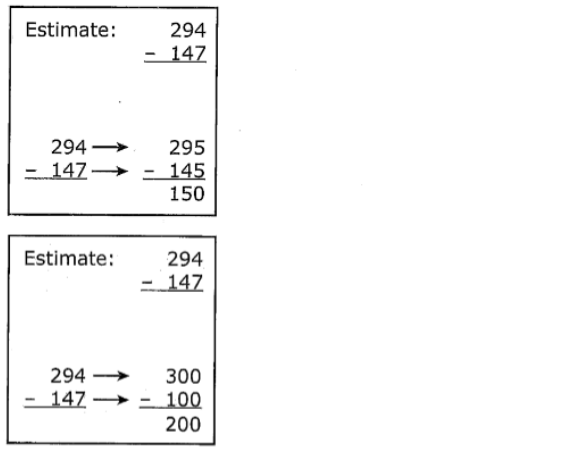
Compatible numbers are the numbers that are easy to add, subtract, multiply, or divide mentally (in your head).
Rounded numbers are an integer that ends with one or more "0"s.
1
Which box below represents compatible numbers and which box below represents rounded numbers?
Other Answer Choices:
Compatible numbers
Rounded numbers
Turn & Talk (level 1)
Which method of estimation do you think is easier, compatible numbers or rounded numbers? Why?
Sentence Stem:
I think the easier method of estimation is to use _______________ because __________________________.
Vocabulary
compatible numbers approximate round
rounded numbers estimate add/ subtract
1
Use a complete sentence to answer the following question.
Which method of estimation do you think is easier, compatible numbers or rounded numbers? Why?
Use a complete sentence to answer the following question.
Which method of estimation do you think is easier, compatible numbers or rounded numbers? Why?
1
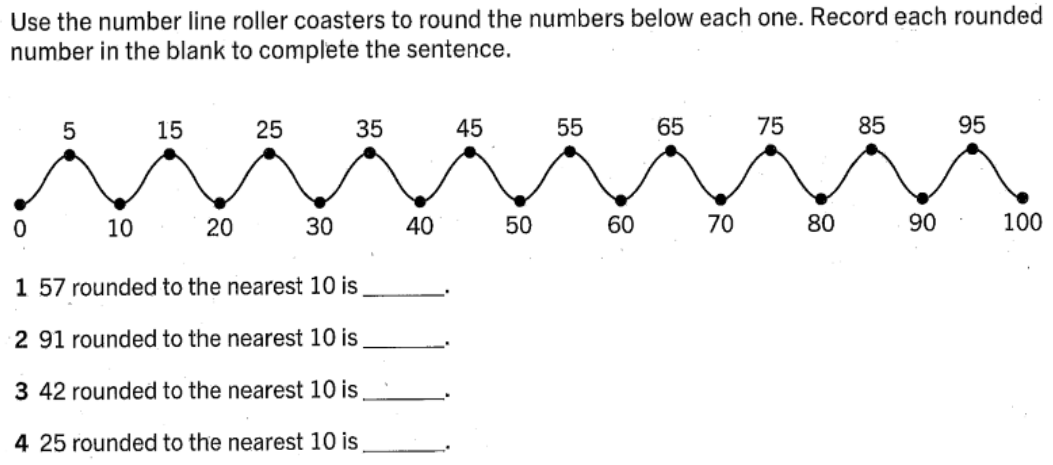
57 rounded to the nearest 10 is _______.
91 rounded to the nearest 10 is _______.
42 rounded to the nearest 10 is _______.
25 rounded to the nearest 10 is _______.
1
Round to the nearest ten.
Example: 237 → _240_
132 → __________
743 → __________
336 → __________
1
Round to the nearest hundred.
Example: 2,432 → _2,400
4,768 → __________
2,423 → __________
8,462 → __________
1
Round to the nearest ten.
Example: 2,453 → __2,450__
3,682 → __________
54,637 → __________
41,608 → __________
1
Round to the nearest hundred.
Example: 47,286 → __47,300__
25,473 → __________
53,729 → __________
67,821 → __________
1
Round to the underlined number.
Example: 472,563 → _473,000_
854,368 → __________
91,483 → __________
748,924 → __________
1
Round to the leading digit.
Example: 472,563 → _500,000_
8,328 → __________
683 → __________
748,924 → __________
1
Estimate the sum or difference by rounding to the nearest ten.
Example:
28 + 17 → __30__ + __20__ = __50__
17 + 23 → __________ + __________ = __________
1
Estimate the sum or difference by rounding to the nearest ten.
Example:
28 + 17 → __30__ + __20__ = __50__
42 + 37 → __________ + __________ = __________
1
Estimate the sum or difference by rounding to the nearest ten.
Example:
28 + 17 → __30__ + __20__ = __50__
38 − 14 → __________ − __________ = __________
1
Estimate the sum or difference by rounding to the nearest ten.
Example:
28 + 17 → __30__ + __20__ = __50__
9 + 63 → __________ + __________ = __________
1
Estimate the sum or difference by rounding to the nearest ten.
Example:
28 + 17 → __30__ + __20__ = __50__
68 − 21 → __________ − __________ = __________
1
Estimate the sum or difference by rounding to the nearest ten.
Example:
28 + 17 → __30__ + __20__ = __50__
12 + 82 → __________ + __________ = __________
1
Round to the nearest ten.
Example: 263 → _260_
164 → _______ 281 → _______ 538 → _______
1
Round to the nearest hundreds.
Example: 6,473 → _6,500_
7,564 → _______ 3,281 → _______ 5,738 → _______
1
Round to the underlined digit.
Example: 34,562 → _34,600_
34,269 → _______ 729,281 → _______ 25,738 → _______
1
Round to the leading digit.
Example: 49,502 → _50,000_
723,483 → _______ 3,281 → _______ 26,738 → _______
1
Estimate the sum or difference by rounding to the nearest ten.
Example:
28 + 17 → __30__ + __20__ = __50__
46 + 31 → _______+ _______ = _______
1
Estimate the sum or difference by rounding to the nearest hundred.
Example:
278 + 137 → __300__ + __100__ = __400__
486 + 341 → _______+ _______ = _______
1
Estimate the sum or difference by rounding to the nearest hundred.
Example:
278 + 137 → __300__ + __100__ = __400__
5,263 − 2,823 → _______− _______ = _______
1
Estimate the sum or difference by rounding to the leading number.
Example:
278 + 37 → __300__ + __40__ = __260__
24,389 + 4,823 → _______+ _______ = _______